
August, 8, 2023
Many Ears to Please: Fairport’s U.S. Tours 1974-1975
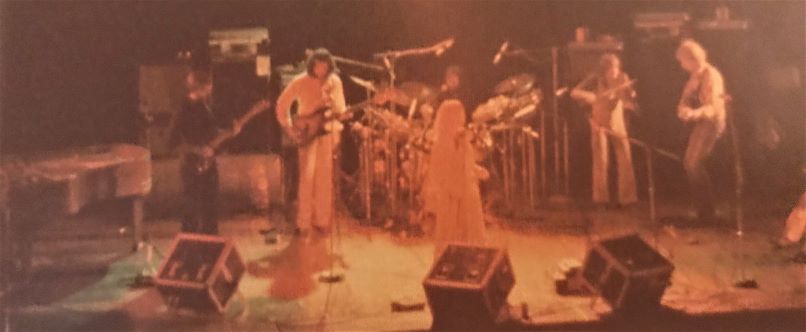
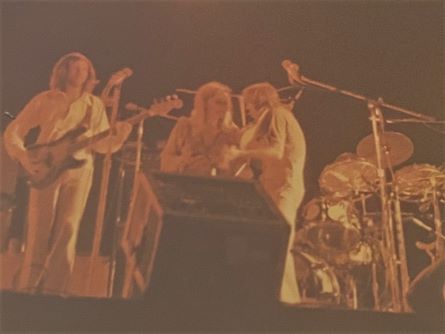
Portions of the following article and three of the Trenton concert photos were reprinted, with permission, in Richard Houghton’s book Cropredy Capers: Another People’s History of Fairport Convention in 2024. Unfortunately, the three photos, found on page 41, were not credited to photographer John Kee, who has been a close friend and devoted Fairport fan since high school. This ‘correction’ of sorts is meant to at least somewhat rectify the oversight in the book’s acknowledgements.
New Jersey hasn’t been known as a familiar touring location for the fifty-plus-year-old British folk-rock band Fairport Convention, but in its search for a wider U.S. audience in the mid-1970s the group made ample visits to the Garden State. Recently reunited with singer Sandy Denny, whose first tenure with Fairport culminated in the classic Liege and Lief album, the lineup consisted of violinist/vocalist Dave Swarbrick, bassist/vocalist Dave Pegg, guitarist/vocalist Trevor Lucas, lead guitarist Jerry Donahue, vocalist/pianist Denny and drummers Dave Mattacks in 1974 and Bruce Rowland in 1975.
In the early 1970s, Fairport’s music could be heard by South Jersey residents on radio stations like Philadelphia’s WMMR (New York City’s WNEW served the same for North Jersey listeners). Electric arrangements of folk songs like “Matty Groves,” “Tam Lin” as well as original material like “Sickness and Diseases” were a staple of playlists. Denny would drop by with Richard Thompson in tow at the WMMR studios to chat before her concert at the Main Point in Bryn Mawr, Pennsylvania. Fairport’s syndicated performance at the Howff Folk Club was able to find its way into weekday evening programming.
But the music industry was changing by the mid-1970s, and British folk music had nearly run its course with most radio stations and record labels who had dabbled in it. That’s the world in which Fairport chose to launch its biggest tours in the U.S., playing colleges, theaters and even Carnegie Hall twice along the way. Its 1975 album, Rising for the Moon, was produced by the noted Glyn Johns, whose ear for commercial product didn’t quite mesh with the band’s ties to jigs, reels and folk songs of the British Isles.(1) For the first time since the group’s 1968 Unhalfbricking, there would be no traditional music included on an album. Its lack of success would ultimately lead to the dissolution of the band by the end of 1975.
The concerts, however, continued to be a high point. Live shows in this period didn’t forsake the traditional ballads or the instrumentals and featured plenty of Denny’s songs, old chestnuts, and even an array of cover songs. The concerts were never leashed and always permitted the musicians to exhibit the abilities that had established their place in contemporary music as songwriters, players or vocalists.
Fairport carried its reputation into the U.S. through April and May 1974, beginning with shows in upstate New York at Syracuse and Ithaca on April 19 and 20, respectively, according to the FairPoint website. The May 9 issue of Rolling Stone next places them moving through Pennsylvania with stops in Philadelphia, Wilkes-Barre and Allentown. April 27 included two shows, according to FairPoint – an afternoon festival slot in Storrs, Connecticut and an evening performance in Worcester, Massachusetts.
There are six known recordings from this spring tour, three of which are radio broadcasts, beginning with the Worcester concert on April 27. Fairport played My Father’s Place in Roslyn, New York on May 8, 1974, and part of the night was broadcast on radio by WLIR. The concert date is not listed in the Artists Calendar of the May 23 issue of Rolling Stone, but initially it was one of two off days after a trio of shows on May 5, 6 and 7 in Ohio and before the May 10 Cambridge, Massachusetts performances, so it was probably a late addition to the tour. The band’s appearance for two sets at Ebbet’s Field in Denver, Colorado on May 23 was also professionally recorded and features the earliest live version of a new Denny composition, “One More Chance,” which would take its place as a highlight on Rising for the Moon the following year.
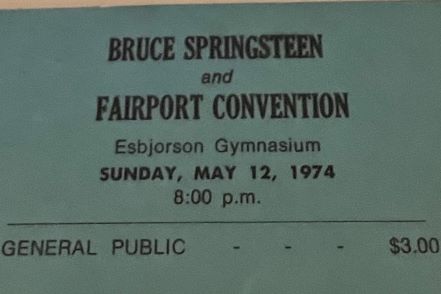
Previously, the closest Fairport had come to South Jersey while touring was Philadelphia’s Electric Factory in July 1970 when founding members Richard Thompson and Simon Nicol were still in the lineup. By 1974 colleges and universities were regularly booking musical acts. The May 12 concert at Glassboro State College was the second New Jersey stop on the spring tour that year, with Parsippany the site of a show on May 4, according to the Artists Calendar listings in the May 9 issue of Rolling Stone. But the Glassboro concert had what might be the most interesting turn of events.
The headliner that night was Bruce Springsteen, a popular draw in the area but still a year away from beginning his candidacy for superstar status, with Fairport as his opening act, and that’s how the concert was advertised until the doors to the college’s Esbjorson Gymnasium opened on the night of May 12. Greeting ticket holders was the announcement that Springsteen had cancelled.(2) Attendees were told refunds could be obtained at one of the tables in the foyer. Some availed themselves of the offer, but those who stayed witnessed Fairport perform a ninety-minute set that had both fans and non-believers on their feet dancing by the end of the show.
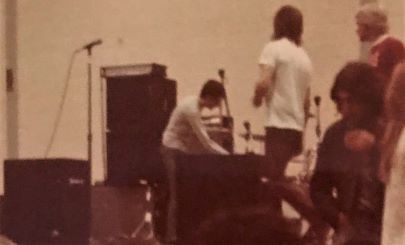
Fairport’s arrival that night was evident to anyone observant in the slowly filling gym. Pegg and Swarbrick walked through the crowd, deep in conversation with a Student Activities Board representative, no doubt discussing the band’s new headlining status. Before long, Mattacks was onstage setting up his drum kit in full view of the growing crowd.
Because Fairport was suddenly the headliner at the Glassboro show, the band’s set list could offer a wider array of the lineup’s repertoire, which had been reshaping itself since Denny had rejoined the group. Several songs from Fairport’s recent album Nine appeared less frequently as the spring tour progressed, replaced by some of Denny’s solo material and new compositions such as “Like an Old Fashioned Waltz,” performed by the songstress alone onstage. At the Glassboro show, she confided to the audience that the other musicians always abandoned her when this song came up in the set. Another new tune, “Solo,” summoned the band back to the stage in the Glassboro gym. And “Rising for the Moon,” a regal composition which would become the title track of the band’s next album, was yet another of Denny’s new songs to whet fans’ appetites for future releases.
Fairport standards were performed as well at Glassboro, including “Sloth” in an arrangement that added a bass solo for Pegg along with Donahue’s and Swarbrick’s improvisations. And there were additional workouts by Donahue, Swarbrick, Mattacks and Pegg on traditional songs like “Dirty Linen” and “Matty Groves,” which served as the concert opener and soundcheck, with Denny still in her street clothes before exiting during an instrumental to change into her stage attire.
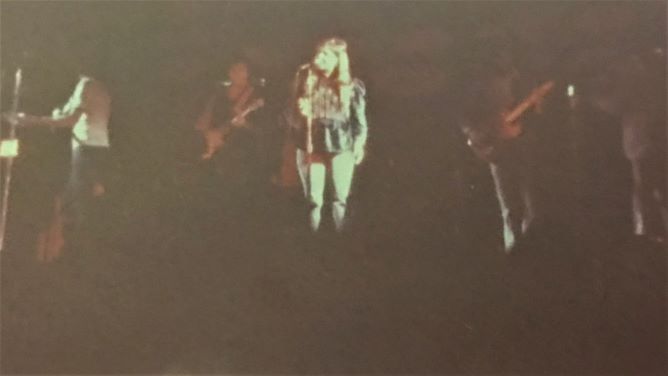
A defining moment of the show, however, was the first encore of the evening, Denny’s “Who Knows Where the Time Goes?” which was delivered as a delicate performance that politely demanded and graciously received the audience’s reverence and quiet. The song, which was last performed at the February L.A. Troubadour shows, had been recently reinstated to the set, probably in Cambridge, Massachusetts on May 10.(3)
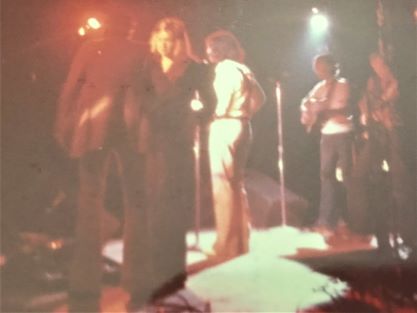
Glassboro was among the last stops on the spring tour, according to the Artists Calendar in Rolling Stone’s May 23 issue, before appearances in Atlanta, New York City, Washington, D.C. Denver and Long Beach, California on May 24.(4) The set lists in the final round of gigs in the spring would form a template for the U.S tour in the fall, which would commence on the East Coast October 10 and conclude on the West Coast November 10. During the run, Fairport would play at three more New Jersey locations: New Brunswick, Trenton and Parsippany before heading back to England to complete sessions for Rising for the Moon. It wouldn’t be until the following fall that Fairport would revisit these shores and play two more Garden State shows in Trenton and Parsippany.
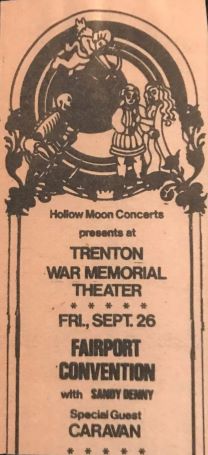
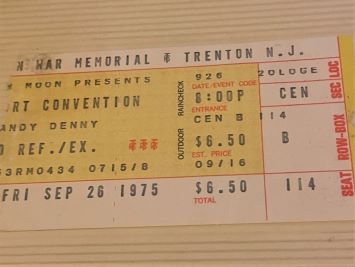
Unlike many of the previous year’s concerts, the September 26, 1975 Trenton War Memorial show opened with “Dirty Linen” and “Tam Lin.” After a performance at Philadelphia’s Academy of Music five days earlier, Fairport put in an appearance on Gene Shay’s folk music program on WMMR, during which the band was interviewed and Swarbrick and Pegg entertained by playing a series of instrumental traditional pieces.(5) When asked why “Tam Lin” had been added to the set, Denny replied, “I just got fed up with singing ‘Matty Groves,’” and explained further that audiences usually requested both songs. As if to prove her right, several callers to the radio station that night solicited on-air performances of both tunes.
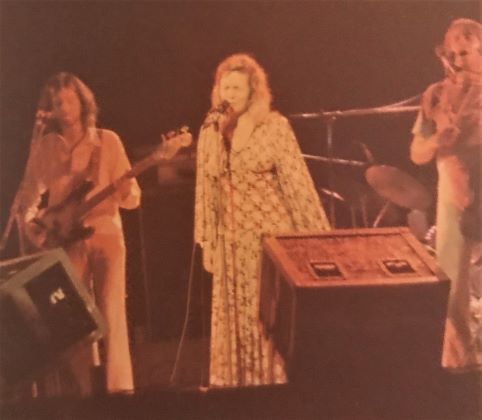
If concertgoers in Trenton thought the opening songs of the 1975 show signaled a trip through the band’s back catalog, they were wrong. The tour had less flexible set lists than in 1974 and leaned heavily on material from Rising for the Moon, interspersed with staples from the previous year, including “The Brilliancy Medley and the Cherokee Shuffle” and “It’ll Take a Long Time.”
“Sloth” was still in the set, having evolved since the previous year with Denny’s piano augmenting the arrangement and Donahue’s solo segment implementing a churning groove. And there were the occasional covers, but surprises like “Mr. Lacey,” “Rosie” “The Quiet Joys of Brotherhood” and “Listen Listen” that had been added to the band’s Royal Albert Hall set list in June had already been retired. The new album was on display, with the title track, “One More Chance,” “Stranger to Himself” (featuring Swarbrick on dulcimer), “Restless,” and “Iron Lion” chosen to represent the release.
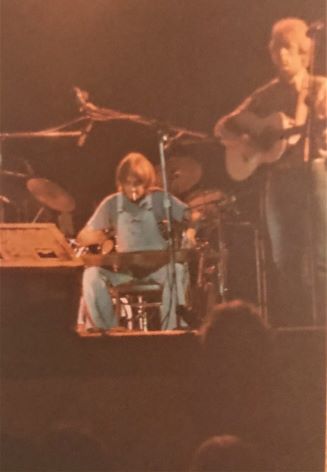
Even though Fairport’s fall 1975 trek, which ran from August 31 to October 4, returned to a number of the venues played in 1974 and added a dozen cities, there is a dearth of audience recordings from this tour and only several sourced from radio. An extant audience tape of what appears to be a warm-up show on August 30 at the Burl Theatre in Boulder Creek, California offers a typical 1975 set and includes “Walk Awhile” and Nighttime Girl.” But the most circulated tape consists of a radio broadcast of two sets from the Amazing Grace Coffeehouse in Evanston, Illinois on September 5. And the first hour of the Trenton show was broadcast by WMMR two weeks after the concert (Caravan’s opening set was also broadcast by the radio station one week after the show).
Ultimately, Rising for the Moon was not the hit that was hoped for. The band toured England in October and November, but the end for this lineup was in sight. Discussing the 1975 tour, Pegg told Jon Kirkman in 2002, “The group never lost its spirit for playing music and as a bunch of people, but it was just like a business thing and there was no way we could carry on. Literally, we had done everything. We’d done America, we did England, and that was it. We sold out every gig in England and finished up with absolutely nothing, and everybody had had enough.”
Fairport would resurrect itself in 1976 and survive multiple lineup changes in order to continue to make music over a half-century since its inception. Due to cost effectiveness, the band hasn’t toured the U.S. in several decades. The 1975 U.S. tour with Fairport would be the last time Denny performed in this country before her death three years later. Perhaps it is most fitting that Richard Thompson, now a New Jersey resident, usually includes “Who Knows Where the Time Goes?” in his solo acoustic shows, a memorial to his former bandmate as much as a consideration for us all.
Notes
- (1)According to What We Did Instead of Holidays: Fairport Convention and Its Extended Folk-Rock Family, the selection of Johns as producer was “as wrong-headed a choice as could be, evidenced by a comment one Fairporter recalls him making on day one of the second set of sessions, ‘Right, let’s hear what you’ve got, and I don’t want to hear any airy-fairy folk bullshit.’”
- (2)It was announced at the concert that Springsteen was sick, but online sources report he opted out of the show in favor of a recording session.
- (3)Earlier recordings from the tour, including Philadelphia on April 26 and Worcester on April 27, contain no trace of “Who Knows Where the Time Goes?” but an audience tape from Cambridge confirms it was performed that night. Since there were early and late shows at Cambridge, it’s likely that “Who Knows Where the Time Goes?” premiered there to reduce the repetition of songs between shows. Based on performances in Glassboro, Washington, D.C. and Denver, the tune was retained in the sets for the remainder of the tour.
- (4)An audience recording of the May 18 Washington concert at Lisner Auditorium is in circulation and is well worth seeking out.
- (5)With Swarbrick on fiddle and Pegg on acoustic guitar, the segment included songs like “Byker Hill” and “O’Carolan’s Concerto.” When asked what piece had presented the most difficult time signature for the band, the duo launched into “Willow Day” to illustrate why it had been abandoned. A year later, a Fairport lineup of Swarbrick, Pegg, Rowland and Nicol would begin performing the song live and, in 1977, record it under the title “Adieu Adieu” for its Bonny Bunch of Roses album.





 Epistrophe
Leave a comment