

February 15, 2024
Brian Auger & Oblivion Incorporated

In 2018, keyboardist extraordinaire Brian Auger, who blazed a path through jazz, rock, R&B, funk and standards over the past six decades, released his piano-trio CD Full Circle – Live at Bogie’s. Mostly known for his accomplishments on the Hammond B3 organ, Auger offered, on this release, a different context from his usual fare. Yet this collection of standards and originals lives up to its title, coming full circle to Auger’s formative days in the London clubs of the early 1960s before his name became synonymous with 1970s jazz-funk through his Oblivion Express ensemble. And last year’s two Soul Bank Music CD compilations, the anthology Auger Incorporated and box set Complete Oblivion, trace that two-decade musical arc.
Auger’s early piano explorations included stints with vibraphonist Dave Morse’s Quartet from 1960 to 1962 and saxophonist Tommy Whittle from late 1962 to the beginning of 1963 before settling into his own piano trio. (1) “The Preacher” and “Poinciana,” the opening tracks of the career-long retrospective that is Auger Incorporated, provide a taste of this period. While the set’s liner notes fail to provide specific dates or personnel for the tracks, “Poinciana’s” previous appearance on the Back to the Beginning…Again compilation identifies it as having been recorded at the Hop Bine Hotel in 1961 as part of Whittle’s group with Auger on piano, Mike Scott on drums and Lennie Williams on bass. According to The Guardian’s obituary of Whittle, the saxophonist at the time was “operating his own club at the Hop Bine pub in Wembley, often jousting with visiting star soloists, including fellow saxophonists Tubby Hayes and Tony Coe.” (2)
Two years later Auger would form the jazz trio Trinity with future Mahavishnu Orchestra bassist Rick Laird and drummer Phil Kenorra, playing venues like Ronnie Scott’s, the Flamingo and the Marquee. Unfortunately, this lineup is sadly missing from Incorporated. (3) David Thompson’s book A Kind of Love In, reports that Auger was, by 1964, augmenting his lineup for some gigs with guitarist John McLaughlin and saxophonist John Hughes. By then he was playing organ as well as piano, a move he told Thompson he had initially resisted: “I was adamant that I would never play [organ] myself. I wanted to remain true to the jazz scene…” But when he was hired to replace Georgie Fame for a series of shows and discovered the absence of a piano at the venues, he adapted to the instrument for which he is now most known. “I took to it like a duck to water,” he told Thompson. (4)
The same year, sporting a new lineup of the Trinity, Auger recorded the album Don’t Send Me No Flowers with bluesman Sonny Boy Williamson and in 1965 entered a nearly two-year period as part of Steampacket, an ensemble that mixed blues, jazz, soul and gospel and included singers Long John Baldry, Rod Stewart, Julie Driscoll and a Trinity roll call of drummer Micky Waller, bassist Ricky Brown and guitarist Vic Briggs. Steampacket afforded the keyboardist an opportunity to develop his B3 skills and perform a wide variety of musical genres. After the band’s demise in September 1966, Auger, the Trinity and Driscoll united for a run which produced an innovative and successful series of singles and albums culminating in the 1969 masterpiece Street Noise, after which Driscoll began a solo career and Auger and the Trinity recorded the Befour album.
Both the Steampacket and Sonny Boy Williamson sessions are represented on Incorporated with two tracks each, and the organist’s solo on “Sidewinder” alone is worth the price of the set. There’s also a healthy sampling of Auger/Driscoll/Trinity selections, including the single-only release of the cover of Bob Dylan’s “This Wheel’s on Fire, the sinuous “Indian Rope Man” and a lovely demo version of “Jeannine,” from Auger’s personal archives.
By summer 1970, Auger was ready to retool things yet again, creating Oblivion Express for that purpose, and the second disc of Incorporated serves as a sublime primer for that band’s music, a greatest hits collection of 1970s recordings along with a smattering of tracks by more recent incarnations of the band and some solo offerings. Yet Complete Oblivion, like the 2022 Auger/Driscoll/Trinity box Far Horizons, is still the best way to acquaint oneself with or revisit this period of the keyboardist’s career, in this case through a set of six studio albums nicely remastered under Auger’s supervision.
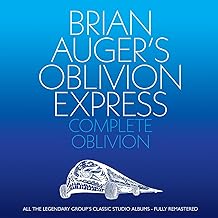
In early 1974, while Oblivion Express was playing sold-out shows in U.S. clubs, Gil Podolinsky interviewed Auger for Rolling Stone, noting, “the band’s objective is to discover, to get away from the commercial field and to stand or fall on musical ability…” Auger explained to him, “After a while you realize that being a star gets in the way of your playing.” (5) In 2015, he revisited this concept, telling Andy Thomas that the creation of this lineup was a means of advancing the sound. “The idea,” he said, “was to roll on and push the envelope forward, but the record company didn’t want that at all. They wanted me to keep doing the same winning formula we had with the Trinity. So, I thought maybe I’m pushing against the commercial tide here and maybe I’m going to oblivion – so to hell with it, I’ll call it the Oblivion Express.” (6)
The band readjusted lineups several times during the 1970s and included an array of players like drummers Robbie McIntosh and Steve Ferrone, guitarist Jim Mullen, singer Alex Ligertwood and bassist Barry Dean, with Auger as the mainstay throughout the journey. Its first release established the template for the sound, picking up where the Trinity’s last album, Befour, left off. But if Befour had paid tribute to the title track of Herbie Hancock’s Maiden Voyage, Brian Auger’s Oblivion Express led off with John McLaughlin’s “Dragon Song” and a fusion-laced statement to clearly set the two bands apart. Only the Trinity’s cover of Sly and the Family Stone’s “I Want to Take You Higher” had foretold Auger’s next direction, and even that couldn’t envision the full scope of the next five years.
Ironically, the Oblivion Express’s second album, A Better Land, took a detour into a softer, guitar-leaning, prog-like exploration that contained a dearth of Auger solos, making it an oddity in the artist’s canon. The new direction was short-lived, however, with the third album, Second Wind, hailing a return to the debut release in sound and boasting a title to signify it. The album contains several classic Oblivion Express tracks like “Truth” and a cover of Eddie Harris’s “Freedom Jazz Dance,” as Auger resumed his role as the driving force and primary soloist in the band.
If the first three albums, which had reportedly received very little in the way of record company promotion, signaled the coming of Oblivion Express, the next, Closer to It, cemented its place in the decade. Augmented by hand percussion, the band had now arrived at the right ingredients of a funk-driven jazz-and-R&B hybrid that churned through pieces like “Whenever You’re Ready” and Marvin Gaye’s “Inner City Blues.”
Its follow-up, Straight Ahead, is a perfect companion piece for Closer to It and features the classic title track and a laid-back rendition of Wes Montgomery’s “Bumpin’ on Sunset,” the two tracks Auger has declared his two favorites from the album. (7) It was in May 1974, during the tour for this album, that the band gave a live radio concert in Dallas which still circulates in the digital world. The performance is evidence of how tight and rich the lineup sounded outside the studio at the time, offering a set filled with gems from the most recent albums and even diving back to the Trinity’s Befour with its own version of “Maiden Voyage.”
The 1975 release Reinforcements, often likened to the Average White Band sound, has its share of funky rhythms but is more synth-laden with tracks like “Brain Damage” and “Thoughts from Afar” and Latin-flavored with cuts like “Something Out of Nothing” and “Future Pilot.”
Auger concluded the 1970s with Encore, a reunion album with Julie Driscoll (now Tippetts) produced by and featuring the keyboardist. A remastered version of the CD was released last year by Esoteric boasting the same type of detailed liner notes and gatefold packaging found in the Complete Oblivion box. Collectively, Auger’s work over the 1960s and 1970s is testament to how such an artist can cover so much ground in a twenty-year period and not repeat himself in the process of exploring, creating and advancing.
Notes
- Chilton, John (ed.). “Auger, Brian.” Who’s Who of British Jazz. New York: Continuum, 2004.
2. Vacher, Peter. “Tommy Whittle Obituary.” The Guardian, 23 October 2013.
3. The 2015 Auger anthology Back to the Beginning offers three jazz-trio tracks – “Blues Three Four,” “There is No Greater Love” and “Broadway” – while the 2016 collection Back to the Beginning…Again contains two tracks – “Love for Sale” and “Work Song” – from 1964 featuring a Trinity lineup of Auger, Laird and drummer Robert Anson for those interested in hearing this phase of Auger’s career.
4. Thompson, David. A Kind of Love In. privately published, 2019.
5. Podolinsky, Gil. “Brian Auger: The Oblivion Expresses’ Show of Strength.” Rolling Stone, 14 February 1974, 20.
6. Thomas, Andy. “Brian Auger.” J&N, 2015. retrieved from brianauger.com.
7. Back to the Beginning…Again liner notes, page 11.







 Epistrophe
Leave a comment