
August 15, 2025 /Updated October 4, 2025
Cold Day in Hell/Hush 2

In 1981, Daredevil writer and future Batman helmsman Frank Miller explained what he called a “crucial difference” between the Man Without Fear and the Caped Crusader: “comparing [Batman] to Daredevil, I’d say Daredevil’s basic concept is very dissimilar. I see Daredevil as someone who operates on a basic motive of love for seeking out justice…And I see Batman’s as negative. He’s punishing those who killed his parents. Batman’s focus is on the criminal, Daredevil’s is on the victim.”
It would be another sixteen years before we would witness an actual meeting of the two characters to illustrate Miller’s perspective. Early in D.G. Chichester’s 1997 Marvel/DC crossover comic “Eye for an Eye,” the Caped Crusader, in pursuit of Two-Face/Harvey Dent, tells Daredevil, “He’s a criminal. I plan to see him pay for his crimes in the harshest manner the law allows.” DD counters, “Harvey Dent is still there. His…deformity – it’s a mask.” Annoyed by the comments and Hornhead’s interference, Batman is dismissive of Daredevil’s advice that “justice needs to at least offer redemption.” Matt Murdock sees Dent as a victim, mentally and physically altered by the acid that disfigured him. Bruce Wayne sees only the criminal Two-Face. “They’re not so alike as some might believe,” the narrator says of the two superheroes.
This year’s arrival of Charles Soule and Steve McNiven’s Daredevil: Cold Day in Hell and Jeph Loeb and Jim Lee’s Batman:Hush 2 provides an ideal opportunity to test Miller’s viewpoint again. The former’s three-issue arc and the latter’s six-issue run features the return of two sets of creative teams recognized for their previous work on the characters. And the two title vigilantes are given the depth and scope only veteran writers and artists can provide.
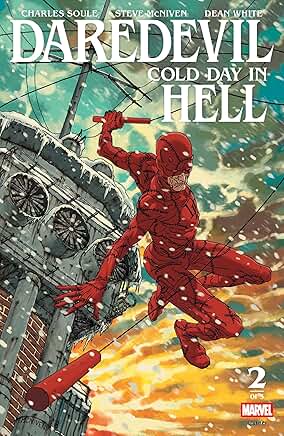
Daredevil:Cold Day in Hell, set in a superhero-less future and featuring a retired sixty-something Matt Murdoch, has already been likened to Mark Millar’s Old Man Logan and Miller’s The Dark Knight Returns, but to evaluate by comparing is a bit unfair. The team of Soule and McNiven are known for their work last decade on Wolverine and are both credited on Cold Day as authors, with the latter also handling the penciling and, for the first issue, coloring. They date the start of the project to around 2018-2019, which allowed the comic to gestate at its own pace, even if the final issue of the run was delayed by several months.
Having helmed the Daredevil title from 2015 to 2018, Soule seems to have envisioned Cold Day as a reintroduction rather than a continuation. Reading the three-issue series is an invitation to reconnect with familiar characters now distanced from us through the passage of time within the comics. We are only offered glimpses of some; others are full-fledged moments of reacquaintance, including Murdock, who must resume his abandoned role as Daredevil in a war-torn world.
“As we all know,” Soule told IGN earlier this year, “Matt got his powers by being accidentally dosed with radioactive goop. Radioactivity fades with time, and in this story, the idea is that over time Matt’s powers faded away too. He’s still got all his combat training, but he hasn’t used it for a very long time.” When a dirty bomb detonates near him, Murdock’s heightened senses are restored, but only for a limited time, giving him three days to carry out the mission with which he is charged by none other than Steve Rogers.
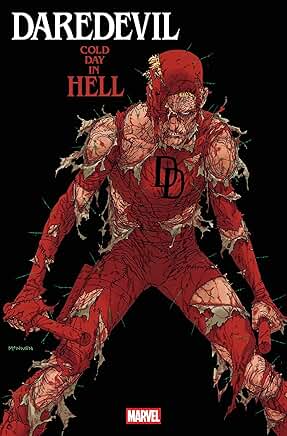
Donning an ancient, stitched-up version of his DD outfit, Daredevil enters the fray when he must protect a young girl sought by villains working to provide a counterbalance to new weaponry developed by the enemy “deebees.” And at least one archenemy lurks behind the scenes.
There are plenty of words prefixed by ‘re’ that can be used to describe Cold Day as the characters address the past, which is alluded to in Watchman-like moments interspersed by McNiven throughout the issues. Indeed, the series lays claim to Watchmen’s meta-narrative on comic books, in this case Marvel’s. There’s an ageless Elektra looking as if she were plucked from the pages of Miller’s Elektra Lives Again. In a sampling of plot notes and drawings at the end of the first issue, McNiven explains that he “decided to use the Frank Miller sixteen-panel grid as an overall structure to each page.” And a Silver Age cache of super-soldier serum and gamma-infested technology figure significantly in the plot.
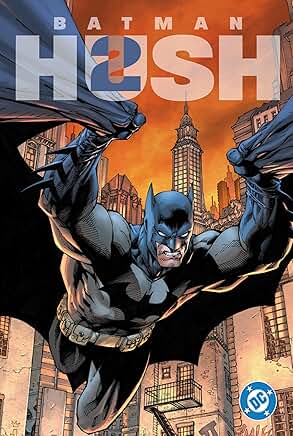
“Murdock’s always been interesting because, like Batman, he’s essentially a highly-trained ordinary human,” Soule told Newsarama in March. DC’s current run of Jeph Loeb and Jim Lee’s Batman: Hush 2 makes that clear and more. Both Cold Day and H2SH reunite the protagonist with former villains and allies, but the latter revisits a dangerous scenario from some twenty ago.
“Loeb’s talent as a writer often leads his readers along mazes and through puzzles to illustrate the true deprivation of truth that exists in reality,” Stuart Warren wrote about Hush in 2013. All of it is an exercise perpetrated by Thomas Eliot, former friend of Bruce Wayne who becomes the character Hush, “to destabilize Batman through emotional manipulation,” the result of which is “a Batman muddled in confusion.”
The legendary status of Hush makes its follow-up a highly anticipated, big-selling event. That doesn’t mean the attention is unwarranted. Featuring a similarly untrustworthy cast of allies and villains whose roles seem interchangeable at times, Hush 2, has Batman consumed with the same paranoia that pervaded the first story arc. Only Hush knows where the narrative is headed, leaving all, including the reader, off-balance and in the dark.
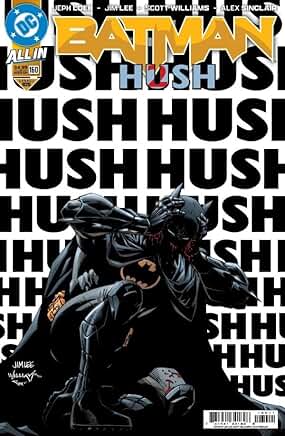
The aforementioned characteristics Miller uses to distinguish Batman from Daredevil are evident here. Loeb’s work on the Dark Knight’s series is evidence enough to corroborate Miller’s thesis. Like the original Hush and The Long Halloween, H2SH is about stopping the villain at any cost, including the rescue of an enemy from the brink of death, which proves to be as much an act against Hush as it is an oversight on the hero’s part.
Time is just as much a factor here as it is in Cold Day. In this case, it’s time for, as T. S. Eliot put it, “decisions and revisions which a minute will reverse.” And it’s about how precious little of it there seems to be while in the throes of a deadly conspiracy.
Like Cold Day, Hush 2 is facing its own set of production problems. The series’ six-issue 2025 run was to have concluded in August but, reportedly, a delay in Lee’s artwork now has the final two issues looking at publication dates this November and in January 2026. Both Daredevil: Cold Day in Hell and Batman: Hush 2 won’t receive collected edition releases until early next year. By then, the reported concluding six issues of the Batman series might be ready for their appearance.
Notes:
Chichester, D.G. “Eye for an Eye,” in DC Versus Marvel Omnibus. New York: DC Comics/Marvel Comics, 2024.
Howell, Richard and Carol Kalish. “An Interview with Frank Miller.” Comics Feature #15, December 1981.
Jewell, Stephen. “Matt Murdock’s powers are failing and he has just 72 hours to solve a deadly mystery in Marvel’s new limited series, Daredevil: Cold Day in Hell.” Newsarama 21 March 2025. retrieved from gamesradar.com.
Schedeen, Jesse. “Daredevil: Cold Day in Hell Gives Matt Murdock the Dark Knight Returns Treatment.” IGN, 28 February 2025. retrieved from ign.com.
Warren, Stuart. “Gotta Loeb Batman: Batman and Synergy in Hush.” Sequart Organization, 31 January 2013. retrieved from sequart.org.









 Epistrophe
Leave a comment