
February 1, 2026
Daredevil @ 60: DD & Punisher
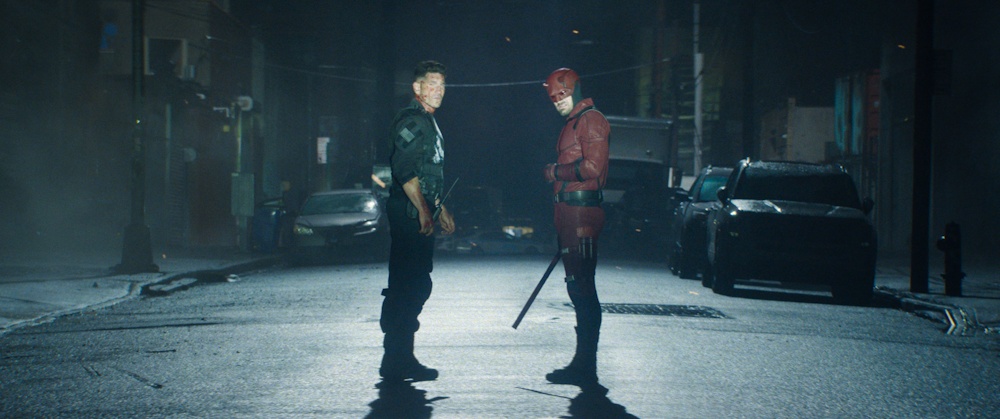
Matt Murdock/Daredevil and Frank Castle/Punisher. Two characters, one of Irish heritage, the other Italian, engaged in a contest of wills and ideologies. Both raised Catholic. One a lawyer, the other ex-military. Each a vigilante. One believing in the law, the other creating his own. Each protecting the innocent while trying to convert the other. Assessed by another Marvel superhero as “opposite sides of the same coin.”
Daredevil and Punisher have danced with and around each other in comics, on television and now in a novel with no resolution in their disputes for over forty years. The polarity enhances the drama already generated by each character’s alter ego and leaves the reader/viewer to discern the right, wrong and why of it all. But it’s those ideological differences that expose the intricacies of each character.
The core of their disagreement lies in each character’s view of his role in dispensing justice. In his essay “Daredevil and Punisher: Polar Opposites?” M.S. Wilson observes, the “belief in justice is common to both,” but “Daredevil believes everyone deserves a second chance and has the potential for good, while the Punisher believes criminals have already made their choices and eliminating them is the only way to prevent future criminal behavior.” It’s a succinct evaluation of the characters’ commonality and differing ideologies, taking into account Murdock’s concept of redemption as opposed to the Punisher’s black-and-white rationale. But the duality is more complex than that, more nuanced in its portrayal and execution.
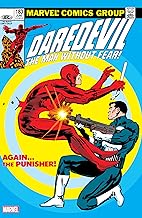
The first meeting between Punisher and the Man Without Fear occurred in Frank Miller’s Daredevil #183. Paul Young posits that “Miller brought the Punisher, then Marvel’s most homicidal lead character, into the comparison to develop a pet point about Daredevil’s singularity: his duty to the legal system, for better or worse.” Wilson notes that in that initial meeting, “we see the dichotomy between the two already, and this split only gets wider over the years.” Weighing in on that dichotomy in 1982, Miller explained, “The main difference between [Punisher] and Daredevil is Daredevil’s sense of responsibility to the law,” adding that “Daredevil has to believe that the law will work in every instance…” As if to test the extent of this belief, Danny Fingerroth’s somewhat surreal 1989 “What If Daredevil Killed the Kingpin?” has Murdock seeking justice for his murder of Fisk at the hands of the Punisher.
The year before Fingerroth’s What If? scenario, Carl Potts had arranged a different meeting between the two. “Is that any way to greet your savior?” Daredevil asks a wounded Punisher in War Journal Vol. 1, #3, before continuing to harangue the latter about how he should have handled his recent altercation. Punisher thinks, “Doesn’t he ever stop preaching?” The terminology used is pointed and intentional. After DD assists Castle in returning home, he leaves, prompting Punisher to think, “Good riddance. We would only wind up clashing over our different views of ‘justice’ again.” He may begrudgingly accept the help but grumbles about who it is lending him a hand.
Punisher’s first appearance was in Amazing Spider-Man #129 (Feb. 1974) as a hired assassin working for the Jackal. It was nothing more than a sketch of the character. He is never referred to as Frank Castle or Castiglione. Other than stating he was a Marine, his background and motivation are mysteries, but his determination to eliminate those guilty of crime is clearly established. Marvel, it seems, didn’t know what to do with the character. He was denied his own comic book until a limited series in the late 1980s, having been relegated to sporadic appearances in various titles until then. The limited series proved popular enough to spawn an ongoing run, with issues appearing every six weeks.
According to Steven Grant, writer of the first series, “Marvel didn’t actually want to do a limited series. I went around from office to office trying to peddle this rough idea I’d had since 1976. It took ten years to get it off the ground. They thought the Punisher was a character that shouldn’t be promoted because he kills people.” Grant and his team can be credited with introducing the identity of Frank Castle, which “Marvel was against. We finally talked them into it, but they weren’t thrilled about giving him an identity,” preferring instead to continually change it.
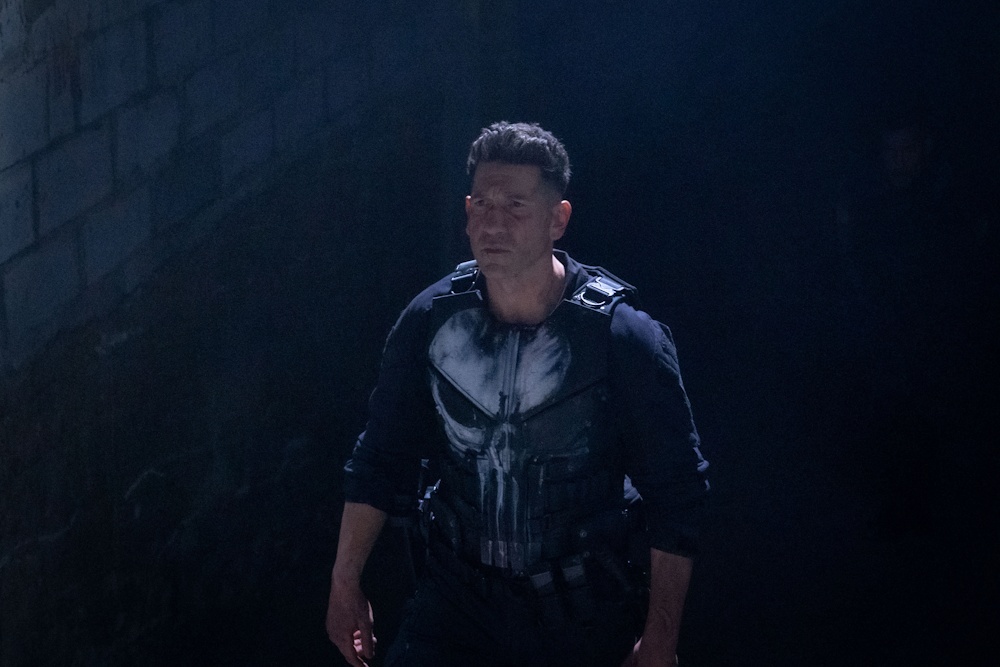
Evaluations of the Punisher tend to examine overt facets of the character, namely his actions or statements, but the current tendency to view him based on one’s personal beliefs in such matters as gun control or politics compromises the character, imposing on him a value or context that risks falling outside the intended literary scope of the comics or television writers. That’s why his pairing with someone like Daredevil or Micro helps define him more precisely by providing a foil. The Season 1 finale of Daredevil: Born Again was effective in delineating the title character’s brutal yet non-lethal fighting style and Castle’s barbaric approach, elevating it several steps above the violence of the Netflix series. Co-director Justin Benson explained, “in the moment, when you see him committing to kill itself, it was important to us…to see the dopamine hit that Frank gets from that, just milliseconds of relief from his pain of his past in that moment and also show how absurdly grotesque it is what he’s doing.”
Yet others, like Grant, have referred to him as someone who is “desensitized” and who “works very hard at it.” Editor Carl Potts, who oversaw the first Punisher ongoing series, explained the character as “subconsciously rationalizing his own desire for action by righting wrongs.” Castle’s internal landscape has become more nuanced over the decades and, depending on who’s writing him, determined by a variety of factors that define his identity. Witnessing the death of his family, experiencing war first-hand or discovering the corruption that accompanies it have all been suggested as influences in the creation of the Punisher psyche. According to Grant, “he doesn’t view himself as Frank Castle, he views himself as the Punisher,” and Wilson holds that “the Punisher has declared numerous times that Frank Castle no longer exists; the person doing all the killing is only the Punisher.” But on occasion, we’re offered a clearer glimpse of Castle’s fractured mental state as victim and vigilante.
Grant’s successor, Mike Baron, told Comics Interview in 1988, “I have tried to structure him as an existential hero.” Miller agreed, saying, “I would consider him a hero [but] I don’t consider him a role model.” Most fans would probably agree. The hero aspect speaks for itself as an attraction, but the boundary-less perspective of Punisher creates its own drama when Daredevil is placed in the mix.
Nicholas Brooks, in his assessment of the character’s appearance in Daredevil: Born Again, noted in 2025, “More than other characters in the MCU, Frank Castle is one of the most complex and least likely, on paper, to work on the small screen. He barely talks, is hyper-focused on his mission, and doesn’t like to work with people unless he has to,” even though, “in essence, the Punisher works when his darkest traits are on display only when he’s working with people who are morally better than him.”
And that would include Daredevil, whose distinction from Punisher is perhaps best explained by Miller: “A lot of what the Daredevil character is about is controlling and restraining that which is dangerous within us through law and through rules. He does that with himself.” And, as a result, he is intolerant of the Punisher’s lethally violent fighting style, what Kent Worcester refers to as “blunt force trauma” as opposed to DD’s “agility and grace.” “Maybe,” Wilson professes, “Daredevil detests the Punisher so much because he sees what could have happened (and what could conceivably stillhappen) had he not had the strength to rise above his past and become the hero he is today.”
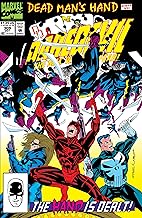
DD is also one of the few characters able to detect the vulnerability that exists in Punisher and use it to his advantage. In Daredevil #184 (July 1982), he tells Punisher, “You’ve killed dozens of criminals in your time. But you’ve never harmed an innocent. You won’t kill me.” The same strategy appears in D.G. Chichester’s “Dead Man’s Hand” run in the early 1990s. Worcester notes in his essay “To Shame Its Adequacy” that “Daredevil’s strategy in Chichester’s run is that because he doesn’t kill, he avoids becoming one of Punisher’s targets and can use that privilege to ‘unnerve’ him.” In Mark D. White’s estimation, this is “perhaps the only part of Frank’s moral code that keeps him from being cast as a full-blown villain and makes Matt feel comfortable working with him when necessary.” When Punisher does unintentionally cross that line, as he does in David Lapham’s 2006 Means and Ends #6, we observe the remorse that can consume him in such a situation. It’s not something he can verbally dispel, and his interior monologue is clearly wracked with guilt. Similarly, the Netflix Punisher series’ second season contains a situation that uses this vulnerability as a weapon against Punisher.
The fact that Punisher isn’t territorial is a notable distinction from the Man Without Fear. With Daredevil, defending Hell’s Kitchen and NYC, is personal. His clash with Wilson Fisk, aka Kingpin, usually stems from each character’s belief that it’s “my city.” With Castle, it isn’t about defending or reshaping a domain. It’s about eliminating threats in general. It’s a mission to be accomplished and one without a personal connection like Daredevil’s.
In 2016, Charles Soule’s adjustment of Murdock’s career in the Seventh Circle series impinged on the Daredevil/Punisher dynamic somewhat. When Murdock, now a prosecutor, procures a fairer trial for a defendant by arranging a transfer to Texas, and Daredevil, as bodyguard, protects that defendant from the Punisher, the expected skirmishes ensue until the latter confronts the Man Without Fear with the notion that a trial in Texas, with its death penalty, is the same type of justice Castle dispenses. “You want to see him punished just as much as I do,” Punisher says. “I do, Frank,” DD responds, “But not by me. And not by you.” As prosecutor, Matt moves a legal step closer to Frank Castle’s side of the line and away from what Daredevil and defense attorney Murdock have previously chosen to avoid.
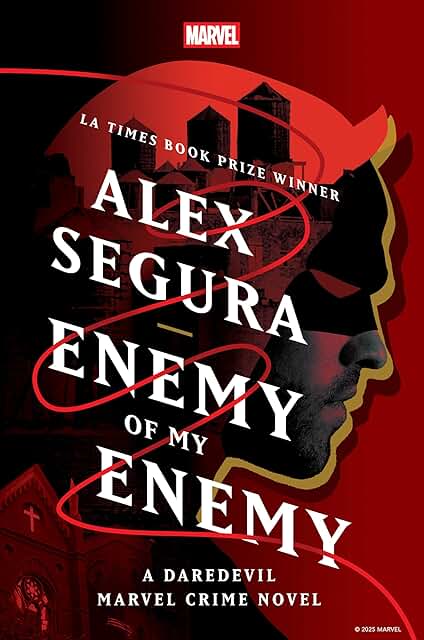
In Enemy of My Enemy, Murdock is still defending clients and representing Castle in the murder of Kingpin. It’s the fourth Daredevil prose novel to be released but the first to examine the DD/Punisher relationship. After a delay of eight months, its arrival in March promises a further examination of the contrasts between the two characters.
Curiously, though, it’s the similarities between the two, awash in this vortex of contradictions, that define the characters most accurately and form an unspoken bond that permits them to work together despite how much they relish the opportunity to verbally flaunt their individual ideologies and proclaim they are not the other. Some writers have addressed this directly. In Ann Nocenti’s 1988 Daredevil #257, the antagonist Coppersmith, who initially sees the Man Without Fear as a “savior” when DD interrupts Punisher’s intended execution of him, is aware of his changing viewpoint as he watches Daredevil and Punisher battle. He now sees a “couple’a bullies beatin’ on each other to see who wins me, who gets to decide my fate.” He notices the ideological differences in their conversation and the fact that they’re “talkin’ ‘bout me like I ain’t even here.” But his ultimate revelation is that “they think they got somethin’ to argue about. But they don’t ‘cause they’re the same guy.”
In 2025, Jon Bernthal, who plays the Punisher in the Daredevil Netflix and Born Again series, noted that “I think that Frank is seeing himself in Matt, and Matt knows that he’s seeing Frank in himself, and there’s a glee in that…For Frank, there’s nothing like having that bit of wisdom over Matt and torturing him about it because he knows that he’s right.” The observation is an accurate description of the unspoken part of the relationship, unlike their differing views on justice or the impatience each expresses about the other.
Their Catholic backgrounds are a shared experience, providing the same moral foundations before each pursues his own religious path. Surprisingly, it’s Castle who initially considered a life in the priesthood. In 1989’s War Journal #13,Punisher recounts, “I left the seminary when I couldn’t shake the feeling that the guilty should be punished before they were forgiven – punished by a whole lot more than saying a few ‘Hail Marys.’” And while Murdock adheres to a belief in redemption, his faith experiences occasional moments of doubt, particularly in Season 3 of the Netflix series, which bring him closer to being one bad day away from becoming Castle.
What might best demonstrate how similar Daredevil and Punisher can be in the right circumstances occurs in Garth Ennis’s “The Devil by the Horns” rooftop setting in the Marvel Knights Punisher storyline from 2000. The scene, borrowed by Season 2 of the Netflix Daredevil series and mixed with a Miller rooftop meeting, may be the most intense confrontation between the characters’ conflicting ideologies. DD, bound by chains with a gun taped to his hand, faces the choice of shooting Castle before he takes out an intended victim or allowing Punisher to play sniper. Daredevil’s decision to pull the trigger, after exploring all other options, is telling.
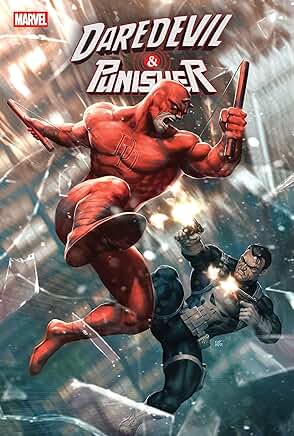
Appropriately, that particular scene and all it entails is revisited by writer Jimmy Palmiotti at the start of the recent series Daredevil/Punisher: The Devil’s Trigger, which has the pair facing multiple crime organizations in an offshoot of the Ennis storyline. So, following the rooftop incident, Palmiotti has Punisher leave DD bound and hanging from the rafters of a warehouse in Red Hook where he can eavesdrop on a meeting between crime bosses planning to conquer and divide the Gnucci family’s territory. “He wanted me to witness,” Daredevil realizes. “He knew I helped put two of them away for what I thought was a life sentence, and yet here they are, right back to their old ways.”
Punisher’s demonstration of how the legal system itself undoes DD’s attempts to deliver justice is both direct and indisputable. There are no ideological arguments, no shouting matches, no physical battles – only empirical evidence. “The deeper I go, the clearer it becomes,” Palmiotti said in a press release. “Both men are right, and both are wildly wrong.” He told Comic Book Resources that their conflict can be seen not only in their battles but in “the emotional and moral fallout they leave behind.” They are archetypes, he says, whose “fractured methods reflect the real world we live in.”
Ultimately, the extremes applied to the situations in “The Devil’s Trigger” fail to provide any far-reaching solutions, despite each character’s certainty of his perspective. But there is some evidence of an understanding between the protagonists. A portion of Daredevil’s concluding interior monologue addresses both Punisher and himself, acknowledging that Castle “already understands what I’m trying to say,” but “it’s just not the truth he can afford to accept” on his chosen path. “I’ve stood in the shadows myself, felt the pull of that darkness,” Daredevil admits. “But not like him. Not to the depths he’s been dragged.”
Palmiotti says that the conclusion he sought in the series is one of “coexistence.” “In the end,” he explained,” the series is about exploring the tension between idealism and reality and finding the humanity that exists in both.” Undoubtedly, it’s the preferred course of action in 2026, but it may have been the answer all along.
Notes:
Brooks, Nicholas. “The Punisher Special Presentation Can Set Up the Perfect Series (But Not How You Think.” Comic Book Resources, 27 February 2025. retrieved from cbr.com.
Brubaker, Ed. “The Devil in Cell Block D, Part 4.” Daredevil Vol. 2, #85, July 2006, n.p.
Brubaker, Ed. “The Devil in Cell Block D, Part 6.” Daredevil Vol. 2, #87, September 2006, n.p.
Chichester, D.C. “Dead Man’s Hand Part 7: Cards on the Table.” Daredevil #309, October 1992. n.p.
David, Brandon. “‘That’s Not How We Start Season 2’- Daredevil: Born Again Finale Director Interview.” Phase One, 16 April 2025. retrieved from YouTube.
Decker, Dwight R. “Frank Miller: An Interview with the Young, Critically-Acclaimed Writer-Artist of Daredevil.” The Comics Journal No.70, January 1982, 68-93.
Ennis, Garth. “The Devil by the Horns.” Punisher, Vol. 5 # 3, 2000. n.p.
Fingerroth, Danny. “What If Daredevil Killed the Kingpin?” What If… #2, August 1989, 14-16.
Fisch, Sholly. “The Punisher.” Marvel Age #51, June 1987, 18-21.
Howell, Richard and Carol Kalish. “An Interview with Frank Miller.” Comics Feature #15, December 1981.
“Jimmy Palmiotti Reignites Daredevil and Punisher’s Rivalry in Daredevil/Punisher: The Devil’s Trigger.” Press Release retrieved from manwithoutfear.com., 6 August 2025.
Lapham, David. Daredevil vs. Punisher: Means and Ends #6, January 2006, Marvel Comics, n.p.
Nicieza, Fabian. “Dead Man’s Hand: The Mortal Coil Shuffle.” Nomad #6 October 1992.
Nocenti, Ann. “The Bully.” Daredevil #257, August 1988, 15, 18-20.
O’Connell, Sean. “‘Justice is a Bullett’: CBR’s Exclusive Interview with Daredevil/Punisher Writer Jimmy Palmiotti. Comic Book Resources, 21 October 2025. retrieved from cbr.com.
Palmiotti, Jimmy. “Slaughter in Sutton Place,” Daredevil & Punisher: The Devil’s Trigger #5, March 2026. n.p.
Palmiotti, Jimmy. “The System Is Flawed,” Daredevil & Punisher: The Devil’s Trigger #1, January 2026. n.p.
Potts, Carl. Punisher War Journal #3, February 1988, Marvel Comics, n.p.
Romano, Nick. “Bernthal is Eager To Do More with the Punisher, and This Re-introduction is Getting Him Closer to the Frank Castle He Really Wants to Play.” Entertainment Weekly, 18 March 2025. retrieved from ew.com.
White, Mark D. A Philosopher Reads Marvel Comics’ Daredevil. UK: Ockham Publishing, 2023.
Wilson, M.S. “Daredevil and Punisher: Polar Opposites?” in The Devil is in the Details: Examining Matt Murdock and Daredevil, Ryan K. Lindsay (ed.), Edwardsville, Illinois: Sequart Research and Literacy Organization, 2013, 156-165.
Witterstaetter, Renee. “Steven Grant.” Comics Interview #72, 1989, 5-13.
Worcester, Kent. A Cultural History of the Punisher. Chicago: Intellect, 2023.
Worcester, Kent. “To Shame Its Adequacy: The Punisher and His Critics,” in Judge, Jury and Executioner: Essays on the Punisher in Print and on Screen, Alicia M. Goodman, et al. (ed.), Jefferson, NC: McFarland & Company, Inc., 2021, 15-26.
Young, Paul. Frank Miller’s Daredevil and the Ends of Heroism. New Brunswick, NJ: Rutgers University Press, 2016.
Zimmerman, Dwight Jon. “Mike Baron.” Comics Interview #63, 1988, 4-19.
Other articles in the Daredevil @ 60 series:









 Epistrophe
Leave a comment