
August 1, 2025
Mick Herron’s First Novel
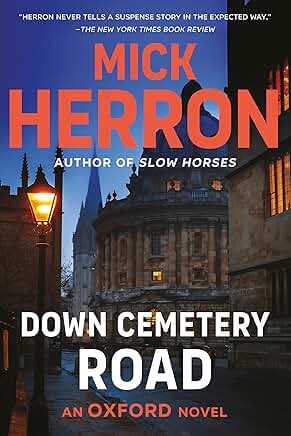
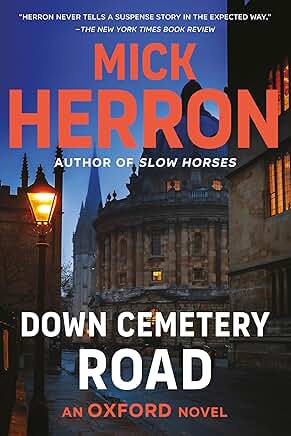
In anticipation of the Apple TV+ adaptation of Down Cemetery Road, we take a look at the book that started it all.
Having a house explode in your town has probably never been an incentive to read a novel, even if the book contains a similar event, but there’s a first for everything. When a local house here blew up several years ago, it stirred an interest in reading Mick Herron’s Down Cemetery Road, at least for my Book Club partner Krissy and me. It wasn’t morbid curiosity. We were drawn by the randomness of the event and our concurrent discovery of Herron’s book. As would be expected, our local news-worthy moment lacked the complexity and intrigue of the novel but carried its own drama, one that, at first, strode, then limped and finally crawled into the disinterest of waning news cycles and thinning social media commentary. Without a Sarah Tucker, the incident was permitted to quietly recede from memory.
Down Cemetery Road, Herron’s first novel, is part of the four Zoe Boehm books in his Oxford series, but Tucker is the protagonist and the reason to read it. She’s smart, determined and a bit too impulsive, a character who instinctually understands the need to pursue a cause before rationally comprehending why, and that makes her a fascinating study. “There’s more to Sarah Tucker than meets the eye,” Herron commented in an August 4, 2024 Facebook post and, despite her vulnerabilities, including anxiety and personal/professional failings, you feel you can trust her. One might even recognize a trait or two of subtle resemblance with Stephen King’s Holly Gibney, but Tucker was there first, eleven years before King’s character, and she’s not a detective. That’s a refreshing twist.
Regardless of the novel’s classification as the first in the Boehm series, the real private eyes, Zoe and husband Joe Silvermann, appear sparingly throughout the book’s 340-plus pages. That doesn’t minimize their significance. It merely places the weight of the narrative on Tucker, who acquits herself formidably.
Herron’s early attempts as a would-be writer were not always successful. Jill Lepore’s 2022 New Yorker profile of the author reports that “he’d written reams of pages only to destroy them.” She quotes him as admitting, “My early narrators were fairly hapless, useless men.” Then, she says, “he came up with Sarah Tucker, a bored and frustrated out-of-work lawyer living in South Oxford,” and the road to being published looked a lot friendlier. Still, it took more work and patience.
“[Down Cemetery Road] took me a long time to write because I had a life going on. I wasn’t a professional writer,” he told The Guardian last year, adding that the novel was “scribbled here and there in moments you can seize for yourself.” Whatever scribbling was being done in the late-1990s/early-2000s became what fan Clarissa Aykroyd, in addressing a question to Herron on the Spy Write website in 2018, described as the “style of your Oxford/Zoe Boehm books…highly descriptive, almost lush at times, and extremely detailed about your main characters’ internal states.” In contrast, she referred to Herron’s Slough House characteristics as “much more terse and snarky.”Admitting his style has changed, Herron responded that ‘terse’ and ‘snarky’ “seems appropriate” in writing about the Slow Horses. “Perhaps, if I wrote about Zoë again, I’d slip back into a more leisurely style – if I were focused on a single character, I’d certainly have more time to rummage around in her consciousness.”
For his debut novel, Herron delivers a riveting narrative that weaves an array of characters into a rapidly fraying tapestry, provides background information from unexpected points of view, executes twists and turns to catch the reader off-guard, follows trails that conclude in dead ends and travels down cul-de-sacs that unexpectedly unlock answers. Like a maze, the novel’s only way out is through the final chapter, which is guarded by a gauntlet of characters either duplicitous or straightforward but equally dangerous.
The novel’s pacing is masterful, with the tour de force being the final third of the book. With the stage set and less than one hundred pages to go, there is a sense of foreboding, of dread and anticipation as a showdown awaits the gathering of its participants. Herron fragments the narrative, manipulating it forwards and backwards, from character to character, move to move.
All of which brings us to the upcoming Apple TV+ television adaptation of Down Cemetery Road, premiering October 29. Highly anticipated by fans, it will feature Emma Thompson as Boehm and Ruth Wilson as Tucker, but the nature of the book will require changes for a screen version. One would think that Boehm would have a larger presence in the TV production. The advantages of the novel’s print medium to maneuver the twists and turns, however, will not be reproducible for television. And Aykroyd’s observations about the characters’ “internal states” are less suitable for the screen. Then again, the series boasts acting of a high caliber with Thompson and Wilson, so we’ll see how these personas and the storyline adapt.
The Guardian reports it’s “clear that character is where all [Herron’s] work starts, and that his intricate plots…are a “maypole around which the characters dance.” For Down Cemetery Road, Herron seems to have used himself somewhat as a model for his protagonist. “It’s the most autobiographical thing I’ve ever written,” he admitted to Lepore, who explains that “a house on his street blew up. And he was Sarah: clever, curious, and painfully thwarted.”
As with the Slough House novels, Herron supplements his longer Oxford narratives with short stories about the characters. Three of the four tales originally published in Ellery Queen’s Mystery Magazine from 2008 to 2013 feature Zoe and her husband. The first two, “Proof of Love” & “The Other Half,” were published just prior to the fourth book in the series and the third, “Mirror Images,” one year after the run. Each provides an earlier glimpse of the couple’s dynamics and what they were up to before encountering Tucker, a sort of literary retconning. The fourth story, 2013’s “What We Do,” is set after Sarah has entered their lives.
For those who haven’t yet entered this fictional world, an argument could be made for starting with the first three Zoe Boehm short stories, all of which are collected in the Dolphin Junction anthology, before undertaking Down Cemetery Road and the other three novels. Chronology of narrative vs. chronology of publishing? Toss a coin and dig in.
Related Articles






 Epistrophe
Leave a comment