
March 1, 2026
Loud and Clear: A Grateful Dead Sonic Biography
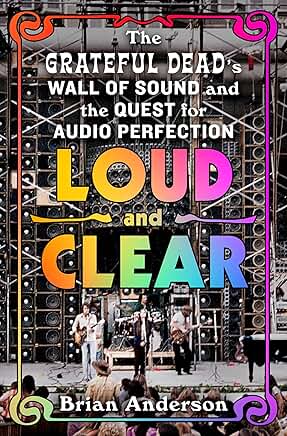
In 2016, Alice Kaplan’s Looking for The Stranger received publication as a unique biography that was not about the life of a person but of a novel, Albert Camus’s The Stranger. It traced the writing process from gestation through its development into A Happy Death and finally to its completion as a cornerstone of existential literature. It was an unusually clever approach to the biographical form, not unlike Walter Kolosky’s 2024 Mahavishnu Memories, a tour biography about the Mahavishnu Orchestra’s original lineup.
And now there’s Brian Anderson’s 2025 Loud and Clear, one of the newest additions to the Grateful Dead canon. Covering the band’s history from its inception in 1965 through 1974, the book is more accurately a biography about the group’s acclaimed PA system, the Wall of Sound.
Anderson’s account is an extensively researched and well-documented journey into the evolution of the system. There are some traditional Grateful Dead biographies not as well-executed as this book, which opens with an account of the arrival of what Anderson calls “the artifact,” a monitor cabinet from the Wall of Sound “with a patina of scuffs, dings, worn edges, adhesive residue and frayed wiring” that the author purchased from Sotheby’s. Having been raised by parents who were both Dead Heads, he came to appreciate not only the music but the technology of the band, and his passion for all things Dead makes for a thoroughly engaging read.
Anderson uses first-hand accounts and anecdotes by former Dead crew members, other employees and concert attendees to document the process of discovery that was the experiment in creating a state-of-the-art sound system ahead of its time and accommodating to both band and audience. Additionally, he augments the interviews with material ranging from the minutes of Grateful Dead meetings and diagrams by the band’s crew to notes from recordings archivist Dick Latvala.
Outlining the scope of the book through chapter titles, Anderson lays out the trajectory from the earliest systems to the end result: The Mother Rig, The Lead Sled, The Good, Old Reliable Soundsystem, The Righteous PA, The Tie-Dye Rig, The Alembic PA, and The Wall. He spends the most time on 1973 -1974, when the Dead used the concert stage as a laboratory for experimenting with live sound in its own sets, Ned Lagin’s Seastones performances and the Ned & Phil segments during Dead shows.
This period witnessed the use of delay towers in large outdoor settings, phase-cancelling microphone setups for higher volume with reduced feedback and tilted speakers to allow for clarity at the back of venues. The book also chronicles how the developing sound was continually making a positive impression on newspaper critics, who began regularly acknowledging the sound system in reviews.
Anderson cites the November/December 1973 Boston Music Hall run as the turning point for the Wall. Due to stage limitations, it was the first time the entire unit was stacked directly behind the band, providing a glimpse into its sonic future. The remaining shows that year fine-tuned things and began adding the two-piece center vocal-cluster of speakers in the huge array.
After two test-runs in early 1974, the full-fledged rig was in use. But the system’s demands had grown and now included a twelve-hour set-up time and continued maintenance, all of which began to take its toll on the band’s finances. Abandoned in 1975, the Wall of Sound may have never achieved perfection, but as Anderson notes, it became “a roving system and a place of research and development, incubating technologies that still ripple today.”
Related Article







 Epistrophe
Leave a comment