

March 1, 2024
Daredevil @ 60: Part 1 – Hell’s Kitchen
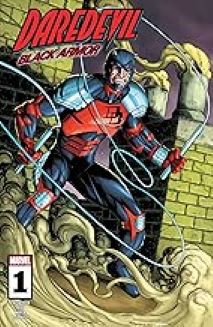
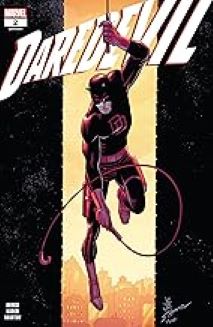
The 2023-24 comic book series Daredevil: Black Armor, writer D. G. Chichester’s recent Marvel Comics return for a four-issue story arc that concluded February, re-positions the title character in the 1990s following the events of Chichester’s Fall From Grace narrative. Three of the issues open with a flashback to a youthful Matt Murdock and the lessons he observes watching his father, Battlin’ Jack Murdock, training would-be prize fighters in the skills of his profession. Collectively, the moments form a lesson Matt applies to his adult role as Daredevil, the Man Without Fear, yet it’s just as much about the pulse emanating from Hell’s Kitchen, the portion of Manhattan now known as Clinton where Matt and his alter ego reside and defend against an increasingly violent and dangerous environment threatening its citizens.
Saladin Ahmed’s concurrent series in the ongoing Daredevil comic title is set thirty years in the future, today’s world, yet its Hell’s Kitchen bears an uncanny resemblance to Chichester’s depiction, down to the denizens and urban sweep of this NYC territory spanning Eighth Avenue to the Hudson River. And it’s eerily similar to Frank Miller’s depiction in the comic title’s run in the late 1970s and early 1980s. Miller, in turn, owed his inspiration in part to the comic book writers and artists during the previous fifteen years.
Since the 1960s, the favorite stomping ground of the ever-expanding roster of Marvel Comics characters has been New York City, where they were usually seen cavorting. The five boroughs were fair game for heroes and villains alike, but several were particularly identifiable not only by their abilities but also by their specific geography, and none more effectively than Daredevil and Hell’s Kitchen.
Co-created by writer Stan Lee and artist Bill Everett, Daredevil was a resurrection of sorts of a similarly named Golden Age character. In his new incarnation as a blind lawyer with his other senses enhanced to assist in his costumed work, Matt Murdock could use the legal system by day to fight crime and allow his vigilante alter ego to carry out the same mission by night. With his Catholic upbringing and the battles raging in his conscience, Daredevil was equipped with enough dramatic complexity to permit the original and future writers to explore a wide range of scenarios.
Except for several temporary West Coast runs in the comics, Hell’s Kitchen, or at least the version of it that existed at the time of the character’s introduction in 1964 through the early 1980s, has been mostly retained as a base of operations in the comics and in last decade’s Netflix Daredevil series, now streaming on Disney+. Hell’s Kitchen contains a sordid legacy that at first provided a gritty backdrop and criminal element for the comics. By the time Frank Miller took over writing duties in 1979, the devolving state of the location served as a darker, more threatening psychological battleground that would become the foundation of the Netflix series, despite the recent drastic upscale changes to the actual physical NYC location.
As Marc Spectrum notes in his article “Hell’s Kitchen: On the Conditions That Created Our Daredevil” on the Nothing But Comics website, “perhaps the largest and most complicated influence on Miller’s Daredevil wasn’t anything literary at all, it was the city he lived in, the largest city in the United States and one that felt like it was falling apart at the seams due to corruption, politics, economics, poverty, crime, drugs and disease…More than just an important part of comics canon, Miller’s Daredevil stands as one of many artistic byproducts of what is perhaps the world’s greatest city’s darkest days, made fresh in Hell’s Kitchen.”
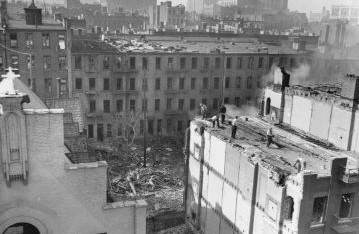
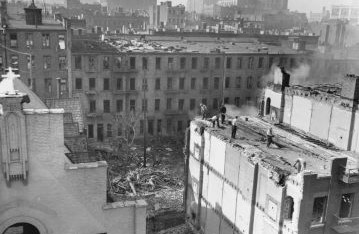
The location’s reputation dates back to the 19th century when it received its now famous moniker in an allegedly offhanded comment by a veteran policeman who declared the region too mild to be hell and dubbed it Hell’s Kitchen. But Richard O’Connor, in his book on this area of Manhattan, argues that “the less picturesque probability is that the designation was imported from England,” where a section of London “noted for its crime and disorder once was called Hell’s Kitchen…” English immigrants could have carried the name with them.
Either way, the name stuck for this location, whose indeterminate boundaries as part of the Middle West Side are just as elusive as the origins of its designation. Hell’s Kitchen’s “outermost limits allowed by anyone are Twenty-third to Fifty-ninth Street,” according to O’Connor. But what had once been a placid setting of cobbled streets surrounded by rolling meadows until 1855 slowly transformed into what A.E. Larsen says on his website An Historian Goes to the Movies has been described as “the most violent area on the American continent.”
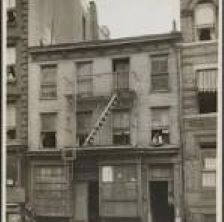
Over the late 19th and early 20th centuries, the region was populated by criminals sporting colorful names such as Duke of the West, Battle Annie Welsh and Parlor Mob, aliases that might have been at home in an early Daredevil comic book. Even the events surrounding Clubber Williams, a police captain who, O’Connor reports, overlooked the pleas of residents to shut down the brothels in Hell’s Kitchen and who collected his share of the profits from the trade, aren’t too unlike the exploits of Kingpin. The irony that Williams was opposed by a Catholic priest wouldn’t be lost on anyone reading the current Daredevil comics.
It was Stan Lee who fashioned Matt Murdock from Irish stock, and it was an appropriate choice considering Daredevil’s geographic center. By the 1860s, O’Connor reports, 203,000 Irish were already settled in Manhattan, including Hell’s Kitchen. Over the course of the first half of the 20th century, many Irish were working as longshoremen on the West Side docks and warehouses. But residents were unaware at the time that factors would conspire to affect the region financially. Larsen reports that “by the end of the 1950s, Hell’s Kitchen was in decline economically. Developments in the shipping industry led to the decline of the West Side docks and a consequent rise in unemployment in the area.”
According to Paul Young, in his study Frank Miller’s Daredevil and the Ends of Heroism, as of 1963, while the Man Without Fear’s debut was being planned, the location’s reputation “was still mixed enough that New Yorkers would probably have recognized Hell’s Kitchen in Daredevil #1 from Battlin’ Jack’s working-class Irish vibe and the hardscrabble look of Everett’s location drawings.” But as the decade wore on and the 1970s emerged, the era, Larsen reports, “saw the area drop into poverty, squalor, and many of the associated social ills that come with poverty.”
The economic downturn and increased crime rate helped trigger a real-life backdrop for Miller’s Daredevil narratives. As former Marvel Comics editor Axel Alonso explained to NPR reporter Neda Ulaby, “In Marvel comic books, Hell’s Kitchen sort of functioned as Mean Street Central, the underbelly of society, the place where there are predators and prey.”
Matt Murdock was born into a semblance of these conditions, the son of a boxer who moonlighted for organized crime by collecting or prompting payment of overdue debts. According to Ben McCool’s techtimes.com article on Daredevil’s geographic setting, Jack is a product of his environment and era, “an uneducated Irish man” with “few opportunities other than manual labor, and being a prize fighter might have been a way to make extra money or earn more money than being a longshoreman.” Jack’s insistence that Matt devote himself to study is his way of securing the boy’s escape from from the grasp of Hell’s Kitchen, a plan that fails the moment he is killed by the mob boss for whom he works, prompting his son to exact revenge.
A year after Daredevil’s 1964 debut/origin story, McCool reports, the real-life “Hell’s Kitchen was the home-base of the infamous Westies gang, comprising of Irish American ruffians and members of the Gambino crime family. Murder, theft, liquor, drugs, extortion, gambling…the Westies were the ‘hood’s iron-fisted overlords of all things immoral. Their reign of terror lasted right up until the 1980s, with the RICO convictions finally stripping the gang of its power and influence.”
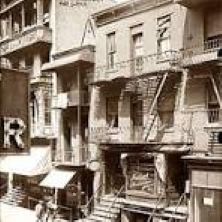
These changes opened the door to the gentrification of Hell’s Kitchen. “The blue-collar Irish American and Latino families were mostly displaced by a more affluent group of residents living in new or refurbished apartments,” Larsen writes. NYC housing costs prior to the launch of the Daredevil’s comic title consisted of an average monthly rent of $200, the techtimes.com article reports, “but you could find housing for less: According to millersamuel.com, a three-and-a-half room apartment on East 92nd Street was going for $95 p/m in October 1960.”
As Hell’s Kitchen entered the new century, “the average household income in the district was around $72,000, nearly twice what it had been in 1990,” Larsen notes. “After 9/11, new zoning laws allowed high rises to replace most of the strip clubs.” But the changes that have infiltrated Hell’s Kitchen don’t and, realistically, can’t apply to the location’s portrayal in the current crop of Daredevil comics and television adaptations because, as comic book writer, historian and New Yorker Fred Van Lente told Ulaby in 2017, “superheroes defending Hell’s Kitchen as it is now, filled with rich people — that’s not a good look for superheroes.”
The result is that Miller’s depiction of that region of NYC has been frozen in time, preserved as the set on which the play and players of each Daredevil narrative spin their tales without comment on inaccuracy or revisionism. The continuation of a now archaic Hell’s Kitchen is not only acceptable, it’s expected and it’s necessary. As Spectrum has commented, the location provided Miller during the late 1970s and early 1980s a backdrop in which “dormant villains like Kingpin & Bullseye are reimagined as the type of sinister sociopaths that thrived on the city’s disorder, people transform and become severely damaged by the surrounding world like Elektra, and our hero is right in the eye of the storm.” That’s where a portion of the power of the Daredevil narrative derives, almost as if it’s a primary character in the tale despite its makeover in the real-life NYC location.
As such, Hell’s Kitchen has become a state of mind for the Man Without Fear’s comics, a location filled with equal parts historical legacy and foreboding mindscape, a wider palette from which to paint the portraits necessary for the story arcs. In discussing the Netflix Daredevil series, Spectrum warned viewers that, “you are going to see a fictitious version of New York City,” but that fiction has prevailed for decades.
Which brings us back to Chichester’s Black Armor narrative and the current Daredevil comic series authored by Ahmed, two recent storylines set decades apart yet shaped by the same unchanging physical surroundings. No matter the comic book era, Daredevil’s setting is more concerned with time than place in order for it to work properly, certainly a distinction from other Marvel titles. In that respect, its protagonist is and isn’t a part of the same universe, so that when another superhero or a visiting villain sets foot on the Man Without Fear’s turf, he or she must subscribe to the fiction of the location even if the rest of the comic book renderings of NYC have kept pace with reality.
Sources:
Constant Geographer. “Daredevil Lives Here: The Geography of Hell’s Kitchen.” constantgeography.com, 17 April 2015.
Larsen, A.E. “Daredevil: Putting the Hell Back in Hell’s Kitchen.” An Historian Goes to the Movies, aelarsen.wordpress.com, 20 April 2015.
McCool, Ben. “How Marvel’s Hell’s Kitchen Compares to the Real World.” tech times.com, 20 November 2015.
O’Connor, Richard. Hell’s Kitchen: The Riotous Days of New York’s West Side. New York: Old Town Books, 1993.
Spectrum, Marc. “Hell’s Kitchen: On the Conditions That Created Our Daredevil.” nothingbutcomics.wordpress.com, 10 April 2015.
Ulaby, Neda. “Marvel Comics Meet Reality on the Not-So-Mean Streets of Hell’s Kitchen.” npr.org, 18 August 2017.
Young, Paul. Frank Miller’s Daredevil and the Ends of Heroism. New Brunswick, NJ: Rutgers University Press, 2016.
Related Articles
Daredevil @ 60: Part 2 -The Netflix Series
Daredevil @ 60: Part 3 – The Charles Soule Run (2015-2018)
Daredevil @ 60: Part 4 – Miller’s Elektra
Daredevil @ 60: Part 5 – Born Again








 Epistrophe
Leave a comment