
November 1, 2025
James Douglas Morrison, Poet
In its August 5, 1971 issue, Rolling Stone offered reviews of Joni Mitchell’s Blue and Marvin Gaye’s What’s Going On, articles on the closing of Fillmore East and West, Traffic, the Newport Jazz Festival and Ralph J. Gleason’s appreciation of Louis Armstrong. But its cover story, comprising seven of its fifty-six pages (Gleason’s piece, incidentally, totaled eight), was an obituary and appreciation piece on Jim Morrison, who had died in Paris on July 3 that year, three days before Armstrong. A headline, direct and unadorned, read “James Douglas Morrison, Poet: Dead at 27.”
For the previous six years, Morrison, in his personae as singer and Lizard King, had risen to fame as lead vocalist with the Doors and was attached to all the compliments and controversies surrounding the band. So, recognizing him as poet, Rolling Stone was acknowledging the identity Morrison saw for himself, despite having published only one poetry collection (The Lords and The New Creatures) in his lifetime.
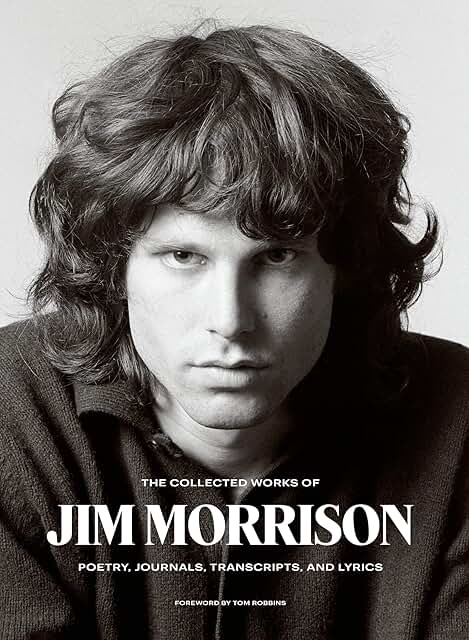
In Jeff Finn’s 2025 documentary series Before the End, available on Apple TV+, a high school classmate of Morrison’s comments, “There was never anything I can recall that led you to believe he was going to be a musician.” Another classmate discusses seeing him on a single occasion rehearsing with a band at the time, but most interviewees throughout the documentary instead note Morrison’s literary ambitions, something that was certainly affirmed in the years following his death with the posthumous publication of The American Night and Wilderness and the release of the American Prayer album. Four years ago, The Collected Works of Jim Morrison, a massive anthology of poetry, lyrics, journals and an audio companion containing his spoken word recordings, offered a testament to the extent of his literary output. And that doesn’t count the multitude of notebooks he had incessantly filled with verse from his Alexandria, Virginia high school days until his final months in Paris.
Before the End contains some fascinating interviews on Morrison’s intellectual pursuits that discuss the extensive library he amassed in Alexandria, drawings and paintings he undertook in his adolescence and his early college poetry readings in Florida. Mark Opsasnick’s sleuthing for his indispensable 2006 book The Lizard King Was Here was the first to uncover how far Morrison’s early literary interests and activities extended, and Finn is happy to expand on that.
In one sequence, the director assembles four of Morrison’s high-school classmates in the actual basement-bedroom of the future rock star’s Alexandria home and allows their dialogue to recreate those adolescent years. One of their first comments is about the number of books that once occupied the room, a total assessed by Morrison’s brother Andy in Opsasnick’s account as one thousand. During his Florida shoot, Finn talks to junior-college and university acquaintances and even an educator, who discusses how his pupil redesigned a three-essay assignment into one long study that incorporated Hieronymus Bosch into the mix.
Finn’s documentary was said to be completed in 2016 before the director discovered the mysterious Frank X, who he believes to be Morrison living out his days in obscurity after faking his death fifty-four years ago. Finn began focusing on Frank, a decision, he admits, that earned the derision of some fans, and the not-so-complimentary attention of the media. The New Yorker even titled its article on the documentary “Why Do We Want to Believe Jim Morrison is Still Alive?” It could be that after over a half-century, those interested in Morrison have settled into an acceptance of his death and don’t appreciate a revival of the Jim-Isn’t-Dead theorizing. The fact is, when not trying to prove his thesis on Frank X by connecting the most tenuous of dots, Finn offers a rather watchable documentary on Morrison’s early years through informative present-day interviews with friends and former classmates conducted in Alameda, Alexandria, Los Angeles and other locations.
What’s notable about Before the End is that it joins a series of books about the Doors’ frontman published over the last two decades that indicate a proper study of Morrison-as-artist now demands a specialized look that needs to be distanced from biographical tomes such as No One Here Gets Out Alive, Break on Through: The Life and Death of Jim Morrisonand Jim Morrison: Life, Death, Legend. Unlike the current crop of studies, each of these biographies are premised on the singer’s myth, their narratives derived from a larger-than-life perspective associated with his role as lead singer of the Doors.
The more recent studies have been bold enough to largely divorce Morrison from the Doors and focus more intently on his individual accomplishments. Books like The Lizard King Was Here, Fabrizio Federico’s The Genius of an Unsung Filmmaker and William Cook’s Gaze Into the Abyss: The Poetry of Jim Morrison are all comfortable enough to focus on a particular facet of his intellectual life, whether it be his early influences, his studies/work in the film medium or his poetry.
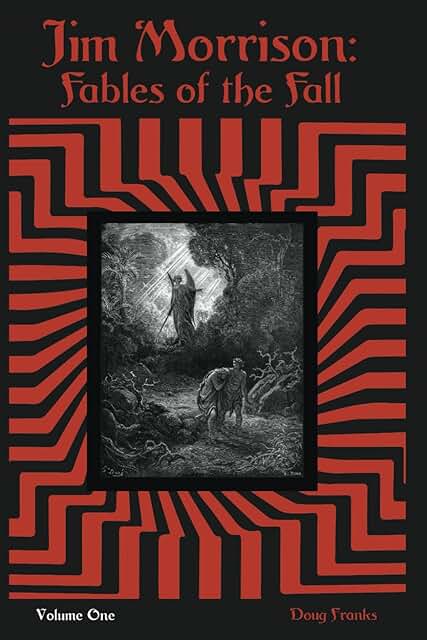
Doug Franks’s Jim Morrison: Fables of the Fall is the latest addition to this collection. A two-volume set released in January, it boasts over 900-pages of evaluative text and a meticulous study of the intricacies and labyrinthine nature of Morrison’s poetry and lyrics. It’s probably safe to say its arrival is something at least a small circle of fans has been anticipating for five decades.
Filled with interpretation, background information, passages from the unreleased Paris notebooks and an interlocking study of the material, Fables of the Fall is a very readable, comprehensive study of Morrison as poet, thinker and philosopher. Simply reading through the notes of each volume can’t help but engender a realization of how little of Morrison’s literary backdrop and design has properly been examined previously.
Earlier books have acknowledged the works of Nietzsche, Rimbaud and Blake as an influence, but Franks identifies a wider range of writers, including Proust, Camus, Nin, Faulkner, Goethe, Celine, the Beats and James Frazer, as well as filmmakers like Godard, Truffaut, Rohmer, Brakage and Bunuel. He provides more specific connections between influences and Morrison’s work. He notes practices like Morrison’s early penchant for copying passages from his readings into his notebooks. And, most importantly, Franks avoids misconstruing interpretation with fact by clearly identifying any hypotheticals or presumptions he discusses.
If this is the future of Morrison studies, it’s a promising direction. When, ten years after Morrison’s passing Rolling Stone followed up its 1971 obituary, it was with a cover story reading, “He’s Hot, He’s Sexy and He’s Dead.” With fifty years’ worth of such muddling to amend, it’s not too soon to augment the most recent investigations into the man’s work.
Related Article





 Epistrophe