
April 1, 2026
Roberto Bolano’s Labyrinthine Fictions

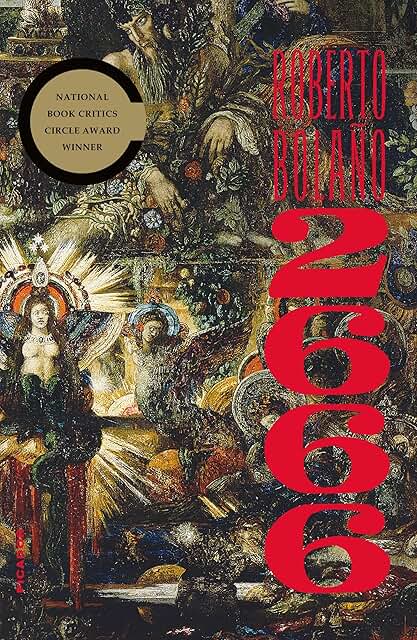
In the second part of Roberto Bolano’s magnum opus 2666, “The Part About Amalfitano,” a character discovers himself in possession of a book on geometry he does not recall purchasing. On page four, “where the publisher’s information usually appears,” he finds a photograph “that looked as if it was taken at the end of a party.” Eight men are seated at a table and identified by name, friends of the author who made the publication of the mathematics book possible. The character notes that the surname of each friend is rendered in upper case whereas the author’s is presented in lower case.
The moment is an echo of Bolano’s “Labyrinth,” a short story that first appeared in the New Yorker in 2012 and in the collection The Secret of Evil the same year. In the magazine’s layout, the text is preceded on the page by a photograph of eight French intellectuals, circa 1977, seated at a table, most of them staring at the camera. The story, which opens with a discussion of the photo and its subjects, correlates appropriately to the conundrum that is Bolano’s fiction.
The Chilean author died in 2003 at the age of fifty having just completed 2666. In a 2010 entry on her website, poet/songstress Patti Smith wrote that he “knew he was going to die and that his child, the prophet masterpiece 2666, would be condemned to totter out into the world without him.” It stands to reason Bolano would be proud of his creation, already declared at the age of twenty-one a candidate as one of the best books of the new century.
At 900 pages of non-traditional narrative and unconventional characterization, it’s a notable achievement. And its allure is unmistakable. In another entry on her website, Smith describes breakfasting while reading the novel at her usual New York City eating establishment, waiting for her table to be cleared, her excitement to “plunge right back into the abysmal pool of 2666” palpable. “I sit on edge as the plate with toast crumbs is somewhat laconically removed and then at last, readjusting my sitting position, I crack open 2666…” The passage rather accurately describes what it’s like to read Bolano, to be “permeated” as she calls it.
What “Labyrinth” reveals about 2666 and other works by the author is the fine line between real and unreal, non-fiction and fiction. After introducing the eight individuals featured in the photo through a fairly even mix of fact and personal opinion, Bolano begins to interpolate, despite the inability of anyone to discern the lives, relationships, secrets and desires from the visages in a photograph or to identify the persons or objects just outside the frame commanding the gaze of several people in a picture. Bolano, nevertheless, crafts a story for each individual, innocently suggesting, for example, that what can’t be seen outside the frame are people, then naming them (“let’s call these two beyond the frame X and Z”) and finally bringing them to life so that they connect to someone in the photo. His language conjectures for a while (“he may well be,” “maybe,” “let’s say,” “we can imagine”) before it becomes more definitive, more assertive (“he has never seen the others in his life,” “what we can’t imagine or justify in any way”).
As we are directed by an unfolding tale interpreted from a decades-old black-and-white photograph of eight people caught in the context of a moment about which we know nothing, the author slowly crafts his account into an unreality devised by himself, a fiction devoid of any objectivity once the introductory paragraphs are complete. Yet, Bolano’s exercise, which some believe is meant as a joke, is accurate in portraying the fiction we impose upon each other as humans. It’s how we cope, how we formulate an identity for others to explain the differences between us and them or, failing that, assuage ourselves with the notion that they were never what we thought. Fiction occurs everyday within perception; Bolano is simply exercising that perception. We can call it the fiction of the average person and, accordingly, 2666 is filled with fictions created by characters about characters.
Within its first section, “The Part About the Critics,” the novel follows four literary scholars whose primary focus is on the fictional German writer Benno von Archimboldi. We learn of some of his novels’ titles and small pieces of his background, but any overview of his life and works is withheld, much as they are in “Labyrinth.” The result, as Hilton Als assessed in a New Yorker review of a stage adaptation of the novel, is that “the absence of Archimboldi’s texts only makes him loom larger,” almost as if he is composing the scholars’ existence, their friendship and their elitist critical thinking in lieu of his own.
When a report surfaces that Archimboldi had once been sighted in Mexico, the four embark on a journey, what Chris Andrews calls “an intellectual quest,” during which they fall back on fictional constructs as their search “loses its urgency,” failing to ascertain the author’s presence there. It can be said the same applies to their relationships as well and to other characters who frame themselves and others within fictions throughout the novel, in some cases denied resolution or catharsis much like “Labyrinth’s” characters. As Andrews suggests, “Bolano’s work as a whole is loosely woven and abounds in loose ends: stories stop without concluding and gaps within them are left unfilled.” It’s as if these works are never meant to resolve so that characters are allowed to continue in other writings and, posthumously, in the imaginations of readers.
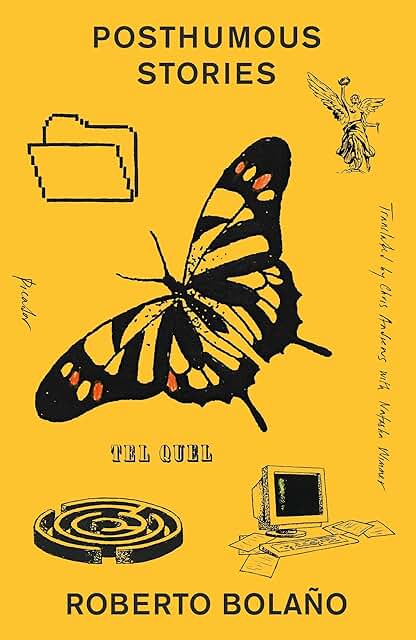
The idea isn’t as outrageous as it might sound. In the short story “The Secret of Evil,” Bolano breaks the fourth wall, telling the reader the tale is “incomplete, because stories like this don’t have an ending.” The collection of writings published under the title The Secret of Evil and republished last year by Picador as Posthumous Stories contains works found on the author’s computer in various stages of completion and are quite effective. According to Daniel Zalewski, prior to his death, “Bolano asked his editor to publish the five sections of 2666 individually” to accommodate an inheritance for his children. It wasn’t, but it would have been apropos if it had since the tales of each section “don’t have an ending.”
In her 2015 book M Train, Patti Smith writes, “If only he could have been given special dispensation, been allowed to live. For 2666 seemed set up to go on forever, as long as he wished to write.” Four years later, she told The New York Times Book Review that her idea of a dinner party with literary greats would take place over the course of a day. “I would invite Roberto Bolano over in the morning,” she said, explaining that their meeting would be accompanied by Glenn Gould’s rendition of The Goldberg Variations. “We’d drink coffee and talk about his daily practice, or whatever he wanted to talk about. Then I’d ask him the literary question of the 21st century: ‘How would 2666 have played out if he had lived long enough to keep it going?’”
Giles Harvey, in his user’s guide to reading Bolano published in the New Yorker, cautions readers to “avoid 2666 for as long as possible, and for heaven’s sake, don’t start with it. The book is a desert of negative space across which the panting reader will search in vain for the traditional pleasures of the novel: form, character, coherence, meaning.” A better suggestion would be to pick it up, read about ten pages and determine if you can put it down. If you can’t, you’re ready for Bolano.
Notes
Als, Hilton. “Bookworms.” The New Yorker, 21 February 2016. retrieved from newyorker.com.
Andrews, Chris. Roberto Bolano’s Fiction: An Expanding Universe. New York: Columbia University Press, 2014.
Bolano, Roberto. “Labyrinth.” The New Yorker, 15 January 2012. retrieved from newyorker.com.
Harvey, Giles. “In the Labyrinth: A User’s Guide to Bolano.” The New Yorker, 18 January 2012. retrieved from newyorker.com.
Smith, Patti. “2666 (part I).” Patti Smith, 10 January 2010. retrieved from pattismith.net.
Smith, Patti. “2666 (part II).” Patti Smith, 5 February 2010. retrieved from pattismith.net.
Smith, Patti. “By the Book.” The New York Times Book Review, 8 September 2019, 8.
Smith, Patti. M Train. New York: Alfred A. Knopf, 2015.
Zalewsky, Daniel. “Vagabonds .” The New Yorker, 19 March 2007. retrieved from newyorker.com.
Related Articles






 Epistrophe
Leave a comment