
September 20, 2025
Clown Town: Past, Present & Pitchforks
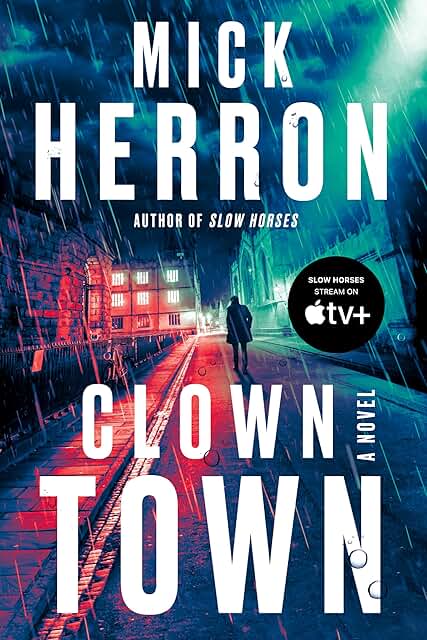
The past is quite adept at creeping into Mick Herron’s Slough House tales, as if a standing invitation has been offered, particularly in its most recent appearances in the tangentially related Secret Hours and now Clown Town. It always carries with it a fiercely tenacious hold on memories best left buried and of deeds preferably abandoned to the dustbin. But for a contingent of spies, including the team of slow horses that have become Herron’s trademark, the past is yet another challenge.
Spies are never who we think they are, and who they actually turn out to be is a series of others. But time wears down the identities, the subterfuge, the game itself so that old spies, as Herron postulates, “can grow ridiculous. Old spies aren’t much better than clowns.”
Early in his new novel, Herron asserts that “spying is other people,” an oblique reference to Sartre’s “Hell is other people.” The truth is that a melding of the two constitutes what Clown Town is about – “Hell is other spies,” all of whose lives, the author maintains, “end in failure,” which sometimes is engineered by those pulling the strings within the network.
The slow horses have already arrived at their failures over the course of the previous eight books in the series, living out the remainder of their careers in a pointless capacity that is the limbo of Slough House. They are regularly reminded of it by their leader, tormentor and protector Jackson Lamb, although he would deny that third category. They are also bound to the mistakes that landed them at Slough House and, for that, they, too, are prevented from escaping the past.
When it’s discovered that the personal library of the late David Cartwright acquired by Oxford University is missing a book from the collection, one that doesn’t actually exist, it sets off a chain of events that includes the unofficial reassembling of a retired MI5 team, whose past endeavors, codenamed Pitchfork, and whose current activities rally the efforts of the slow horses, sweeping them into the proceedings. The novel juxtaposes the loyalties of the older, seasoned Pitchfork team against those of the younger, sullied slow horses, who are possibly “looking to fill the void where their jobs used to be, back when they felt useful,” creating a whole other level of intrigue inherent in a spy system.
At one point, Herron discusses a character who “never believed that history should be preserved as it was,” that “history was still happening, and with careful tending might produce new shoots.” Clown Town is about what happens when those shoots begin to grow, when the past’s secreted moments impinge upon the present. We’ve witnessed it before in the Slough House series, arguably best executed in Spook Street, but this time Herron blurs the line separating morality from its darker counterparts.
“Spies lie, spies betray,” the novel intones. And they do, prior to the moment things go wrong, as they do in Clown Town, and afterwards, as well, to redeem or to avenge or simply to subvert the failure facing all spies in the end.
As the ninth of the Slough House novels, Clown Town is the latest representative of how the series is evolving its universe into a darkening complex system that serves the mystery/spy genre well. Add in the John Bachelor novellas, the related short stories and Secret Hours and it’s an impressive collection of fiction awaiting its next installment.
Related Articles








 Epistrophe
Leave a comment