
December 1, 2025
“Riu Chiu” – The Story Behind the Monkees’ 1967 Christmas Cover
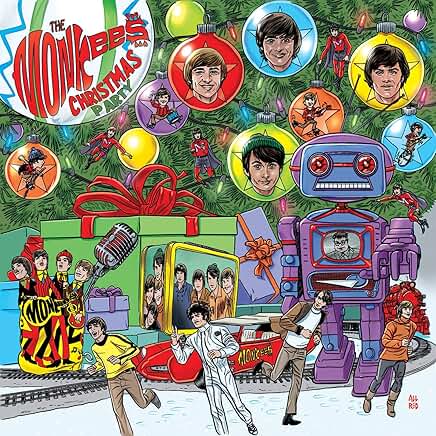
Back in its heyday, the Monkees, the 1960s band that began life as a television creation and, in a Pinocchio-like turn, became real, never released a Christmas album or single. Granted, its popularity occurred within a lightning-fast two-year period, but there was a trend of holiday releases by hit-makers at the time. That was finally rectified in 2018 with the release of Christmas Party, one edition of which features a bonus track of a song that could have been a Christmas single back in 1967.
Christmas Party consists largely of a mix of Micky Dolenz-sung material penned by current songwriters and some standards such as “The Christmas Song” rendered by Mike Nesmith and a sparse banjo-guitar arrangement of “Angels We Have Heard on High” by Peter Tork. There are even Davy Jones tracks, “Mele Kalikimaka” and “Silver Bells,” the vocals for which appear to derive from around 1967 when Chip Douglas was producing the band, indicating Christmas material was on the agenda at the time. And then there are bonus tracks found originally on the Target Exclusive release of the CD that include a 1967 recording of a song called “Riu Chiu.”
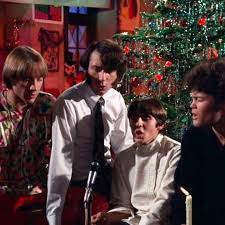
The song hasn’t had a high profile during the holiday season, but it once received national attention when, in 1967, it was featured during the second season of The Monkees’ TV series in an episode entitled “The Christmas Show.” The episode’s storyline, a take on the familiar Scrooge tale, isn’t one of the more memorable installments in the NBC series, but in the final moments of this sitcom’s holiday offering, all four Monkees are seen singing (or, more accurately, lip-synching to a pre-recorded track completed on August 24, 1967) a version of “Riu Chiu.”
How a centuries-old song wound up in a Monkees television episode has a lot to do with chance and the folk music revival of the early 1960s. “Riu Chiu” is classified as a villancico, a Spanish form of poetry and music derived from dance that was popular from the 15th to 18th centuries. Secular at first, the villancico was adapted to religious services in the 16th century. Its eventual decline during the 20th century reduced its designation to simply “Christmas carol.”
“Riu Chiu,” also known by the title “Riu Riu Chiu,” exists as part of the 1556 collection Cancionero de Upsala. The title, which forms part of the song’s refrain, is comprised of nonsense words meant to mimic the sound of a bird, reputedly a nightingale or kingfisher. The tune opens with the refrain, which is then repeated after each of its three verses. The Spanish lyrics reference the Virgin Mary, the birth of Christ and singing angels who carry the word of Jesus’s birth to shepherds.
Despite the disregard of the villancico by the 20th century, the folk group the Kingston Trio recorded the song in 1961 as “Guardo el Lobo,” a reference to the wolf mentioned in the first verse of the piece. Three years later, the Modern Folk Quartet (MFQ) restored the song’s original title when it included a version on their album Changes.
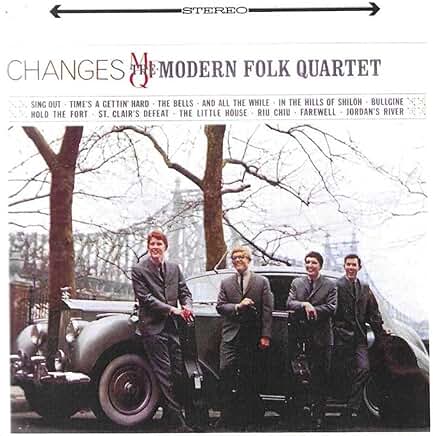
The guitar-banjo-vocal sound of the MFQ was well-known at the time, yet the quartet’s version of “Riu Chiu” is a beautiful choir-like a cappella arrangement. Only two of the three verses are sung, and background harmonies accompany the lead vocal on each verse.
MFQ bassist Chip Douglas (born Douglas Farthing Hatlelid) had crossed paths with Nesmith and Tork in the early 1960s at the Los Angeles club The Troubadour. Douglas told Flip magazine they “were both fans of the MFQ.” According to a Facebook post by music writer John Einarson, Nesmith approached Douglas about producing the Monkees in 1967 following the band’s decision to take control of its musical direction, which began with the dismissal of Don Kirshner, who had shepherded the songs on the first two albums by the group.
Douglas produced the Monkees’ Headquarters, the first album on which the band’s instrumental contributions can be heard on every track. Recorded in a six-week period, Headquarters benefitted from Douglas’s production, song contribution and bass playing, making good on the group’s declaration of independence.
In a 2009 interview I conducted with Tork, he described recording Headquarters as “a lot of fun,” adding, “I was thrilled to be able to do it. To me, one of the great aspects of The Monkees’ story is that we did do that and became a superior stage act. We became so much more in command of what we were doing and cranked out stuff that as far as I’m concerned is every bit as good as the early stuff.”
It was during work on the next project, originally titled At Random but released as Pisces, Aquarius, Capricorn & Jones, Ltd., that Douglas introduced the band to “Riu Chiu.” The main sessions for this album were conducted at RCA Studios in Hollywood, with overdubs and mixing in New York City and Nashville while the band was touring. Pisces, Aquarius, Capricorn & Jones Ltd. is generally considered the Monkees’ masterpiece, a tightly woven, cohesive collection of songwriting gems in a wide range of genres that Monkees authority Andrew Sandoval says “exhibit[ed] their growing consciousness as artists.” The hit single “Daydream Believer” comes from its sessions. Even its outtakes, like the single b-side “Goin’ Down” and “Riu Chiu,” are top-quality achievements in the group’s catalogue, the latter earning praise as “one of the most powerful songs they ever committed to tape” from Scot P. Livingston in his book The Monkees: A Many Fractured Image.

The a cappella arrangement of “Riu Chiu” recorded by the Monkees under their producer’s guidance bears a striking resemblance to the MFQ two-verse rendition. However, Sandoval’s research years ago revealed there had been subsequent attempts by Douglas in September and October 1967 to re-record the song. In one instance, the vocalists were Nesmith, Dolenz, Tork and Douglas, a version of their recording appearing in 1990 on the now-out-of-print Missing Links Two album. Meanwhile the TV version of “Riu Chiu” appeared in 2007 on the deluxe CD edition of The Monkees’ fourth album and the 2018 limited release of Christmas Party.
In fall 2025, the TV version made yet another appearance on the long-overdue Pisces, Aquarius, Capricorn & Jones, Ltd. Super Deluxe box set from Rhino. But two previously unreleased takes and a Session track offers more insight into its history and the Monkees’ performances. We finally get a peak at the September session in which all four Monkees reassembled to attempt another take of the tune. This time, they sound more comfortable and Dolenz delivers a more subdued lead vocal, testing the parameters of the song.
The October 3 studio date, with Douglas replacing the absent Jones, has the best representation on the set, with a Session track that demonstrates how they’re tinkering with the arrangement, doing a heavier vocal approach before revisiting the gentler style, turning corners very comfortably and gracefully throughout. It’s apparent they know the song extremely well by now, enough so to move from one approach to the other and execute each proficiently. There is the expected goofing around and flubs, but their ability to deliver perfect harmonies jump at the count-off is impressive. They talk about wanting to get a complete live take, presumably to eliminate any touch-ups afterwards. The alternative complete take from October 3 is a companion piece to the Missing Links Two track from the same session. This arrangement has a return to the unison vocals on the chorus near the end before resuming full harmonies to bring the song to its conclusion.
The most curious version of the song on the set features just Nesmith and Douglas singing all parts. It bears the closest resemblance to the MFQ rendition, with background harmonies behind the lead vocal during the verse section. But the track is unique in that it includes handclaps. The box set booklet dates this session to late 1967, but Sandoval’s liner notes conjecture that this recording was made “perhaps as a prelude” to the other versions with the rest of the Monkees. If that’s correct, it would pre-date the August TV rendition, and the fact that it contains only one verse and is only about a minute long lends credibility to the theory that it was meant as a blueprint. (Interestingly, MFQ took to performing a one-verse version in the 2000s.)
The additional versions of “Riu Chiu” on the set reveal that work on the song after August was not simply an attempt to embellish the original track or try to simply re-create it. There are enough subtle differences in the arrangements/performances between August and the later months of 1967 to indicate that the group had to have been interested in another version worthy of album release, possibly on Pisces, Aquarius, Capricorn & Jones, Ltd.
Ultimately, though, it’s the TV version of “Riu Chiu” that deserves its place as the preferred rendition, containing as it does all four Monkees’ vocals still exhibiting the freshness of having just learned it. It’s just one product of this fertile period for the band and its producer. In the liner notes for the Deluxe Edition of Pisces, Aquarius, Capricorn & Jones Ltd., “Douglas discussed his plans for the Monkees’ fifth album: “I was getting more ideas, you know. Then [they said], ‘Chip, we’re not working with you anymore. We’re going to do our own thing.’ It just drifted apart.” There would be five more albums by the band with slowly dwindling lineups. The group’s sound gradually gave way to solo recordings that comprised each new release. But once upon a time, the four voices that lifted a song like “Riu Chiu” to the sublime could brag about having a truly unique sound in the world of popular music.
The Monkees – “Riu Chiu” video
Home at Last’s cover of “Last Train to Clarksville”





 Epistrophe
Leave a comment