

April 15, 2024
Daredevil @ 60: The Netflix Series
When it comes to adaptation, it’s all about getting the ingredients right. For example, when transferring comic books to the realm of television and film, those ingredients require an adherence to the correct genre and loyalty to character, situation, setting, mood and, most importantly, villainy. But it’s also the right mix of new touches an adaptation adds that contributes to success.
We might want to consider the Netflix Daredevil series as a reboot of a comic book title and, as such, a version capable of paying homage to its predecessors while providing its own vision of what can be done with familiar characters and situations. Reports of an abandoned attempt last year to film new episodes of Daredevil as a legal procedural can serve as a sample of how certain new visions might be off the mark and how properly established genres/characters could be ignored. But the Netflix Daredevil series of the previous decade remains an example in which the old and the new attain a balance that is quite effective and worth a more detailed look.
The precedents of the Daredevil series begin with Frank Miller, the writer and artist who commenced his work on the Daredevil comic book in the late 1970s. Joined at one point by artist Klaus Jansen, Miller brought a new economy and sensibility to the title, creating new characters like Stick, the villainous collective The Hand and, most significantly, Elektra, Matt Murdock’s former-lover-turned-assassin, to create a more complex landscape of identities and personalities for Daredevil to traverse. The result was visually stunning and narratively alluring, and it propelled the title from a bimonthly publication to a monthly best-seller.
James Kelly noted in 2015 that “Frank Miller was able to breathe life and vitality to characters that had been mostly forgotten by not only fans of Marvel, but the company itself. His work brought a maturity and elements of storytelling found in novels to comics.” One of the reasons for that clearly stemmed from the writer/artist’s background. Miller told Comics Feature in 1981 that his influences extended beyond the realm of comic books, including crime stories in the form of detective novels, films and television, particularly the police procedural Hill Street Blues. “There are storylines that develop over four or five episodes,” he said of the TV series, “but each episode still has a complete story. But the continuity makes you come back each week…I think it’s revolutionary for series television, because it has characters developing throughout it…”
Acknowledging the influence of Miller’s source material, Paul Young, in his study Frank Miller’s Daredevil and the Ends of Heroism, notes that “the difference between Daredevil and the contemporaneous soap-and-space opera that was X-Men…might productively be boiled down to Miller’s focus on the conventions within the genre in which he worked…Miller was not making superheroes more realistic…he was exploring the internal makeup of the superhero genre, poking around for contradictions and paradoxes, with the similarly styled ‘realist’ genre of crime fiction as his probe.”

Miller’s take on Daredevil and his alter ego was unique. He told Comics Feature that “it’s an essential part of Daredevil’s character that he’s a lawyer – a defense lawyer, particularly. It’s something I had a hard time dealing with when I first worked on the character, because my first reaction was, “He should be a prosecutor, he hunts down criminals,” but it became clear to me at one point…that Murdock’s concern – and Daredevil’s concern – is with the victim of crime, not the criminal.” In the same interview, Miller referred to Daredevil as “probably the most Christian of superheroes, in that he loves his enemies, to some degree…” and that the Man Without Fear’s “concerns are with the right and wrong of the world around him.”
Those three concepts as components of a single superhero offer a wide range of character exploration that the Netflix series utilized. Steven S. DeKnight, showrunner for the series, told Travis Langley and Jenna Busch that “in our season 1, there’s a massive amount of guilt that [Murdock] feels for his father’s death…He’s driven to help people, and I think him getting hurt is kind of a bit of self-flagellation. It’s the penance he’s paying for what he’s doing.” Craig Ambegoda wrote that the show’s second season, “proved that Daredevil is the best balance of order and chaos in Hell’s Kitchen.” And, in 2018, lead actor Charlie Cox described Daredevil’s character arc in the third season in the following way: “He’s gone to a darker place than he ever has before, and we get to rebuild him over the course of the season.” All of these assessments derive from the foundation Miller provided for the character in the pages of Marvel Comics.
Netflix’s Daredevil contains plenty of traces from Miller’s various runs, from single moments (like a rooftop scene with Punisher from Vol. 1 #183) to a retelling of his 1993-4 origin tale “The Man Without Fear” to a reworked version of his 1986 “Born Again” story arc as the series’s third season. Its depiction of Wilson Fisk, a.k.a. Kingpin, as the Devil of Hell’s Kitchen’s main adversary is straight from Miller’s pages. Its final-season treatment of the psychotic killer Bullseye, whom Kelly credits Miller with transforming into “an unstoppable and irredeemable force of evil,” can be found in his finest issues during his initial run. Both villains had debuted prior to Miller’s arrival, but both became who they are within his purview.

The origins of other characters populating the series, like Karen Page, Foggy Nelson, Ben Urich and Turk, can be traced back to the earliest periods in the comic title’s history. Most interesting is how prominent Karen is, since she wasn’t featured in Miller’s initial Daredevil run, having disappeared from the comic, save for one appearance, from 1972 to 1986. She was reintroduced by Miller at the start of the “Born Again” narrative as the catalyst who triggers Kingpin’s assault on the life of Matt Murdock and his alter ego.
In addition to the influence of Miller, elements of other writers and artists can be seen in the Daredevil series. The use of a sort of armored costume, although not as elaborate as the 1993 “Fall from Grace” storyline or the recent Black Armor comic book series, can be traced back to D. G. Chichester, as can Foggy and Karen’s belief that Murdock is dead at the start of the third season just as they were at the beginning of the “Tree of Knowledge” story arc.
The incorporation of several of Chichester’s contributions to the ongoing Daredevil narrative is particularly appropriate considering he was the writer to pick up the Kingpin’s tale in the early 1990s. As Julian Darius observed in his essay “What Fall from Grace,” Chichester’s “The Fall of the Kingpin” storyline, which completed the “Born Again” concept “represented the fulfillment of the narrative threads Miller had left. Daredevil readers who began with Miller could have stopped with issue #300 and felt like Miller’s story had come to some sort of completion.”
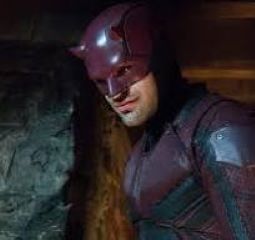
In his book, Young discusses Miller’s philosophy of art, explaining that “rules, whether self-imposed or forced from without, make artists work harder to invent new complications and dynamics without breaking them.” Akin to that thinking, the TV series was being designed to lay outside the norm of TV and, like Miller, the producers and filmmakers were ready to draw from a variety of sources both within and outside the realm of comic books. Cinematographer Matthew Lloyd told Noah Kadner that Daredevil’s producers “were looking to create something outside of the typical scope of broadcast. Showrunner Steven DeKnight said they really wanted to push the boundaries…” And Director Phil Abraham told Kadner in 2015 that, in preparation for filming, he and Lloyd “looked at many of the classic New York street movies for reference and inspiration, like Taxi Driver, Dog Day Afternoon, The French Connection…[and] a British vigilante crime film, Harry Brown…[which] has a lot of visceral camera movement and stylistic lighting…”
DeKnight, in 2018, identified that the look of the series was based on Alex Maleev’s art from the early 2000s comics penned by Brian Michael Bendis. “We really wanted to bring that down-to-earth realism to the character,” he explained. The same year, Cox, in turn, called the first season “very down-to-earth and gritty, boots-on-the-ground type storytelling, and maybe a little bit broody at times…”
Discussing the adult nature of the Daredevil TV show, Cox explained in 2016 that “the reason that I think Daredevil works so well as a PG-16 or an R rated, or whatever we like to call it, is because it suits the source material that is most beloved, and talked about, and remembered. I’m thinking of course of Miller’s “The Man Without Fear,” “Born Again” obviously the Bendis/Maleev run, and the Brubaker/Lark stuff. All that stuff definitely seems to be geared toward a slightly older audience in the comics and therefore translated well to the TV show when the tone is maintained.”
In addition to establishing the show’s dark palette in the first season, the filmmakers distinguished between past and present moments, Abraham said, by “being mostly handheld in present time while the flashbacks could be a little more rooted on traditional dollies or a crane.” They also concocted captivating fight sequences, including the first of the extended continuous takes that would appear throughout the series, something that earned the show some well-earned attention.
What the designed choreography and editing of each hand-to-hand fight conveys isn’t much different from Miller’s explanation that, when drawing a fight scene in comics, “sometimes reality just doesn’t work on the page…” In order to translate a punch in a comic book panel, the artist is required to render the feeling of the physical contact, “to stylize and exaggerate the gesture of the figure that’s punching and what effect a punch has on the other body…the visual has to represent the feeling.” Fight scenes in the TV series embrace the same philosophy from the staging to the cutting in order to produce a moving set of panels much like the kinetics of Miller’s pages.
Young comments in his book about Miller’s work on Daredevil that “I relish the atmosphere of the Netflix series and admire its determination to recreate the clarity of mood and action that Daredevil might never have acquired without Miller’s intervention, even if it doesn’t entirely succeed.” Young, whose book was published prior to Daredevil’s final two seasons, characterizes Netflix’s Murdock as “much angrier” than Miller’s and as “a bringer of vengeance pure and simple,” but such criticism tends to overlook the necessary alterations required to fulfill a new vision, which in this case is faithful to and compatible with its source material. Kelly’s assessment that “Miller’s Daredevil has his principles, but Miller introduces doubts that his hero will remain a paragon of virtue” is exactly what invites a plausibly angrier “bringer of vengeance” in the Netflix series.
Cox, in discussing the third season of Daredevil, said, “one of the themes of this season is how fear can lead people down a path that is very destructive and painful and encourage people to behave in ways that are not very conducive to their own happiness or the happiness of others.” Such a theme and its development over thirteen episodes is fittingly reminiscent of Miller’s description of his purpose on the Daredevil comic nearly forty years earlier: “I’ve been hired to do morality plays that children can read for Marvel Comics, and I’m having a great time doing them the way I’m doing them. They don’t have to be shallow.”
Notes
Ambegoda, Craig “A Look at Daredevil, Season Two.” Sequart Organization website, 4 April 2016. Retrieved from sequart.com.
Darius, Julian. “What Fall from Grace? Reappraising the Chichester Years” in The Devil is in the Details: Examining Matt Murdoch and Daredevil, Ryan K. Lindsay (ed.). Edwardsville, Il: Sequart Research and Literacy Organization, 2013.
Dibdin, Emma. “Daredevil: Charlie Cox has Mixed Feelings about Matt’s Finale Decision.” Hollywood Reporter, 22 October 2018. Retrieved from hollywoodreporter.com.
Howell, Richard and Carol Kalish. “An Interview with Frank Miller.” Comics Feature #15, December 1981.
Kadner, Noah. “Without Fear.” American Cinematographer, May 2015, 58-67.
Kelly, James. “Frank Miller’s Daredevil Saga, Parts 1 & 2.” Sequart Organization website, 6 January 2015. Retrieved from sequart.org.
Langley, Travis and Jenna Busch. “Interview with Marvel’s Daredevil Executive Producer Steven S. DeKnight: Running the Show in Hell’s Kitchen” in Daredevil Psychology, Travis Langley (ed.). New York: Sterling Publishing Co., Inc., 2018.
Walker, Glenn. “Interview with Daredevil’s Charlie Cox.” Biff Bam Pop, 17 March 2016. Retrieved from biffbampop.co.
Young, Paul. Frank Miller’s Daredevil and the Ends of Heroism. New Brunswick, NJ: Rutgers University Press, 2016.
Related Articles
Daredevil @ 60: Part 1 – Hell’s Kitchen
Daredevil @ 60: Part 3 – The Charles Soule Run (2015-2018)
Daredevil @ 60: Part 4 – Miller’s Elektra
Daredevil @ 60: Part 5 – Born Again







 Epistrophe
Leave a comment