
October 1, 2025
The Geography of Neil Young
“What a pity that the people from the city can’t relate to the slower things that the country brings.” – “Here We Are in the Years”
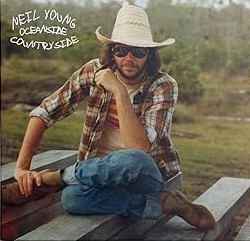
“I just don’t like to stay in one place very long,” Neil Young once told Rolling Stone. “I move around, I keep doing different things.” The statement can be interpreted as meaning his shifting residences in the second half of the 1970s as well as his penchant for completing albums that have gone unreleased for decades. For example, Oceanside Countryside. Its stand-alone release in 2025 is nearly fifty years removed from when it was recorded. And its history is bound to two other aborted albums in the same time frame during which Young attempted to arrive at the proper vehicles in which to deliver a prolific amount of newly written material.
The trend of abandoned albums began with Homegrown, a largely acoustic 1975 project that promised an extension of the uncommercial boundaries Young had explored since Harvest. Instead, the raw, dark and equally challenging Tonight’s the Night, recorded in 1973, was released. It reintroduced on vinyl an electric Neil Young that lasted largely through 1976 before a return to acoustic touring and solo studio work.
Indigo Ranch Recording Studio, located in Malibu, California, was established in 1974 by Richard Kaplan. In summer 1976, Young and engineer David Briggs had temporarily relocated to beach homes in the area while the former was composing and recording solo versions of songs like future Rust Never Sleeps staples “Powderfinger” and “Ride My Llama,” “The Old Country Waltz,” “Campaigner,” “Hitchhiker,” “Hawaii,” “Give Me Strength,” “Human Highway,” “Pocahontas” and “Captain Kennedy.” The last three tunes are of special interest to this article.
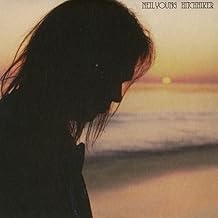
These three songs would eventually find a place on Comes a Time, Rust Never Sleeps and Hawks and Doves, respectively, but in 1976, they comprised roughly one-third of the intended track-list for the abandoned Hitchhiker album. Reportedly, the project was halted by Warner Bros. Records, which considered the tracks in need of a band.
Rather than re-recording the material, Young augmented his repertoire with new compositions, retaining “Pocahontas” and “Captain Kennedy” for yet another album, Chrome Dreams, but the May 1977 release of the more electric American Stars‘n Bars, which included no less than five songs from the Hitchhiker and Chrome Dreams projects, ended any chance of the latter’s release. Stars‘n Bars was also intended to introduce the concept of a theme for each side of the LP, absent from the actual release, but the concept would linger for Oceanside Countryside.
“In many ways, Chrome Dreams is a more powerful collection than the haphazard snapshot of Stars‘n Bars,” Jack McDonough writes in his Young biography. Johnny Rogan, calling Stars‘n Bars one of the artist’s “more erratic, uneven and frustrating records,” reports that “Pocahontas” “Ride My Llama” and “Captain Kennedy” were originally included before reconsideration. A version of the album was prepared at one point, with a track listing “almost identical” to Chrome Dreams, “albeit with ‘Homefires’ and the deletion of ‘Captain Kennedy.’”

Explaining the ‘Bars’ portion of the album’s title, Young claimed he had been spending a lot of time in such venues during this period, and throughout summer 1977 he would continue to do so, this time as a performer. Joining Bob Mosley, Jeff Blackburn and Johnny Craviotto, Young became part of the band the Ducks for the summer of 1977. The musicians with whom he was playing had been a portion of a reconstituted Moby Grape in 1974, Mosley having been one of the founding members. Three years later, the trio was performing with guitarist Eddie James as the Jeff Blackburn Group when Young decided to switch his California residency temporarily from La Honda to Santa Cruz and replace James.
According to the Sugar Mountain website, the group confined its performances exclusively to Santa Cruz, playing twenty shows at bars like the Catalyst, the Crossroads, the Steamship and the Back Room at the Riverside in July, August and the early days of September. There was talk of a live album, which finally appeared only a few years ago, although soundboards of several shows had been circulating for some time. Young used the opportunity to debut several new songs, including “Sail Away,” “Comes a Time” and “Little Wing,” which were given their first electric outings after being birthed in acoustic form.
The Santa Cruz summer continued Young’s recent retreat from touring and from his life at his Broken Arrow Ranch home as well. “I haven’t lived in a town for eight years,” Rolling Stone reported him saying. “I stayed at my ranch in La Honda for about four years, and then I just started traveling all over, never really staying anywhere. Moving into Santa Cruz is like my reemergence back into civilization.” Martin Halliwell has noted that the singer/songwriter’s “musical drifting seems to correlate with the shifting status of home for Young; he is never entirely at home despite his long-term residence at Broken Arrow Ranch.”
That musical drifting continued with a series of sessions in September 1977 in Ft. Lauderdale, where Young recorded “Sail Away,” “Lost in Space,” “Goin’ Back” and “Human Highway.” Combined with the Indigo Ranch version of “Captain Kennedy,” they would form the Oceanside half of Oceanside Countryside. Overdubbing all the parts himself, Young provided ringing six- and twelve-string acoustic guitars, vocals, harmonica, vibraphone and synthesizer to create one of his most tranquil, meditative collection of tracks.
For the Countryside half, he used May 1977 Nashville recordings featuring pedal steel/dobro, fiddle, bass and drums, a track from the Homegrown album and the Indigo Ranch recording of “Pocahontas” with overdubs added in Ft. Lauderdale. The result was a preview of the country lilt of Comes a Time, the sessions for which would begin in fall 1977 after Oceanside Countryside was scrapped.
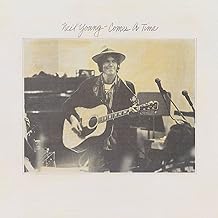
Comes a Time would provide the ending for this phase of Young’s journey, almost as if this LP was what he had been trying to attain in his solo recordings from mid-1976 through December 1977, when the tracks for the album were completed. “I had a good time making it,” he told Song Talk in 1991. “I did most of the original tracks by myself, playing guitar and all…and then went down to Nashville and added a few things. I enjoyed that one.”
At his only 1977 performance under his own name, a benefit for children’s hospitals in Miami that featured his Comes a Time session players billed as the Gone With the Wind Orchestra, he once again embraced his Harvest material, having come full circle back to 1972. Twenty years later, he would tell McDonough, “Harvest and Comes a Time are probably as much me as anything I’ve done with [Crazy] Horse.”
Ultimately, Comes a Time survived a name-change from its original title of Give to the Wind and weathered what Rogan describes as “various revisions and a series of quibbles about the mixing and artwork” to reach record bins in 1978. Its title track comes from the Ducks repertoire and “Look Out for My Love” from Hitchhiker. Three Oceanside Countryside songs (“Human Highway,” “Goin’ Back” and “Field of Opportunity”) are on its track list. The end result is satisfying, but in retrospect it’s the process by which it was created that remains most interesting. As Halliwell has observed, “not only do travel and movement permeate [Young’s] lyrics, but also his songs themselves drift in unforeseen and surprising ways, often appearing as part of a different project or in an alternative form.” Thankfully, Young’s current run of archival releases, makes it possible to hear where it all began.
Notes:
Crowe, Cameron. “Neil Young: The Last American Hero.” Rolling Stone, 8
February 1979, 41-46.
Halliwell, Martin. Neil Young: American Traveler. London: Reaktion Books, 2015.
McDonough, Jimmy. Shakey: Neil Young’s Biography. New York: Random House, 2002.
Rogan, Johnny. Neil Young: Zero to Sixty. London: Calidore Books, 2000.
Zollo, Paul. “Neil Young and Crazy Horse: The Song Talk Interview.” Song Talk, Winter 1991, 29-32.
Related Articles





 Epistrophe
Leave a comment