April 15, 2026
From the Archives: Peter Tork Interview
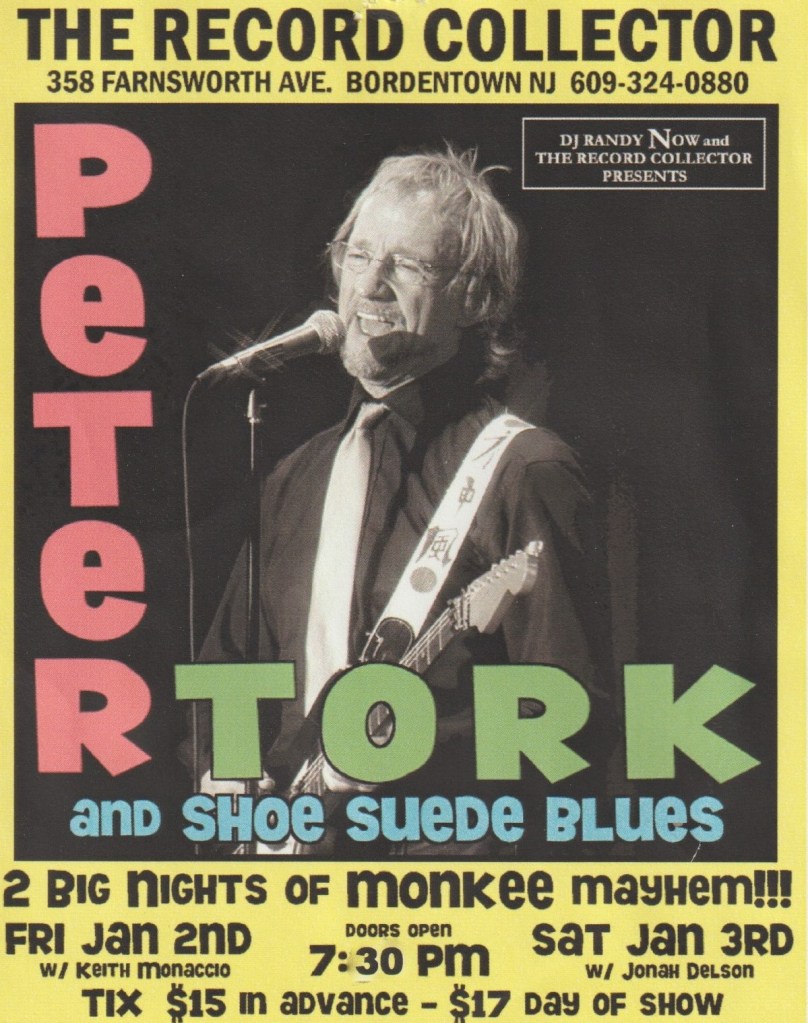
The following is one in a series of interviews I conducted with national touring musicians from 2009 to 2011 that appeared in the South Jersey newspaper The Grapevine.
From 1966 to 1968, the opening theme song from The Monkees’ TV series promised “we may be coming to your town.” That promise for Vineland is fulfilled Thursday night when Peter Tork and Shoe Suede Blues appear at the Fuel House at 8 p.m.
Tork rode the whirlwind of success with The Monkees, a band assembled expressly as a fictional group to star in a TV sitcom inspired by the Beatles’ film A Hard Day’s Night. As recording artists and television stars, The Monkees enjoyed a series of hit albums and singles, sold-out concert tours, two years of a successful TV show, a theatrical film release and a daring television special. Since leaving the band in 1968, Tork has never been far from recording studios, stages and TV cameras, forging a solo career that has culminated in a lengthy run with his current touring band.
“We haven’t been able to pin down a starting date for Shoe Suede Blues,” Tork said by phone last week from his Connecticut home. “We think it’s been something like 13 years.” He explained that the group, which specializes in performing the blues as well as Monkees material, was formed when he and a group of musicians played a dance. That gig led to another, and soon the band was underway, shifting members over the years. Tork says he is the only one left from the original lineup.
“I love the music I do,” he said, “and I love to play with my friends. There’s that great Willie Nelson song [“On the Road Again”]… ‘the life I love is making music with my friends’… that just kills me.”
Tork has been on the road quite a bit himself lately. “We’ve actually had a lovely, hard-working little bunch of time,” he said, reviewing an itinerary that will have the group playing, in addition to Vineland, Doylestown, Pennsylvania and Bordentown, New Jersey before setting out for a series of shows in Ohio. One of the Bordentown concerts will be a rare solo acoustic performance.
“I almost never do that,” Tork said. “Three or four times a year at the most. I much rather play with the band. The thing about doing a solo show is the entire sonic palette is up to me. It takes more concentration than I’d like to devote.”
A multi-instrumentalist, Tork is self-effacing, appraising his playing with terms like “ok” and “fair,” yet his performances on guitar, bass, banjo and keyboards which embellish many of The Monkees studio and live performances as well as his solo projects are a testament otherwise. One fellow musician who recognized Tork’s musical ability was Beatle George Harrison, who asked the Monkee to play banjo on the soundtrack to the film Wonderwall.
“I’d met George when he was a guest at [Mamas and Papa’s vocalist] Mama Cass’s, and I was dating her sister,” Tork recounted. “This was before the Monkees had hit the charts. I’d been selected and we were in pre-production. In 1967 The Monkees played the U.K., and our people and The Beatles’ people managed to structure something whereby we could meet them at one of the London clubs they liked to hang out at. John [Lennon], Paul [McCartney] and George showed, and George was happy to see me and said, ‘Why don’t you come around, I’m doing a recording. Come and play some banjo on this.” Tork says that his playing can be heard in the film but was not included on the soundtrack album.
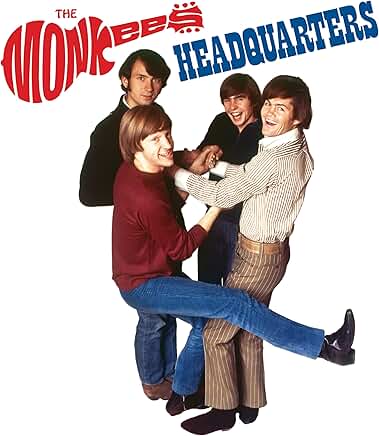
The Monkees earned the respect of bands like The Beatles, but many decried the fact that the group did not really participate in playing on their first two albums, the record company having hired other musicians to provide the backing tracks. The controversy prompted the recording of Headquarters, one of the band’s strongest releases on which they played all the instruments except for an occasional French horn or cello.
“It was a lot of fun,” Tork said of the Headquarters sessions. “I was thrilled to be able to do it. To me, one of the great aspects of The Monkees’ story is that we did do that and became a superior stage act. We became so much more in command of what we were doing and cranked out stuff that as far as I’m concerned is every bit as good as the early stuff.”
Before Tork’s departure from the group, The Monkees filmed the movie Head, which was directed by Bob Rafelson and co-written by a then relatively unknown Jack Nicholson. Tork says the film shoot wasn’t as much fun as it looks on screen. “It was so scattered,” he said. “We read the script and we knew what we were supposed to be doing, but the movie varied from the script quite a bit. After they shot the script, they looked at what they had and reshuffled the deck.”
The film, with its depiction of the corporate control that fashioned The Monkees mythology, has become a cult classic and features two compositions penned by Tork, “Can You Dig It” and “Long Title: Do I Have To Do This All Over Again.” “I was assembling a demo collection of a number of songs and giving them to the other guys,” Tork explained,” and I gave Rafelson a copy and he said, ‘These are two songs that are great for the movie.”
Tork’s final project with the band in the 1960s was the NBC-TV special 33 1/3 Revolutions Per Monkee, a themed variety show filmed in late 1968 that traced the evolution of rock ‘n’ roll through various performances by the group and guests like Jerry Lee Lewis, Fats Domino and Little Richard. “It was magnificent to be playing with the giants of rock ‘n’ roll,” he said. “Hanging out with those guys for a week or so is a great highlight.” Tork was also featured in the special performing Carl Emanuel Bach’s “Solfeggietto.”
In 1986, Tork reunited with fellow Monkees Micky Dolenz and Davy Jones for a tour, and in 1996, the addition of Michael Nesmith restored the lineup to its original quartet, which released the album Justus and toured England the following year. “It was fun to play with the four of us again,” Tork said, “and I thought we gave them a great show, but the British press really had their razors out for us.” Tork explained that although the band was playing to 5,000-8,000 fans per show, the press questioned the audience’s taste in supporting the group’s music. The result was a change in personnel for the U.S. leg of the tour. “I think Mike took it to heart,” Tork explained, “because we were supposed to go on and tour in the U.S. and Michael didn’t.”
Tork says he hasn’t heard from Nesmith since, but sees the other members three or four times over the course of a year. “We talk more often that that,” he added. “Micky and I are in email communication and Jonesy gives me a ring every so often. In fact, Jonesy’s playing nearby, so I might drop in and see him soon.” As for the likelihood of another tour by the trio, he said, “There’s always a chance that we could be on the road again.”
By conversation’s end, it’s snowing in Connecticut and Tork is looking forward to an evening at home before he resumes touring. “While I’m not doing anything, I’m home reading and I’ve got the ballgame tonight,” he said, referring to the opening game of the National League Division Series. Does he have a preference for a World Series matchup? “The Phillies and the Angels,” he said.
Related Article
“Riu Chiu” – The Story Behind the Monkees’ 1967 Christmas Cover