
January 7, 2026
Operation Kenova & the Reality of Herron’s Clown Town
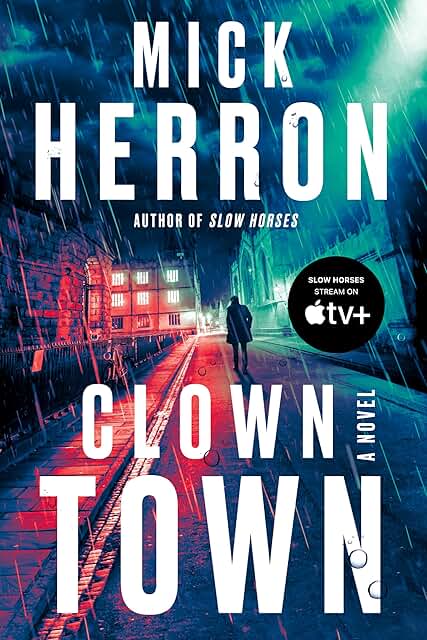
The opening of Mick Herron’s Clown Town is as brutally disturbing as it is vexingly mysterious. An unidentified individual reminisces about murdering several people in an abysmally torturous manner while reveling in his comfortably covert existence. Readers won’t discover how this character, Dougie Malone, figures into the novel’s plot or its characters’ lives for several hundred pages, but it’s an alluring lead-in to the narrative and a foreshadowing of the violence yet to come. It’s also, alarmingly enough, inspired by real life.
“It’s to do with a very horrible, real-life operation that was carried out by the intelligence services during the height of the Troubles,” Herron told Radio Times last July ahead of the novel’s September release, “…it’s dealing with multiple things that happened 40 years ago and the traumatic and ongoing effects that they have on the people involved.”
What the author is referencing is a British intelligence operation that originated in the late 1970s involving Stakeknife, what The Guardian calls “the codename of a top British agent in the IRA who was responsible for multiple murders during Northern Ireland’s Troubles” as part of an “internal security unit that hunted and executed suspected informants.”
The recently completed nine-year, £47.5-million police investigation known as Operation Kenova, which reportedly culled together a 160-page report based in part on interviews with a thousand witnesses, reveals the involvement of Stakeknife in “serious and unjustifiable criminality, including kidnap, interrogation and murder,” according to the BBC. The news service also identified that “files submitted to the PPS (Public Prosecution Service) implicated Stakeknife in 14 murders and the abduction of a further 15 individuals.”
Dougie Malone serves as Herron’s stand-in for Stakeknife, but in real life the codenamed perpetrator of these crimes has never been officially declared. The Guardian reports that in 2003, Ian Hurst, “a military intelligence whistleblower,” assisted the media in outing a man named Freddie Scappaticci as Stakeknife. Scappaticci, who died in 2023, denied the allegation, and the British government has restricted his name from appearing in the Kenova report under its “Neither Confirm Nor Deny” rule for alleged intelligence agents. No prosecutions have so far resulted from the investigation.
The Operation Pitchfork team in Clown Town was in charge of its own Stakeknife-like character forty years ago. It’s a springboard for Herron to examine the effects of such an alliance years after it was swept away by MI5, its tentacles still snaking through the present day and touching people and events who had no affiliation with the Troubles or its players but who are fair game nonetheless. By incorporating it into the Slough House universe, Herron said, it was possible to explore “what it must be like for an agent to do something which is nominally for the good in the country and to safeguard the Commonwealth, if you like, but, in fact, is morally dubious and personally traumatic.”
The “morally dubious” in the Kenova report includes the discovery that Stakeknife “probably took more lives than he saved” and that his protection was “apparently more important than protecting those who could and should have been saved,” according to the BBC. Despite MI5’s description of its involvement with Stakeknife as ‘peripheral,’ an Army representative from “the agent-handling unit” told investigators that “everything done in respect of Stakeknife was done with MI5’s knowledge and consent and MI5 had an influential role.” Additionally, Operation Kenova discovered that on two occasions his Army handlers transported him out of Northern Ireland, “on military aircraft for holidays when they knew he was wanted by the police for conspiracy to murder and false imprisonment.”
According to the BBC, the investigation reveals that “Kenova discovered 3,517 intelligence reports from Stakeknife including 377 in an 18-month period,” but that “the investigation team says ‘time and again’ his reports were not acted upon.” Summing things up, the report contends that “MI5 had automatic sight of all Stakeknife intelligence and therefore was aware of his involvement in serious criminality.”
Understanding the 1980s backdrop while reading Clown Town isn’t necessary, but it does enhance the reader’s understanding of the psychic battleground that ultimately affects everyone in the novel, whether intentionally or not. It’s what happens when the real world invades fiction. And in the end, it doesn’t matter if it’s a Dougie or a Freddie or whoever – it’s what’s done and what’s allowed to be done that ripples beyond its time.
Notes:
Carroll, Rory. “Stakeknife: Seven Years and £40m Later, How Did Inquiry Fail to Deliver Justice?” The Guardian, 8 March 2024. retrieved from theguardian.com.
Cummings, Judith. “Key Takaways from Operation Kenova Report.” BBC, 9 December 2025. retrieved from bbc.com.
Hibbs, James. “Slow Horses Author Reveals Plot Details for Upcoming Slough House Novel.” Radio Times, 8 July 2025. retrieved from radiotimes.com.
Related Articles








 Epistrophe
Leave a comment