
July 7, 2023
Fantastic Four…X-Men…Avengers Assembled!
This summer, the Marvel Cinematic Universe’s Nick Fury can be seen battling the Skrulls, the shapeshifting alien race, on the Disney+ series Secret Invasion. Like most of MCU’s heroes and villains, the Skrulls are not a new threat for comic book readers, dating back as they do to issue #2 of Fantastic Four in 1961where they debuted as the second set of foes to face the then brand-new superhero team.
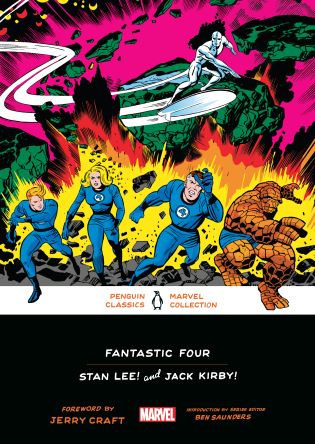
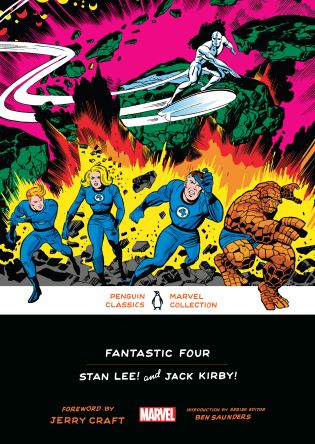
For those interested in tracing the Skrulls and other MCU characters back to the comic book pages where they were first introduced some sixty years ago, this September will provide an opportunity with the release of the second wave of the Penguin Classics Marvel Collection. While last year’s three anthologies focused on selected tales of Captain America, Spider-Man and Black Panther, this year’s collection hand-picks issues from the first decade of Marvel’s initial superhero teams: Fantastic Four, The Avengers and the X-Men.
Each edition contains an informative introduction, forewords by contemporary authors and contextual guidance between the reprinted comic book issues. For the uninitiated, it’s an educational introduction to the Marvel Age of Comics; for fans and true believers, it’s an additional way to appreciate the material and its legacy.
In 1961, Marvel shed its previous publishing personas of the 1940s and 1950s, Timely and Atlas, respectively, and began introducing the superheroes who, within a decade, would dominate comic book sales. Fantastic Four led the charge and contained all the ingredients of the Atomic Age: a scientist-leader of a team protecting the world, a space journey resulting in exposure to cosmic rays which transform each member of the quartet into a super-powered hero and a series of sci-if threats from space aliens and technologically enhanced super-villains bent on controlling the world.
The Penguin Fantastic Four edition contains the team’s origin story, the first appearance of the Silver Surfer and the introduction of such villains as the aforementioned Skrulls, Dr. Doom, the latest MCU super-foe Kang the Conqueror (his comic debut in the guise of a time-traveling Pharaoh is acknowledged in a post-credit scene in the recent film Quantumania), and the planet-devouring Galactus, whose introduction in the trilogy of issues #48 – 50 constitutes one of the most praised and beloved story arcs in the Silver Age of comics. All the selections in the anthology are by writer Stan Lee and artist Jack Kirby, the latter’s earlier DC comic Challengers of the Unknown a precursor of sorts to the FF.
As Marvel’s first family, the Fantastic Four contain a dynamic that was unprecedented in early 1960s comic books, consisting of equal parts love and bickering, allegiance and independence. In the earliest issues, the challenge for Reed Richards, his fiancé (and eventual wife) Sue Storm, her brother Johnny and closest friend Ben Grimm is to accept and transcend their transformations into, respectively, the elongating Mr. Fantastic, the Invisible Girl, the Human Torch and the Thing, whose rock-like appearance afforded the opportunity for Lee and Kirby to explore the psychic repercussions wrought by such a metamorphosis, captured most poignantly in the anthology with issue #51’s “This Man…This Monster.”
The selections in the Penguin FF edition capture the evolution of the comic book title most effectively. The 1950s style of sci-if narrative and artwork dominates the early issues in the collection but, by the mid-1960s Kirby’s panels take on a much more elaborate scheme to accommodate more complex, cosmic storylines such as the “Galactus Trilogy.” The closing entry, 1968’s FF Annual #6, “Let There Be…Life,” demonstrates exactly how the graphics of comic books were advanced during the Silver Age. With a pregnant Sue Richards and her and Reed’s unborn child in danger from the radiation that transformed her into a superhero, the other members undertake a quest through the Negative Zone and battle the realm’s Annihilus to retrieve what will save her and the child. Kirby fills the issue with intricate artwork, photo collages and detailed spatial relationships throughout, using splash pages in dramatic moments to punctuate the narrative.
The inclusion of a Golden Age story from 1939 featuring Namor, the Sub-Mariner, who is resurrected in an early FF issue and proves to be something of a recurring menace for the team, is a nice tribute to a Silver Age antecedent. Yet it’s puzzling that the anthology chose not to include a Timely Golden Age tale featuring the original Human Torch, the precursor to Johnny Storm’s character, as a historical precedent.
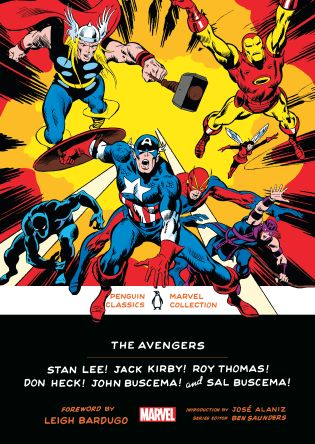
Contrary to a 1988 quote by Lee, included in the Penguin Avengers anthology, in which he credits readers’ preferences for superhero team-ups as the inspiration behind its creation, the Avengers comic book actually owes more of debt to Daredevil, whose Marvel debut, scheduled for summer 1963, was delayed by writer Bill Everett’s day job. In response, Lee collected the heroes of already existing titles, dubbed them the Avengers and launched the new comic in place of the Man Without Fear, who would debut the following year. By that time, Iron Man, Thor, the Hulk, Ant-Man and the Wasp had been together six months after battling the god of mischief Loki in issue #1. By issue #4, the Hulk had departed but a resurrected Captain America had joined.
It can be said that the Avengers are also a Marvel family, if not by blood, then by purpose. But the very nature of the group was tenuous from the beginning, a sometimes uneasy yet necessary alliance with its share of ego and dissension occasionally on view in the Penguin Avengers anthology.
The generous helping of tales about Earth’s Mightiest Heroes begins with the first four issues by Lee and Kirby, but most of the selections here follow the adventures of the subsequent lineup formed in issue #16’s “The Old Order Changeth,” which heralds a roster of Cap, Hawkeye, Scarlet Witch, Quicksilver and, soon enough, Vision, with original members of the team periodically reappearing. By this time Don Heck was handling the drawing, and Lee, after issue #34, would turn over writing duties to Roy Thomas who, according to Jose Alaniz in his Introduction to the anthology, “became the Avengers’ most important and influential writer after Lee.”
The edition’s lineup of villains includes some of the most formidable foes during the team’s first decade: Baron Zemo, Kang and Ultron, all of whom have already found their way into the films. But fans of the MCU will also discover the introductions of the Black Knight and the Collector, appearances by allies/members such as Black Panther, Medusa and Valkyrie and the debut of Vision. As Alaniz notes, the collection “brings together a representative sample of key issues, events, characters and creators for the first seven years of the Avengers (1963 – 1970), a period that would forever define the title (and eventually provide the raw material for the successful film series of the 2010s).”
The Avengers title, both intentionally and unintentionally, offers a view of the extremes that comprised 1960s life. Its early depiction of Janet Van Dyne as a shallow, fashion-conscious shopper juxtaposed against her presence in the feminist-centered issue #83 provides a glimpse of a comic book industry in the early stages of reshaping and redefining itself, a task that would take until the 1980s for a female superhero like Van Dyne to become a fully developed character.
The inclusion of issue # 74, the second of a two-part tale featuring the Black Panther battling the Sons of the Serpent and their mission to purify the country through a violent agenda that targets race, religion and heritage, there is a through-line to the Penguin collection of the X-Men, yet another title established by Lee and Kirby. The selections on view in this anthology pit the titular team not only against high-stakes villains but also against a society that fears them.

Those interested in the X-Men edition should start with the Appendix, which features a forgotten 1962 tale by Lee and soon-to-be-Spider-Man artist Steve Ditko called “The Man in the Sky.” The five-page comic focuses on Tad Carter, a mutant whose psychic powers are the result of his father absorbing “small doses of radiation every day” at his workplace before Tad was conceived. Born with these abilities, Tad recognizes how such powers can be used to help society but quickly learns that they can also alienate and invite hostile treatment since they make him different. At the conclusion, he is summoned telepathically by a community of others like him to an unidentified location where they will all wait until “mankind comes of age.”
The Lee-Ditko collaboration appeared in Amazing Adult Fantasy #14 and, while it was never addressed by Lee, Ditko or Kirby in interviews, it is essentially the foundation on which the X-Men comics were built. And the selection of X-Men issues in the anthology attest to that in several ways. As a mutant team of superheroes, the X-Men experience the fear and anger engendered by their difference from what is considered “normal,” or from those whose superpowers were attained through a scientific mishap. And the group’s mentor and leader, Professor Xavier, exhibits psychic powers which mirror the abilities of Tad, who also shares with one member of the team, the Beast, a similar origin story.
At its most basic, the narrative of X-Men tales is about the student learning from the master, in this case seven pupils training under Professor X. It’s also about good vs. evil, with the team in conflict with Magneto’s collective of Evil Mutants, whose intent on subjugating the inferior human race stereotypes all mutants in the eyes of the oppressed, creating a wave of fear, mistrust and apprehension that soon isolates and threatens anyone considered different.
Such subtext was ripe for exploration, but that wasn’t necessarily the intent of Lee, Kirby and others involved with the comic in the 1960s, nor was it interpreted as such by early fans of the series. In his Introduction to the anthology, Ben Saunders clarifies that Lee and Kirby never intended the characters’ mutant abilities to be the metaphor it has recently become and qualifies that the team instead reflected the “anxieties of the atomic age.” But in the title’s second incarnation during the Bronze Age, “developments of anti-mutant bigotry have fostered a popular interpretation of the X-Men franchise as an extended allegory exploring real-world issues of social injustice and discrimination based on race, gender, sexual orientation and other forms of differences.” The interpretations helped transform X-Men comics into a top-selling publication on par with Spider-Man’s multiple titles.
The earliest narratives in this anthology might be the weakest of the three new releases, but the later tales of issues #41 – 66, some of which are merely discussed or summarized and feature narratives by Thomas and Gary Freidrich with art by George Tuska and Neal Adams, begin to hint more strongly at the look and direction the comic would take in the future. The collection is also well worth checking out for the initial appearances of Quicksilver and his sister Scarlet Witch, whose skepticism about working for Magneto’s team hints at the redemption she seeks for herself and her brother in becoming members of the Avengers.
Like the FF and Avengers sets, the X-Men anthology reminds us that ultimately the team is a family, even if maybe a bit dysfunctional at times. In fact, the collection’s overview of issues #60 – 66, the final round of X-Men comics before the series was cancelled and placed in limbo for a few years, notes that the final panel of issue #66 features all original members of the team surrounding Professor X, “conveying with eloquent visual symbolism that the X-Men are not merely a group of students but a family.”
All three 2023 Penguin Classics Marvel Collection releases, in paperback and hardcover editions, will be available September 12.
A much abbreviated and altered version of this article appeared in the June 21, 2023 issue of SNJ Today.







 Epistrophe
Leave a comment