
October 1, 2023
Altmanesque
Director Robert Altman may not have invented it, but the concept of the unreliable narrator might best be defined by his 1985 film adaptation of Sam Shepard’s stage play Fool for Love, in which the voice-over narration is commonly contradicted by its accompanying visuals. It’s a cinematic exploration of memory vs. fact, myth vs. reality, and it’s pure, unadulterated Altman at his best, leaving us to sift through what is offered in order to arrive at our own conclusions. And it’s the reason fans of his films have such a devout loyalty.
Shepard, who completed four drafts of the Fool for Love script for Altman, is reported to have hated the aural/visual contradictions, and an examination of an early and late draft confirms that the playwright never incorporated such an idea into the screenplay. Regardless, the director saw fit to include it in his vision of the narrative, as he was wont to do. Yet, contrary to his reputation for such revision, Altman apparently valued a completed script as an essential starting point for each of his cinematic projects.
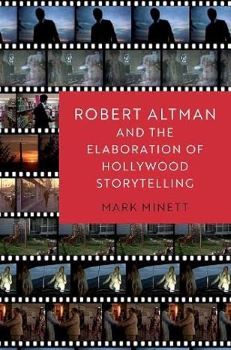
Such contradictions are just one of the topics examined in the most recent studies of the director. Mark Minett’s Robert Altman and the Elaboration of Hollywood Storytelling and the ReFocus series’ installment The Later Films and Legacy of Robert Altman, edited by Lisa Dombrowski and Justin Wyatt and recently released in paperback, both attempt to demythologize and reevaluate portions of the filmmaker’s oeuvre.
Taken together, the books encompass the director’s Hollywood career, with Minett restricting his study largely to the early 1970s films and Dombrowski and Wyatt undertaking the subsequent years up to the filmmaker’s death in 2006. Each provides a wealth of research into Altman’s methodology, which Minett quite convincingly argues is more aligned to conventional Hollywood filmmaking than the director’s maverick reputation might indicate.
Altman established his reputation in what was termed the “New Hollywood” through a string of films in the early 1970s that includes an array of genre explorations like M*A*S*H, McCabe and Mrs. Miller, California Split, The Long Goodbye, Thieves Like Us and Nashville. And they bear the Altman stamp of defying traditional commercial filmmaking: overlapping dialogue, character-driven narratives, playful subterfuge of the genre itself and restlessly wandering camerawork. But Minett contends, with convincing evidence, that the director actually retained the basic narrative of shooting scripts while allowing cast improvisation and revision to augment and shape the final version of a movie.
In his chapter on Altman’s use of scripts, Minett utilizes the collection of screenplays in the filmmaker’s archives at the University of Michigan and the Wisconsin Center for Film and Theater to offer a detailed comparison of the first and final drafts of McCabe and Mrs. Miller.(1) To illustrate how the director maintained the core of the initial draft’s narrative while whittling the final version down to its Altmanesque shape, Minett demonstrates how “Altman and his collaborators seem to have elaborated on the script’s narrative elements during production – adding minor characters, premises and vignettes, and thereby thickening the story world or milieu.” The process included placing Mrs. Miller’s scenes in the hands of actress Julie Christie and McCabe’s into those of Warren Beatty, employing Robert Towne’s uncredited script doctoring, eliminating various scenes and transforming secondary characters into something more three dimensional than their original script roles allowed.
Minett’s study reveals a similar, yet evolving, process with Altman’s other early 1970s movies. By the time of California Split in 1974, script writer Joseph Walsh was asked to supply dialogue for background scenes in the film. An additional unscripted moment with background characters was added during production. Such screenplay/production maneuverings, Minett argues, are the trademarks of a maverick, but the director’s adherence to a shooting script and its core narrative belong to the Hollywood tradition.(2)
Robert Altman and the Elaboration of Hollywood Storytelling saves what is probably its most fascinating research for the conclusion. Returning to the director’s early television work, Minett conducts a thorough examination of the first season of the 1960s TV series Combat. As he does in his previous chapters, the author tussles with Altman’s myth, demonstrating and explaining the more conventional aspects of episodes he directed but also identifying the accomplishments in camerawork, composition and lighting that would constitute the foundation of his film work. Most revealing are the documents, correspondence and scripts referenced or quoted in the chapters, the most detailed background about the show’s behind-the-scenes events to date.
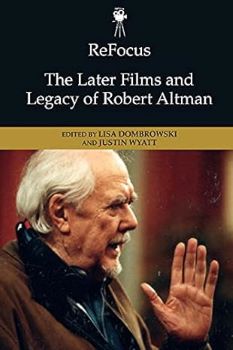
The ReFocus anthology unintentionally manages to touch upon and corroborate some of Minett’s findings, such as the director’s insistence on completed screenplays before production. While the collection of essays that comprise The Later Films and Legacy of Robert Altman is a concerted effort to recognize what anyone familiar with Altman’s output from the 1980s through the early 2000s ought to know (i.e. that these later films continued to advance the stylistic explorations in storytelling with ensemble casts like those Altman had introduced in the 1970s), it doesn’t shy away from worthy archival and interview material.
In the book’s interview with Altman’s former assistant director, Alan Rudolph, there are revealing comments concerning the use of scripts. “Although Bob’s spontaneous style seems to preclude the need for a skillful screenplay,” Rudolph says, “in truth his attitude toward scripts was just the opposite. He was adamant that written material be thoroughly worked out to maximum potential and quality – before it was all subject to change and evolution during prep and especially shooting. He would try to follow story, not the dictation. Screenplay as blueprint.”
The Later Films and Legacy of Robert Altman is the first attempt in print to renegotiate Altman’s later films in order to balance them with his early output, an attempt at inclusion rather than dismissal. But one essay, “Unmade Altman” by Philip Hallman, provides further insight into the filmmaker’s working methods for an unrealized project titled Paint, about the contemporary art world. Relying on the University of Michigan Altman archives, Hallman traces the process of research into preparing for the film and concludes that “although Altman is often considered a champion improviser while on set, the archive reveals that a great deal of critical preparation and research allowed him to feel comfortable to improvise freely.”
Hallman unearths a series of memos and documents that indicate the depth undertaken in determining the accuracy of recreating a realistic art world for a film that was never to be, and one can only guess that the approach was not unlike the preparation that accompanied Altman’s other films. As Hallman notes, “small details tucked inside unseen documents challenge our notion of what we think ‘Altmanesque’ is and reveal that it is more complex than we may have initially thought.”
The director himself professed that he did not quite know what “Altmanesque” meant but, as of 2018, the Oxford English Dictionary added the term to its listings. The expression will no doubt remain, but determining the truth of its meaning is an ongoing process.
In the last of the ReFocus anthology essays, Robert P. Kolker, whose appraisal of Altman in his book A Cinema of Loneliness remains one of the most important early statements on the director, provides a short, poignant piece about the filmmaker’s final movie, A Prairie Home Companion. Part obituary, part appreciation, the essay, titled “An Affection of Death,” contains the perfect summation of why Altman’s place in and contributions to cinema continue to be studied and analyzed. “Altman needed to make films like he needed to breathe, and he refused to be tied down to any one genre,” Kolker writes, before offering the simplest and truest of assessments about the director: “[He] scrambled across genres, took what he had, and made it his own.”
Notes
- (1) The Robert Altman Papers 1969-1972 at the Wisconsin Center for Film and Theater consists of three boxes containing various correspondence, documents and script drafts. The materials are largely associated with M*A*S*H, Brewster McCloud, McCabe and Mrs. Miller and The Long Goodbye. The Robert Altman Papers at the University of Michigan houses a broad collection of 700 boxes of materials from the director’s career dating from 1945 to the early 2000s.
- (2) While Minett’s study stops short of the 1980 film Health, an uncredited draft of the screenplay for the film, dated February 5, 1979, reveals that Altman had moved to yet another level in allowing the script to serve his improvisational purposes. For Scene 67, three largely blank pages are allotted for dialogue for the characters Gloria and Isabella. The directions explain that this segment would be finalized only after the actresses playing these parts had rehearsed and established their characterizations to better assist in informing the scene. The released film, which includes the completed Scene 67, credits the screenplay to Frank Barhydt, Paul Dooley and Altman; it seems likely that the concept and directions for the aforementioned scene are one of the director’s contributions.





 Epistrophe
Leave a comment