
January 15, 2025
Time Will Show the Wiser
Flanked by his wife and several musicians who have shared the stage with him for a decade or better, Richard Thompson spends the evening singing, rattling off blistering electric guitar solos and delivering delicate acoustic ballads about the darker corners of life. Amid the new songs from the latest album, he pays tribute to former Fairport Convention bandmate Sandy Denny by performing a song associated with her and includes another cover tune for good measure. Audience members, consisting of long-time fans, are appreciative and respectful as they exit into the nighttime air after the final notes of the last encore have sounded.
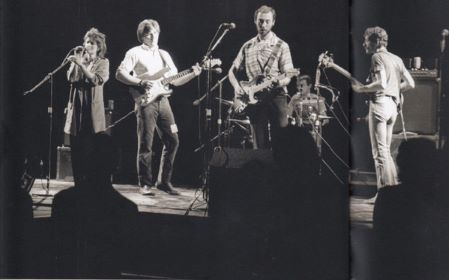
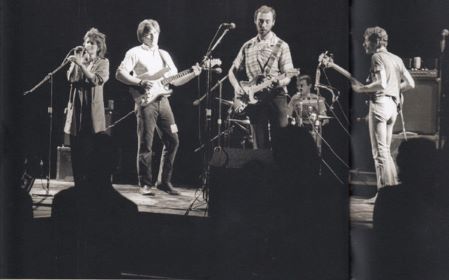
The above description pertains to the 2024 concert at the Dennis Flyer Theater in Blackwood, New Jersey. It also manages to pertain to the Richard and Linda Thompson Band’s 1982 performance in Philadelphia, Pennsylvania. Two different shows with two distinct set lists performed by two unique lineups that decidedly invite comparisons despite a forty-two year span.
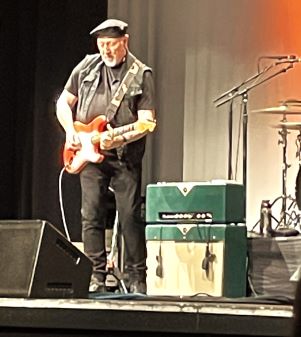
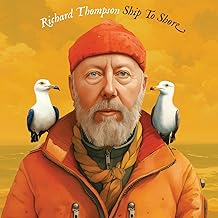
In Blackwood, Thompson, on tour in support of his Ship to Shore album, gleefully told the audience of roughly 700 that he was back with a band for the first time since the pandemic years shuttered live performances. And this lineup, consisting of RT, drummer Michael Jerome, bassist Taras Prodaniuk, guitarist Zak Hobbs and vocalist Zara Philips bears more than a slight resemblance to the group with whom Thompson and ex-wife Linda toured the U.S. in 1982. Other than RT, there are no overlapping personnel between the eras, but the buoyancy of the current mix of players, their relationship with Thompson and their understanding of the music draws a direct connection to four decades ago.
Back then, clubs, where two sets per night was the standard, were primarily the venues RT played in the U.S., earning his way into theater tours. Thompson explained to Clash magazine in 2024 that he “deliberately downsized after Fairport – Linda and I played folk clubs to 100 people. And there’s a limit to that but it was necessary at the time. Then we expanded again. It was clear to me that in order to survive we had to contract and expand. My motto at the time was ‘be flexible’ – don’t let your ego think that you can’t work without certain circumstances.”
In 1982, venues, audiences and stages may have been smaller, but the Shoot Out the Lights tour, like the Ship to Shore run, traveled from the East Coast to the West Coast. News of the shows was disseminated by ads and newsletter. Conventional FM radio had already embraced corporate rock, the antithesis of Thompson’s music, and a college station like Philadelphia’s WXPN, years away from developing a friendly alternative-rock format, sported a wildly esoteric mix that wasn’t as inclined toward the traditional or folk-rock sound of an ex-Fairport Convention guitarist and his wife performing in North America.
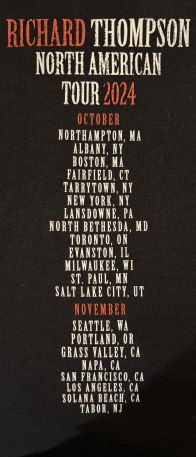
Since the 1990s, WXPN and its cousins have settled into a turnabout stance, sponsoring shows by musicians like Thompson, who acknowledged as much in his Clash interview last year, recalling, “I was treated as a new artist, and I got on to college radio and alternative radio. I found an audience who was younger than me. It became a new lease of life, and I could expand a little bit.” In fact, RT played the WXPN Free at Noon concert solo on October 4 at World Café in advance of the Ship to Shore tour, which began a week later in Northampton, Massachusetts.
Curiously, Salem, Massachusetts, according to producer/Hannibal Records head Joe Boyd, whose acquaintanceship with RT began in the 1960s with Fairport Convention, was where the 1982 tour was to begin, but there’s no evidence of any such show. For the past four decades, the Aurora Theatre in Baltimore, five months prior to its transformation into an adult movie venue, has been credited as the start of the 1982 tour because the M.C. that night, captured on tape by an audience member, introduced the group with, “Ladies and Gentlemen, for the first time in the States…the Richard and Linda Thompson Band,” giving birth to a myth.
In reality, Baltimore hosted the third show of the tour on May 13, the night after a performance in Washington, D.C. Richard and Linda’s first U.S. stop was actually May 11 at Philadelphia’s Ripley Music Hall on South Street, the future site of a local Tower Records. But in May ’82 it was an oddly shaped club pushing drinks before and during performances and providing little space for anyone, including performers, as evidenced by Linda Thompson seen brushing her hair on a stairway behind the stage while her bandmates played on.
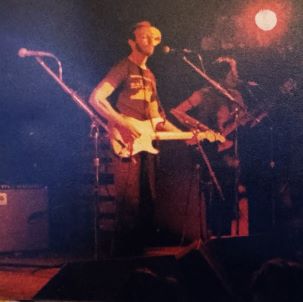
In the liner notes to the Shoot Out the Lights 2010 Deluxe Edition, Boyd explained that, with the exception of Linda’s vocals, the final Richard and Linda album was primarily recorded live in the studio in three days and “the money saved on recording would be invested in a U.S. tour, which “Richard was eager for.” Thompson told Ed Haber in 1982, “I was determined to come to America. It’s been very hard to get a tour together for the last eight or nine years.” In advance of the spring 1982 tour, RT played several solo shows in the U.S., most notably at the Bottom Line in NYC, as a promotion of the upcoming band tour and a foreshadowing of an American solo tour he would undertake in the fall, which would return him to Ripley Music Hall that September.
But in May 1982, Ripley was alive with a full band and stage banter that included comments about the war that had erupted only days earlier between England and Granada. Fairport’s “Sloth” might have been an appropriate choice in the set list, but it hadn’t yet replaced “Night Comes In” as the showcase that allowed the band to stretch out. In 2024, Thompson would deliver a double dose of war commentary, one national and the other personal, by performing Denny’s mediation on the subject, “John the Gun” and his own narrative “Guns are the Tongue.”
The 1982 band consisted of Richard and Linda, Pete Zorn and fellow-former-Fairporters Simon Nicol and Dave Mattacks. According to Humphries, Richard and Linda Thompson were “committed to two dozen American shows.” Two concerts were professionally recorded. Boyd told Humphries “…I had to record it. The only place there were two shows close together was in the Bay area, at Santa Cruz and the Great American Music Hall. I got a good deal for a mobile truck to record the shows. They were the last two shows of the tour…”

Portions of those 16-track recordings found their way onto the second disc of the Shoot Out the Lights Deluxe Edition along with a soundboard mix of “I’ll Keep it With Mine” sourced from a cassette recorded during the tour. Because the tour was emotionally fraught with the disintegration of the Thompsons’ marriage, Linda was unable to perform at the Detroit and Santa Cruz shows, which explains why the multi-track version of “Did She Jump or Was She Pushed” from Santa Cruz on the Deluxe Edition has RT on lead vocals.
The fate of the multi-track tapes from Santa Cruz and San Francisco also limited the selections. According to Ed Haber in the Deluxe Edition liner notes, the multitracks were stored in a facility on the West Coast which underwent construction at one point. Buzz saws unintentionally damaged the tapes, leaving some performances unsalvageable, like the two versions of “Sloth” played on those nights. Hence the choice of selections on the 2010 edition.
Thankfully, most of the shows are preserved as audience recordings and soundboards plus one radio broadcast from Chicago. There’s also a tape from May 15 of Thompson and Nicol playing in a hotel room in New York City that was broadcast by WBAI. A sort of equivalent to RT playing the Free at Noon Concert in 2024 in advance of the tour, the hotel performance foreshadowed the band’s upcoming Bottom Line and Lone Star café appearance on May 17/18 and May 24, respectively.
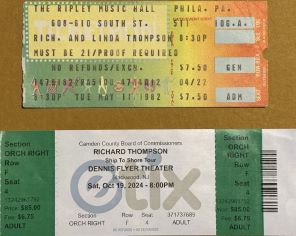
With the dissolution of the Thompsons’ marriage, the 1982 U.S. tour had no choice but to be a farewell run, although the final Richard and Linda concert appearance would be at the South Yorkshire Folk Festival in Sheffield on July 18, 1982. The performances, however, were usually brilliant, charged with an energy and a proficiency worthy of much more attention than it received.
In hindsight, the 1982 tour wasn’t only an ending; it was also a transition, a return for Thompson to the role of solo artist he had assumed with his 1972 debut album Henry the Human Fly. Back then, the U.S. release on Reprise was purported to be the worst selling LP in the history of Warner Brothers Records, the U.S. label for the LP. Despite its poor sales, it stands as Thompson’s musical declaration on the type of material he would write and perform to this day.
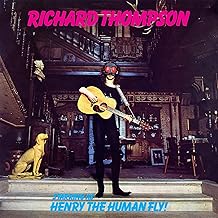
In his memoir Beeswing, Thompson explained his approach to Henry the Human Fly: “I saw these songs as a kind of statement of intent: this was the way I saw British songs should sound from this point forward. As in Fairport, I was almost imagining that Britain had never totally succumbed to American tradition, the tradition had never been broken and we had all grown up singing and playing this way.”
Buying the album at the time of its release was entering a tentative agreement to accept Thompson’s challenge to at least give it a one-time listen. For those who liked or understood what he was doing and continued to listen, a new world of music unveiled itself, one that wasn’t Fairport’s original arrangements of traditional songs or the standard singer-songwriter fare of the time. As RT stated, the album’s opening track, “‘Roll Over Vaughn Williams,’ is telling the listener that the music they are about to hear must not be prejudged – preconceptions must be set aside.”
The material was a musical hybrid of traditional and rock but with lyrics that visited the darker realms of its characters. It was new, exciting and groundbreaking. “Reinventing the English tradition in his own image,” Adrian Smith writes in his book Flying Solo: Richard Thompson and the Making of Henry the Human Fly, “[RT] sang songs that were both disturbing and demanding; it’s no wonder Rolling Stone took over a decade to comprehend what was going on.” By that time, Shoot Out the Lights was receiving favorable reviews from more than just Rolling Stone, and it’s still considered a high point of Thompson’s catalog.
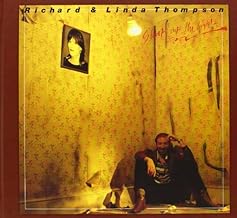
There were no songs performed from the Shoot Out the Lights playlist during the 2024 tour. The featured originals, including a healthy dose from the current album, adhered to the solo years apart from “Withered and Died” from the days with Linda. It’s the only song shared between the 1982 Philadelphia set and last year’s Blackwood concert, a ghost that still walks.
The Ship to Shore material, like much of Thompson’s catalog, bears a kinship to the songs on Henry the Human Fly. There is a connection with traditional British folk, a rock sensibility and a uniqueness of portraiture and narrative. The songs on the new album might be a bit more honed and sport a full-band flavor, but they undoubtedly share a bond with pieces like “The New St. George,” “The Poor Ditching Boy,” “Shaky Nancy” as well as subsequent material. A composition like “The Old Pack Mule” even reappropriates RT’s arrangement of the Renaissance piece “So Ben Mi Ca Bon Tempo” from 1,000 Years of Popular Music and was one of the highlights of the Blackwood concert.
If there’s a true measurement of time between the 1982 and 2024 shows it was most visible stage right in the form of Hobbs. Sure, Thompson has aged in appearance since 1982 – his beard grayed, his balding now covered by a beret and even his classic Stratocaster long replaced. But Hobbs, youthful, clean-shaven and sporting a Telecaster, is the key temporal ingredient here as he is Thompson’s grandson, the latest in several generations of musicians in the family line and clearly someone RT is proud to have in his band. It may now be considered a tradition since Thompson’s son Teddy was a member of the band for the Mock Tudor tours that are now a quarter-of-a-century old.
The October 19, 2024 performance at the Dennis Flyer Theater in Blackwood, NJ had been originally scheduled for the larger 1,820-seat Landsdowne Theater in Pennsylvania, but unforeseen additional work on renovations for the 98-year-old former movie house postponed its reopening. Dan DeLuca reported in an October 6 article in the Philadelphia Inquirer that its reopening “has been pushed back indefinitely,” with concerts relocated to other venues throughout South Jersey from October to December. The Thompson show was one of the earliest in the venue’s schedule.
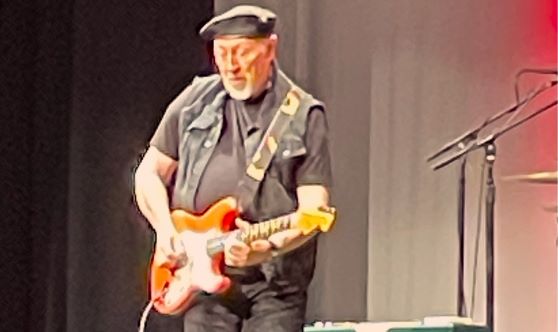
The Dennis Flyer Theater, which has presented a wide variety of musical acts over the decades including a pre-Year of the Cat Al Stewart in the mid-1970s, boasts about only 200 additional seats than Ripley’s Music Hall, intimate enough for everyone in attendance, the majority of whom have grown old and gray along with Thompson. They’re faithful, supportive and appreciative of the musicianship on view. “It’s nice to have an audience,” Thompson declared last year. “It’s nice to have any audience!” Somehow, one thinks, that sentiment applied just as well forty-two years ago.
Related Articles




 Epistrophe
Leave a comment