
March 1, 2026
Thomas Pynchon’s Shadowlands
“Our reward for surrendering expectations that a novel should gather in clarity, rather than disperse into molecules, isn’t anomie but delight.” Jonathan Letham on Thomas Pynchon’s novels
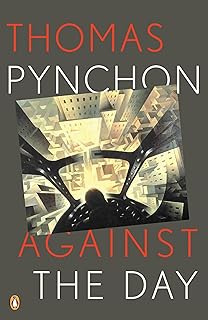
In 1976, Little Brown and Company published Mindful Pleasures, a collection of essays on the works of Thomas Pynchon. At the time, the author had only three novels and a volume of short stories to his name, but there was already plenty written about his works. Some of those evaluations found their way into Mindful Pleasures, including William Vesterman’s “Pynchon’s Poetry,” a fairly standard text reading of the period whose opening appraisal of how “poems, and particularly songs, make up a characteristic part of Pynchon’s work” is an early observation of this particular tenet of the writer. Such poetic practice extends to the author’s prose as well and continues into such later works as the 2006 novel Against the Day, whose concluding sentences could very well constitute a Pynchonesque haiku: “They will feel the turn in the wind/They will put on smoked goggles for the glory of what is coming to part the sky/They fly toward grace.”
There are some who approach reading Pynchon warily, uncertain of the journey, the comprehensibility or the payoff. In choosing to read one of his books, you enter into a pact with Pynchon, one in which he grants you arresting, lyrical prose to carry you through the quirky lives of characters who inhabit narratives filled with gradually revealed thematic links and historical/mythical/dream-like threads. In return, you’re asked not to hold him accountable for failing to tie up any or every loose end, to provide a neat and satisfying conclusion to what is essentially a shaggy dog story and to offer an explanation of what you’ve just read. The endings are what they are.
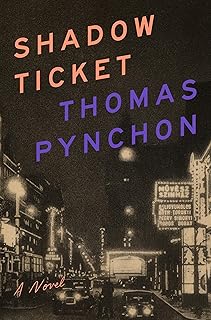
For those willing to accept these terms, it’s a rewarding relationship unlike any other in the literary world. But considering the lengthy time between the publication of new works, Pynchon’s newest novel Shadow Ticket, a mystery of sorts, may be the last opportunity we have to engage in such a deal with the eighty-eight-year-old author.
Pynchon himself is no stranger to mystery, maintaining as he has a reclusive existence outside of his books. According to Matthew Winston, his freshman register at Cornell University “carries a blank space instead of a photograph of him.” Since then, his lack of public appearances, interviews, published photographs or digital presence has made him a best-kept-secret as a person.
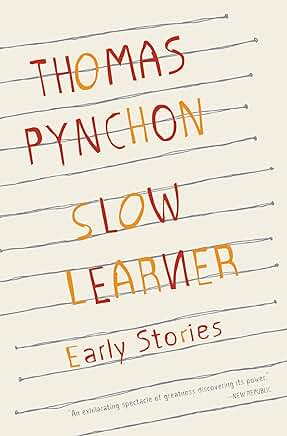
There is only one account Pynchon has provided of himself. That can be found in the 1984 Introduction to his collected early short stories Slow Learner. Even then he was reluctant to accord his younger self too much of a presence, admitting that he’s disinclined to “86 this guy from my life,” but questioning “how comfortable I would feel about lending him money, or for that matter even stepping down the street to have a beer and talk over old times.”
Born and raised in Long Island, Pynchon interrupted his attendance at Cornell with a stint in the Navy, after which he completed a degree in English, although he originally had majored in Engineering Physics. Both interests found their way into his fiction. His cameo in Cornell classmate Richard Farina’s non-fiction “The Monterey Fair,” published in Mademoiselle, was as best man in Farina’s wedding. Returning from a visit to Mexico City in August 1963, Pynchon was “dodging a team of Life photographers who would not tolerate his requests for privacy.” According to Farina, “the mysteries implicit in V., his novel, were causing the literary public to demand counterparts in his day-to-day life.” He took time out from reading Scientific American to join the groom, his bride-to-be Mimi Baez, her sister Joan and others before, appropriately enough, disappearing from the article.
At the wedding of writer Jules Siegel, another Cornell classmate, Pynchon was captured in what is surely by now a long-lost photograph, appearing “bearded, wearing a charcoal-gray suit,” Siegel recalled in a 1977 Playboy article, which also recounts the return addresses of his friend’s letters following college: Washington State, Florida, California and Mexico, where he sported a mustache that amused the inhabitants. Each letter concluded with “the signature in faint pencil, “Tom.”
In 1965, Siegel recollected, Pynchon was residing in Manhattan Beach, California at a one-room apartment with “shabby furnishings, a large gas heater, a narrow cot and a few books…a monk’s cell decorated by the Salvation Army.” A year later he had graduated to a two-room studio with kitchen. Piggy banks lined the bookshelves, empty cans of Hills Brothers coffee sat in the cabinets and an Olivetti typewriter surrounded by drafts of Gravity’s Rainbow occupied space in the living room area. By the time Siegel brings his memoir to a close, the novelist has already taken his leave of the article.
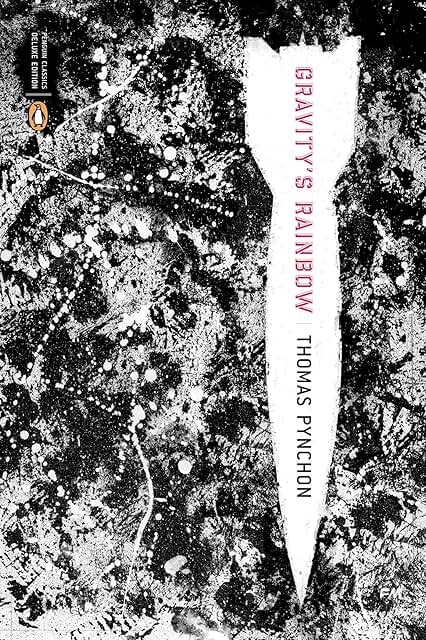
For the next six decades, Pynchon has only allowed his books to speak for him, creating in each novel what Richard Poirier has called, “a curious fictional world which is often directly referring us back to the real one.” Recently in The New Yorker, Kathryn Shultz wrote, “For sixty-two years, the author has been offering up worlds that seem much like our own except weirder and more lawless, with respect to both criminal activity and physics…Opinions vary on the merits and pleasures of these books, but no one, it seems safe to say, has ever yearned to live in the worlds they depict.” People may not desire to live in them, but they do, nonetheless. In fact, it seems as if our world and its absurdities and peculiarities have continued to grow into a Pynchon fiction, the “weirder and more lawless” aspects now commonplace enough so that V. may be more relevant and recognizable today than it was in the early 1960s.
Stylistically, Pynchon’s narratives rarely subscribe to standard logic. Protagonists disappear for a chapter or two, time can shift behind or ahead of the current moment. One character in V. could be describing a Pynchon novel when he notes, “…what an amusing world it still is, where things and people can be found in places where they do not belong.”Once, when Siegel complained about the “complexity of V.,” the novelist, he says, remarked, “Why should things be easy to understand?” Pynchon’s works may be far from conventional, but they do contain an inner logic that can be trusted, which is more than can be said about our real world and its history, a portion of which provides the backdrop of Shadow Ticket.
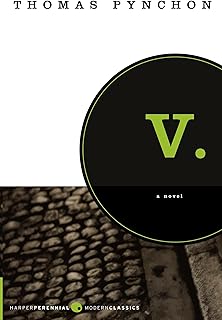
We’re reminded in V. that history is made at night and that “events seem to be ordered into an ominous logic.” “For Pynchon,” Jonathan Letham asserts, “history is a nightmare within which we must become lucid dreamers,” and the 1932 world of Shadow Ticket is a noirish dreamscape, dark and untrustworthy yet leavened with humor. Any expectations we might have require a reminder that this is a Pynchon novel, and Shadow Ticket, as homage to and subversion of the noir genre, is something all its own.
What lie chronologically behind the new novel are the events of Mason and Dixon, Against the Day and the 19th century moments of V. They are a foundation for Shadow Ticket. And like many of Pynchon’s protagonists, the new novel’s Hicks McTaggart is as much historical guide as private eye of the narrative, leading the reader through Wisconsin life and legacy before becoming liaison on his European excursion, where additional historical moments are connected into a complex scheme not unlike what occurs in the author’s other globe-trotting works.
The early 1930s Wisconsin setting of the first portion of the book accurately establishes the state’s history, which included altercations between Nazi supporters and opposers among its German residents. Such violence (and the greed that summons it) becomes the novel’s dominant motif, with references to the Wild West (one character described as “an unreconstructed veteran of the Old West at its least merciful”) and to Chicago’s organized crime, celebrated mob bosses and the perks of Prohibition. There’s also Wisconsin’s share of bombings, turf wars and labor riots foreshadowing a looming World War II just beyond the Depression era. And Pynchon uses the first half of the book to sift through the intolerance contained in U.S. history, referring to “the unquiet spirits of hanged men and women, white, Negro and American Indian.”
Shadow Ticket’s pacing is as terse as its language, a blend of pulp vernacular, British spy parlance and Pynchon wordplay. Its characters constitute an array of idiosyncratic and dangerous, ranging from unimaginative government agents to flamboyant passengers aboard the ocean liner Stupendica, which houses a floating Roaring Twenties bash several years after its expiration date.
As Hicks journeys east to Europe, his trajectory follows a trail of historical breadcrumbs that point the way to the power plays of yesteryear and those yet to come. As one character explains, “It’s a strange time we’re in just now, one of those queer little passageways behind the scenery, where popes make arrangements with Fascists and the needs of cold capitalist reality and those of adjoining ghost worlds come into rude contact…” There’s a weary nonchalance with which it’s presented that seems to indicate a begrudging acceptance that this is and has always been the norm.
The second half of the novel is “a skip into the current disarray of Central Europe, a terrain nearly 100 percent unreadable,” except to the news media eyeing a war “sometime in the next ten years.” In the interim, “blues licks have largely given way to major triads,” and musicians “need to calibrate how klezmeratic, not to mention how Negro, you can afford to present yourself as” in order to avoid, along with everyone else, being “seized and taken away into the nameless, the unrecoverable.” Hicks’s travails reveal the ambition that nourishes such danger, what most would call criminal but what others recognize as the evil it is.
What lie chronologically beyond Shadow Ticket are the events of Gravity’s Rainbow, The Crying of Lot 49, Vineland, Inherent Vice, Bleeding Edge and the contemporary moments of V. They carry us into this century but do not attempt any prediction for the near future, “along the edge of which we’re all blindly groping our way,” as Shadow Ticket informs us. Instead, they poke and prod at the predicament of humanity, allowing readers to diagnose what’s to come. And we may have finally reached the point when the burden of that responsibility belongs solely to us.
Is Shadow Ticket, then, a farewell? Maybe. Does it belong among the masterworks of its author? No. Is it still recommended reading? Yes. Most importantly, is the new novel another warning about the foibles of humanity or just an additional piece in an oeuvre of puzzles? Absolutely.
Notes
Farina, Richard. Long Time Coming and A Long Time Gone. New York: Random House, 1969.
Letham, Jonathan. “Pynchonopolis.” The New York Times Book Review, 15 September 2013, 1, 24-25.
Poirier, Richard. “The Importance of Thomas Pynchon,” in Mindful Pleasures: Essays on Thomas Pynchon, George Levine and David Leverenz (eds.) Boston: Little Brown and Company, 1976.
Pynchon, Thomas. Slow Learner. New York: Back Bay Books, 1984.
Shultz, Kathryn. “No Way Out.” The New Yorker, 29 September 2025, 60-63.
Siegel, Jules. “Who is Thomas Pynchon…and Why Did He Take Off with My Wife?” Playboy, March 1977, 97, 122, 168-69, 170, 172, 174.
Vesterman, William. “Pynchon’s Poetry,” in Mindful Pleasures: Essays on Thomas Pynchon, George Levine and David Leverenz (eds.) Boston: Little Brown and Company, 1976.
Winston, Matthew. “The Quest for Pynchon,” in Mindful Pleasures: Essays on Thomas Pynchon, George Levine and David Leverenz (eds.) Boston: Little Brown and Company, 1976.





 Epistrophe
Leave a comment