

August 15, 2024
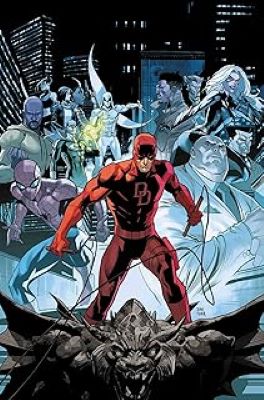
Daredevil @ 60: Part 3 – The Charles Soule Run (2015-2018)

During the tenure of the Netflix Daredevil series, the comic book of the same name was being helmed by novelist Charles Soule, whose run can be summed up as a bit more literary and a lot more noir. In retrospect, it was the perfect print companion to the TV show’s psychological portrayal of the title character, a monthly offering that Soule claimed on his website at the time of its debut “should sort of feel like the Daredevil you know, the one you’ve been watching on Netflix.”
As with any form of fiction, some writers have a superb sense of melding characterization and narrative. Those that don’t simply rely on plot to carry their tales. The former generally have the edge. And Soule undoubtedly belongs in that category. As a comic book writer, his dialogue informs as much as it advances the story. It offers insight into and illustration of characters. In advance of the run’s launch, he told Comic Book Resources his intention was “to focus on telling some deep stories that could really dig into character in an interesting way.” Douglas Ernst noted in April 2016, “Perhaps the best way to describe Soule’s writing is ‘efficient.’ Words are not wasted. Each word means something. Each sentence is important. There is a plan.”
And indeed, there was. “I see the run as a huge novel – I’ve currently plotted out through around Issue 24, the first two years on the title,” Soule explained in the December 2, 2015 post on his The Land of 10,000 Things website. “So, things that happen in these early issues…will have ramifications and resonance as we move forward.”
The result is a cohesive, alluring narrative with fully formed characterizations for both old and new personas. The run’s forty-six issues (fifty-plus if you count the sidebar series) form an exquisite juggling act with seemingly disparate pieces and personalities suddenly reappearing to resolve or illuminate subplots believed to be concluded. Hence, the source of Elektra’s conflict in the story arc of issues #6 and #7 and the twisted motivation behind it is revealed issues later in alter-ego Matt Murdock’s confessional flashback about how his secret identity was restored; an early heist in Macau with Spider-Man eventually serves as the foundation for the “Supreme” storyline; the cult leader Tenfingers disappears at the end of issue #5 only to reappear in later issues; the introduction of Father Jordan in issue #16 reaches its payoff in the “Mayor Murdock” narrative; and the serial killer Muse, introduced in the “Dark Art” plot, is given a return appearance during the “Mayor Fisk” arc. “The more layers you layer in,” Soule told Dave Richards in 2017, “the better the story tends to get.”
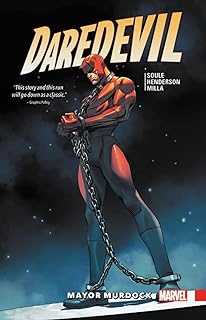
In a June 2018 post on his website, Soule admitted that he loves “playing the long game in comics,” which explains why his planning stage for Daredevil began in April 2015, over six months before the appearance of the first issue. In 2020, he described for Bryan Young the process of writing something like a Daredevil run, saying, “you probably have 20-25 issues in your head, the places you think the story is gonna go. And then you write, and if the story is received well, you get there, and if it is, you know by the time you’re at that point if it’s gonna continue. You have realized that you’re most likely gonna continue and you’re still thinking of ideas for almost what you might call Season 2.”
Marvel, in its 2015 reboot of things in the aftermath of Secret Wars, declared an “All-New, All-Different” line of familiar titles. Daredevil was one of many, having survived the first fifteen years of the new century under a varied array of writers and artists. Soule, who had already worked on She Hulk, Thunderbolts and Wolverine comics, was tasked with penning the reimagined Man Without Fear’s title, and he imbued it with a noir sensibility that allowed Ron Garney’s art in tandem with Matt Milla’s colors to create a unique feel and landscape.
Soule’s discussion with Cole Haddon earlier this year touched upon his approach to working with artists in the comic book medium, saying “I generally don’t ask my comics collaborators to do highly precise and specific shots or layouts – I give them the option of crafting sequences how they want to do them. That’s fun because it creates results I could never have anticipated…”
He acknowledged as much in a March 2016 interview with Comic Book Resources, in which he assessed that “the look [Garney and Milla] came up with for the book is a perfect mix of stylized and literal.” He also included an example of “one of the very first things Ron drew as we were talking about the series” in his December 2015 post. “That’s the image that let me know I’d be in fantastic shape art-wise for my run on Daredevil,” he wrote.
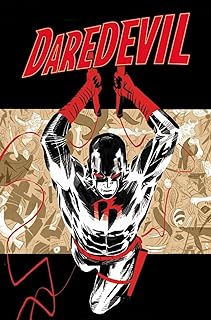
In the same post, Soule explained, “I knew almost from the start that I would go a bit darker, a bit weirder…It’s not a supernatural book by any means, but it is a creepy book, from time to time. I don’t want it to feel safe.” And it doesn’t. From newcomers Muse (who will appear next year in the Disney+ TV series Daredevil: Born Again) and Tenfingers to veterans like Kingpin and Bullseye, this Daredevil run constantly peers around corners and over shoulders. Its Daredevil moments, cast in their usual night settings, are enhanced here by an abundance of dark imagery including DD’s return to a black costume.
Describing the comic to Dave Richards in 2015, Soule said, “The book feels noir-y, and very intense,” he said. “Shadows everywhere — Daredevil almost haunts the book…I honestly feel like we could put the book out in black and white…Ron and I are trying to do something fresh here, that feels new while acknowledging the past.”
Soule’s three-plus years on what has come to be known as “Daredevil: Back in Black” began with a preview of his young sidekick, Samuel Chung/Blindspot, in an eight-page tale that appeared in All-New, All-Different Marvel Point One #1. Written by Soule and penciled by Garney with colors by Milla, the story introduces the character, an illegal immigrant living in Chinatown, working in maintenance at Columbia University by day, patrolling rooftops at night and protecting his territory wearing a self-created outfit that offers him invisibility. Hoping to encounter one of the veteran superheroes on his nocturnal excursions, he happens upon Daredevil, who not only saves his life but offers to act as mentor.
Team-ups for The Man Without Fear have existed to this day, but a sidekick/apprentice is a unique twist, founded on a psychological motivation, according to Soule. “Matt is training him for a number of reasons, but part of it is that he feels like he needs to give back, in a way,” he told Comic Book Resources in 2015. “He wants to make sure that if [Blindspot’s] going to do it, at least he won’t get himself killed.” The decision proved effective, largely because Soule had developed the character’s story arc, including his origin tale, in advance and, most importantly, accepted the consequences of teaming him with DD. “I don’t think you jump into Daredevil’s orbit and expect to get out unscathed,” he said in 2017.
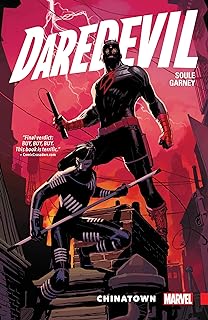
There are other alterations instituted during the run. Murdock returns to Hell’s Kitchen after a period in San Francisco. Daredevil’s identity, revealed to the world in Mark Waid’s prior run on the title, is secreted once again, its reversal explained during the first third of Soule’s run. Chinatown becomes the focus of the first set of stories. Most importantly, Murdock is now an assistant prosecutor for the District Attorney’s Office and has returned to the Catholic Church.
“As far as I’m concerned,” Soule explained to Comic Book Resources in 2017, “Matt Murdock is three things: attorney, vigilante hero and man of faith. Each pushes and pulls on the other and complicates him as a character.” Pitting the three components against each other created a more complex, more interesting Daredevil/Murdock duality, especially with Matt working as an assistant D.A. Frank Miller told Comics Feature that when he began writing and penciling the comic in 1979 his “first reaction was, ‘[Murdock] should be a prosecutor, he hunts down criminals.’” Soule pursued that line of thinking.
Murdock’s role as a prosecutor, Soule explained to Jay Barrett in 2019, allowed him “access to tools that we’ve never seen him use before. Like he had access to the tools of government, access to the cops to help him do things, and it kind of, in my view, made his ability to be Daredevil – it enhanced it a bit and made it different than we’ve seen before.” He told Comic Book Resources in 2015, “I think Matt feels that the two sides of his life are much more aligned now…he can see a case all the way through and makes sure a bad guy gets the sentence he deserves.”
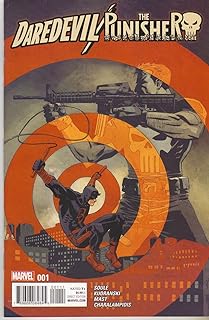
As a testament to that statement, Soule focused his sidebar Daredevil/Punisher four-issue arc Seventh Circle on Daredevil protecting a defendant in one of his alter-ego’s cases from an unfair trial and assassination by Frank Castle, the Punisher, as he’s transported to the airport for a flight to Texas, where he’ll be tried. The conclusion of the tale has the Punisher confronting the Devil of Hell’s Kitchen with the notion that a trial in Texas, which allows for the death penalty, is the same type of justice Castle is trying to dispense.
It’s apparent that Daredevil is fully aware of the defendant’s fate in the Lone Star State. When Castle tells him, “You want to see him punished just as much as I do,” he admits, “I do, Frank. But not by me. And not by you.” It adds to the complexity of a character who, as a lawyer, previously defended clients and, as Daredevil, refrained from killing villains, allowing instead the law to decide the verdict. Now, as prosecutor, he can accomplish what Daredevil and defense attorney Murdock have chosen not to do.
The “Supreme” storyline of the DD arc is designed to feature Daredevil’s alter ago as Murdock argues a case that would allow masked superheroes to testify as confidential witnesses in crime trials. The reader is given the opportunity to witness a battle of a different nature from those of Daredevil’s. Throughout five issues, the playing field leads all the way to the Supreme Court as each courtroom becomes a chessboard carefully maneuvered by Murdock in a contest of guile between himself and Legal, the attorney hired by Wilson Fisk.
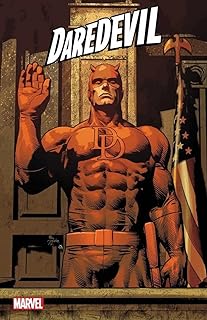
Both Murdock’s legal career and his vigilante role are informed by his religious background in Soule’s run, even if justice in the Seventh Circle narrative favors the Old Testament. In his March 2016 Comic Book Resources interview, Soule explained that “Matt’s relationship to his faith is and will be a running theme throughout the stories I’m trying to tell.”
That relationship dates back to 1964 when the character made his Marvel debut, but Miller is credited with exploring what that meant for the character. Matthew J. Cressler has noted that Miller transformed Daredevil into “a gritty crime noir comic that forced readers to confront the ‘ugly physical violence’ at the heart of the superhero genre itself. Making the character Catholic was part and parcel of this transformation. In fact, Miller later quipped that Daredevil ‘had to be Catholic, because only a Catholic could be a vigilante and an attorney at the same time.’” It helped that Miller was raised a Catholic, as was Soule, who is also a lawyer.
Until the 2015-2018 run, Murdock/Daredevil had been largely portrayed in the Modern Age of Comics as a lapsed Catholic. Such a state deprived him of the extra layer of drama and character development derived from the duality offered by his religion, something the Netflix series seized upon. On TV, Murdock and his alter ego didn’t only battle villains like Kingpin and Bullseye; his own insecurities and doubts are fueled by his roles as lawyer and vigilante, by being the Devil of Hell’s Kitchen in the service of God and by the limitations that imposes in carrying out justice in the courtroom and on the streets. These aren’t so much battlegrounds as boxing rings.

Kelsie Mattson’s 2022 article about the Netflix series, “The Gospel of Daredevil,” argues that “Matt’s grounded in a doctrinal reality authentic enough for any Catholic to recognize…only when he accepts religion on his terms, dragging his beaten self back to God even when he’s angry and reluctant, does he find peace. Catholicism holds the answer to his conflicted selfhood as neither a malevolent devil nor an avenging angel but a human in between like everyone else.”
Soule seems to make the same point. In discussing Daredevil’s religion with Dave Richards in 2017, he said, “I’ve always thought it was a hugely important part of Murdock’s background, a rich vein to mine,” and he chose to return Murdock to the Catholic Church. The moments in which the character is seen in confession with Father Jordan, appropriately enough during the “Identity” story arc, play out as much as a psychiatric session as a religious sacrament. Jordan, who offers his own contribution to religious duality with the Ordo Draconum, recognizes the necessity of healing both psyche and soul, and he treats Murdock as neither devil nor angel, only as human.
From the start of the run, Daredevil’s faith is challenged by Tenfingers, a cult leader threatening Chinatown. “I really wanted to hit the religion/cult dichotomy…” Soule explained in his March 2016 interview. “Tenfingers sees himself as the agent of a higher purpose, and literally anything he does in service of that purpose is therefore justified.” In its 2018 review of the “Chinatown” story arc, the Comic Vault examined this dynamic further: “Matt chooses to put his belief in the law, while Tenfingers’ religious zealotry offends his Catholic principles. But at the same time, clear parallels are made between Daredevil and the man he’s fighting against. Both believe their powers are God given, that they should use their abilities to carry out his will. Matt doubts himself a lot…[and] Soule’s portrayal of Daredevil is a beautifully crafted character study of a man wrestling with his inner demons.”
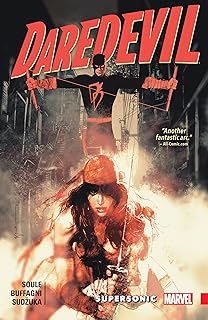
But the character isn’t alone in his torment. Blindspot spars with his own demons and Elektra is confronted with her worst fears when she is made to believe that her daughter has been kidnapped and Daredevil was involved. The daughter is fictional, an illusion allowed to play its part within the scheme of a subplot, but it remains real to Elektra and her response to it provides a unique view of her as a mother willing to go to great lengths to find her child.
“Elektra expresses a sentiment that I think is completely in line with her character, but isn’t something we see said all that often,” Soule commented in a May 2016 post on his website. Two months earlier, he had described her demeanor as “very dark, driven.” Six years later, Soule contributed a short tale set in an alternate reality for the Elektra: Black, White and Blood series in which he revisited the concept of Elektra having a daughter, this one with noticeably red hair in the final panel. As in his Daredevil run, Soule’s contribution is what Henry Varona calls a story “about Elektra’s humanity.”
Soule’s portrait of Daredevil as vigilante may be dark, but that can be partially attributed to the new villains he faces. Tenfingers is brutal as well as legally savvy, with a charismatic touch to lure and control his legion of followers, but it’s Muse, introduced in the “Dark Art” arc of issues #10-14, who’s the more frightening because there is so little known about him other than his appearance and his crimes. Of the former, John Schell notes that “his backpack and hat make him look like a hipster guerrilla artist, while the white costume and mask are like a blank canvas. However, the image of what looks like blood flooding down from his red eyes and pooling onto his chest, that is truly memorable and unsettling.”
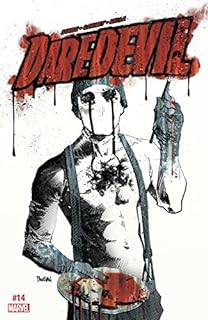
As a serial killer, he perceives his work as art and expresses a genuine interest in Daredevil’s opinion of it yet, Schell surmises, “he appears to be a void of sensory information to the Devil from Hell’s Kitchen, as he somehow draws in nearby sensory input into himself. It’s an unnerving and impressive image, hinting at even more mysterious abilities.” Unmasked, he still offers no clues as to exactly who or what he is other than “an agent of utter chaos,” as Soule referred to him in 2018. “He’s completely unpredictable. You don’t know what he’s going to do next, or even why he does anything…”
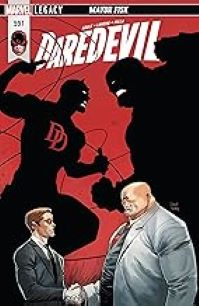
If the Muse plot is captivating because of its antagonist, 2017’s “Mayor Fisk” narrative, the premise of which will be part of the upcoming Daredevil: Born Again TV series, is compelling for its slow boil, as all ingredients are gradually introduced and blended together in just the right proportions to unleash a suspenseful tale about politics and crime. Describing the narrative on his website in July 2018, Soule stated, “Plots intertwine, you get tons of callbacks, and it all builds to a massive Kingpin storyline…” But it takes a novelist’s eye to see and then weave these strands together, using Fisk, Daredevil/Murdock and Muse as three interconnected points, the action of each determined by what the other two do.
The writing and Stefano Landini’s and Garney’s artwork capture the look and feel of NYC, and not simply because the focus is on Fisk as mayor. The arc is filled with familiar sights and sounds that define the location along with the fictional characters who call the five boroughs home in the comics. “I think of the supporting characters as flavors in a Daredevil stew,” Soule told Dave Richards in June 2018. “Daredevil’s the main thing you taste, but Spider-Man, Elektra, all the rest give it accents.”
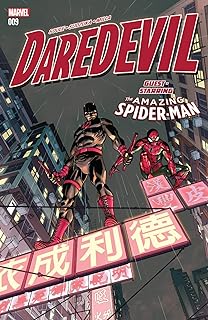
The superheroes who lend Daredevil a hand in the “Mayor Fisk” tale appropriately include DD’s partners in the Defenders, Luke Cage, Jessica Jones and Iron Fist. The team’s comic book, penned by former Hornhead writer Brian Michael Bendis, had been running concurrently with the Daredevil series, and Soule told Comic Book Resources in 2017 that he and Bendis had been “working to make sure everything connects in a satisfying way…”
The Defenders, Spider-Man, Moon Knight and Elektra are still there in the subsequent tale, “Mayor Murdock,” a narrative Soule acknowledged as a genre mix of horror and “city under siege,” as the Hand invades NYC and Daredevil and his alter ego defend the city both on the streets and in the local government. Now mayor, Murdock uses his temporary position to wield both superheroes and supervillains as weapons against the Hand and its leader, the Beast. “I needed him to be defending his city from certain doom on every level,” Soule said in June 2018, “and that’s this story.” We are provided with the best view of who this character really is as the final battle reaches biblical proportions, leveraging Matt Murdock, his faith and his roles as vigilante and attorney into the necessary strategy and power to confront an evil as threatening as this.
With the conclusion of the “Mayor Murdock” arc, Soule undertook Hunt for Wolverine, a series serving as a prelude to the resurrection of the title character. In addition to penning the opening and closing stories, he also oversaw the entire project and authored Weapon Lost, one of four mini-series that followed various teams searching for Wolverine. Soule said in April 2018 that the narrative is set in motion when Daredevil “recruits a group of smart investigative types” comprised of fellow New Yorker Misty Knight, Inhuman Frank McGee and the X-Men’s Cypher. With DD in charge, they become part of what Soule called a detective story. “I’ve always thought of Daredevil as a great detective character,” he said in June 2018, “and this book leans into that in a big way.”
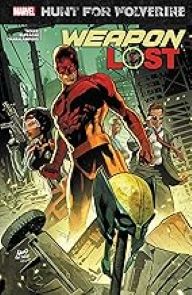
As in the Seventh Circle arc, Weapon Lost provided Soule with a new avenue for the Man Without Fear and a different set of literary tropes. Here, Daredevil functions as a sleuth alongside two former NYPD detectives and a language/coding genius. A fast-paced, intelligently plotted thriller, the story is told from DD’s case files and includes “lots of shadows and red herrings and all of that,” as Soule described it. It was a brief respite from the character’s usual activities prior to entering the final volume of “Back in Black,” its final issue published the day before the cancellation of the Daredevil Netflix series was announced.
Beginning with three issues marking the return of Mike Murdoch through the four-issue concluding tale of the run, the tone of the comic gradually changes in narrative and color. The storyline feels less grounded, more tentative. The shadows and darkness have receded, with nighttime tinted a pacifying blue. Daytime sequences engage in a more colorful palette than the earth tones of earlier arcs but seem filtered, as if in a haze at times. And then there are those single black interruptive panels that say more than they visually convey. This is “The Death of Daredevil.”
Soule, in September 2018, explained the history of concluding a run this way: “It’s part of a long tradition of Daredevil writers doing everything they can to screw with the next writer.” But it’s also an opportunity to pay tribute to the legacy of the comic book title and to acknowledge the current run’s place within it. “You never own these characters, you just guide them for a time and try to add things to their stories and their legacies,” Soule said.
Each of the final four issues examines a particular fear of the title character: Thanatophobia, or fear of death, Pistanthrophobia, which Soule refers to as “the fear of bad romance,” Phobophobia, fear of fear, and Apeirophobia, fear of the infinite or eternity. It’s a fitting closing investigation of the character also known as “The Man Without Fear.” But in a November 2018 post, Soule pivoted on the subject, suggesting the phobia of not mattering as DD’s most pronounced fear, writing, “this arc (and, to a degree, the run as a whole) is about the fear of nothing you do mattering. I think that’s maybe the only thing Daredevil really fears – and it’s a fear I think many of us can relate to these days.”
In February 2018, Soule had acknowledged fans’ response to the run, saying, “Everyone involved in this book has absolutely noticed that a bunch of fans seem to be checking out “Mayor Fisk” and enjoying it – we’re getting lots of great feedback, issues are going back to print, all that amazing stuff.” There must have been an increase in attention for the title at the time because the “Deardevil” letters page, missing from earlier comics in the run, appeared during the “Mayor Fisk” plot. In issue #598, Joe Brown equated the “Back in Black” series to the television production, writing, “Marvel TV knows what they’re doing. And, evidently, so does this creative team.” In the same issue, however, Tim Burnham reported that “I feel as though this run has been criminally underrated so far…”
That, unfortunately, may still be true today. Soule’s work belongs with the best of six-decades worth of Daredevil comics, yet, in the Modern Age, it does not share the same attention or superlatives accompanying the Bendis or Brubaker periods of the late 1990s/early 2000s, nor does it dominate discussions about the title over the past fifteen years. That may make it an underdog, but in name only. Considering the run’s protagonist, the thought of it not finding its proper place in the comic book canon is not an option.
“I cannot see the light, so I will be the light,” Daredevil says in the last issue of the “Mayor Murdock” arc and again in the concluding issue of the series. In a July 2018 post, Soule assessed the character and the overarching theme of the “Back in Black” series in relationship to a line he felt was important enough to include twice in his run. Daredevil, he wrote, “blames himself for what he sees as significant failings, internal and external, and uses his dual careers as vigilante and attorney to address things, to make things right. But what he doesn’t realize…is that the rest of the world doesn’t see him that way. To everyone but himself, he’s a hero, constantly and selflessly. It’s Daredevil’s biggest blindness – he can’t see the light he brings to the world. That’s what this story has been about, and my run has been about.”
Sources
Barrett, Jay. “Meet your hero: Charles Soule talks his runs on Wolverine and Daredevil,” AITP Comics, 5 December 2019. retrieved from aitpcomics.com.
Cressler, Matthew J. “Daredevil: The Man Without Fear and White Catholic Masculinities.” CrossCurrents, vol. 72 no. 2, 2022. retrieved from Project MUSE.
“Daredevil: Back In Black: Chinatown Review: Putting Your Faith in the Right People,” The Comic Vault, 18 October 2018. retrieved from thecomicvault.wordpress.com.
Ernst, Douglas. “Daredevil, Elektra Sizzle Under Soule’s and Buffagni’s Direction,” Douglas Ernst Blog, 27 April 2016. retrieved from douglasernst.blog.
Haddon, Cole. “Q&A: Writer Charles Soule on the Roads Taken and Not Taken,” 5AM StoryTalk, 10 February 2024. retrieved from colehaddon.substack.com.
Howell, Richard and Carol Kalish. “An Interview with Frank Miller.” Comics Feature #15, December 1981.
Mattson, Kelcie. “The Gospel of Daredevil: Matt Murdock Personifies the Struggle of Having Faith,” Collider, 2 September 2022. retrieved from collider.com.
Richards, Dave. “Classic Foes Return, Dark Secrets Unveiled in Soule’s Daredevil,” Comic Book Resources, 25 January 2017. retrieved from cbr.com.
Richards, Dave. “Interview: Soule Challenges Daredevil as a Superhero and NYC Mayor,” Comic Book Resources, 20 Jun 2018. retrieved from cbr.com.
Richards, Dave. “Soule Brings the Reign of Mayor Fisk to a Climax in Daredevil #600,” Comic Book Resources, 2 February 2018. retrieved from cbr.com.
Richards, Dave. “Soule Haunts “Daredevil” with Old Foes, Flames — and Elektra,” Comic Book Resources, 18 March 2016. retrieved from cbr.com.
Richards, Dave. “Soule’s ‘Daredevil’ Reinvents Itself on the Mean Streets of Chinatown” Comic Book Resources, 14 August 2015. retrieved from cbr.com.
Schell, John “Muse: The Life and Death of Daredevil’s Most Terrifying Villain,” Comic Book Resources, 5 November 2019. retrieved from cbr.com.
Soule, Charles. “Ch-Ch-Ch-Changes!” Charles Soule, 21 September 2018. retrieved from charlessoule.com.
Soule, Charles. “Daredevil #605, Darth Vader #18,” Charles Soule, 11 July 2018. retrieved from charlessoule.com.
Soule, Charles. “Daredevil #610,” Charles Soule, 31 October 2018. retrieved from charlessoule.com.
Soule, Charles. “Daredevil #612 Death of Daredevil Finale, Darth Vader #24, Return of Wolverine #3,” Charles Soule, 28 November 2018. retrieved from charlessoule.com.
Soule, Charles. “Daredevil TPB Vol. 6. Mayor Fisk,” Charles Soule, 25 July 2018. retrieved from charlessoule.com.
Soule, Charles. “Hunt for Wolverine #1, Darth Vader #15, Darth Vader Vol. 2 – Legacy’s End,” Charles Soule, 25 April 2018. retrieved from charlessoule.com.
Soule, Charles. “Poe Dameron #28, Daredevil #604, Curse Words #15,” Charles Soule, 20 June 2018. retrieved from charlessoule.com.
Soule, Charles. “What “I’m working on… (aka 4-book Wednesday),” The Land of 10,000 Things, 25 May 2016. retrieved from charlessoule.wordpress.com.
Soule, Charles. “Without Fear. (Thoughts on the start of my Daredevil run.),” The Land of 10,000 Things, 2 December 2015. retrieved from charlessoule.wordpress.com.
Varona, Henry. “Marvel’s Elektra: Black, White and Blood #1 Comic Review” Comic Book Resources, 11 January 2022. retrieved from cbr.com.
Young, Bryan. “Charles Soule: On Writing Comics and Novels,” Writer’s Digest,4 August 2020. retrieved from writersdigest.com.
Related Articles
Daredevil @ 60: Part 1 – Hell’s Kitchen
Daredevil @ 60: Part 2 – The Netflix Series
Daredevil @ 60: Part 4 – Miller’s Elektra









 Epistrophe
Leave a comment