
September 15, 2024 (updated November 2, 2024)
Robert Hunter: Tales of the Consummate Writer
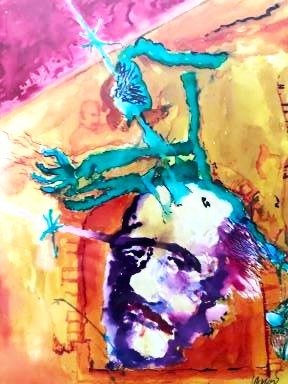
In his artistic rendering of songwriting partner Robert Hunter, Jerry Garcia depicts a man mentally grappling with the 1991 Gulf War. Shadowy images peer through arcing bolts of green emanating from the unsmiling, contemplative disembodied head of the subject. We’re told in a 2014 caption that what is “emerging from his head absorbs vibrations and static.” (1) The Poet Reflects the War is the title given to the portrait, and its images are akin to Hunter’s verse, his creative prose and his lyrics, simultaneously telling and cryptic, nuanced and cadenced. And it’s a moment in which Garcia’s identity as the Grateful Dead’s lead guitarist and Hunter’s role as the band’s wordsmith are abandoned. Here, they are unmistakably artist and poet.
Hunter did, in fact, reflect the war in the epic poem A Strange Music, a 246-page free verse poem that followed TV coverage of the event from start to conclusion over a six-week period, “the first true television war, showing the potential for manipulation of mass consciousness in a way never rivaled.” For him, it was as if “a strange music insinuated itself deep in my tissue, a music without melody during these days when I elected to become a voluntary prisoner of a war fought on a 27-inch battlefield.”
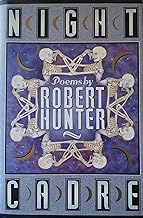
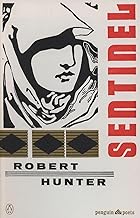
A Strange Music never reached print publication. Neither did Hunter’s only novel, The Giant’s Harp, a fleshed-out narrative of a tale alluded to in the “Terrapin Station” suite. Short poems written during the 1990s along with journal entries, a screenplay draft and correspondence are also missing from his print-published oeuvre that includes Night Cadre (1991), Idiot’s Delight (1992), Sentinel (1993), Glass Lunch (1997) and translations of Rilke’s The Duino Elegies and Sonnets to Orpheus (1993). All but one of the poetry collections have been out of print for some time now. And then there’s Hunter’s short story collection, Red Sky Fishing, which was never intended for traditional publication and is also currently unavailable.
Hunter’s still-yet-to-be-recognized status as poet and prose writer among literati and Deadheads may one day be remedied, but at the moment, because of the scarcity of his catalog, it’s nice to have two releases by him this year in song and prose: the October 8 publication of what is touted as a “lost manuscript,” The Silver Snarling Trumpet, an account of his and Garcia’s early days during the gestation period for what became the Grateful Dead, and an expanded and remastered 2-CD edition of his first album, Tales of the Great Rum Runners. Both, in a sense, are origin stories.
Hunter’s own origins date back to 1941, when he entered the world in San Luis Obispo, California as Robert Burns. The son of a serviceman in the U.S. Navy, he spent his youth relocating to whichever city his father was stationed. As Hunter told Mary Eisenhart in a rather forthcoming 1984 interview, “I’m from up and down the West Coast. I’ve lived in Portland, Seattle, San Francisco, Palo Alto, Los Angeles, Long Beach, all that and a couple of years in Connecticut, in my growing-up period. Never in one place too long. I think Palo Alto about the longest of all— I spent between 8th and 11th grade there. Up till then I think I went to a different school every year, which certainly helped to develop my outsider feelings, always the new-kid-in-school stuff. I grew up defensive that way, I think.” (2)
Before his father deserted the family in 1948, Hunter formed a lasting image he described to Bob Sarlin years later: “My dad was sort of a soldier-of-fortune type dude. He was a good hustler…I remember we’d be driving along in the old panel truck, and we’d drive by a bar – he was an electrician too – and the neon sign would be out…he’d go up there and do a few things with the wires and the sign would go on, and then he’d go in and drink up his pay.” (3)
Hunter’s parents divorced in 1950 and his mother then married Norman Hunter, a man who, according to Sarlin, “prided himself on his intellectuality.” (3) Sarlin perceives the influence of Hunter’s father and stepfather on the lyrics he would later write, assessing that, in the early 1970s, the workingman “character who inhabits many of the best of his songs might well be patterned after his father, while the poetic and philosophical approach of the songs could well be attributed to his stepfather.” (3)
Hunter’s interest in books began at an earlier age than this theory seems to imply. According to Dennis McNally, by the age of eight Hunter had read “Steinbeck’s The Red Pony, then Howard Pyle’s Robin Hood, Robert Louis Stevenson, all the usual children’s adventure material.” (4) After that, it was simply a matter of widening the scope. When he was asked by Eisenhart what his tastes were in books, he responded, “There’s my collection over there [he points to a shelf filled with most of the great works of Western literature], and I hope to have most of that read before I kick off. I was raised around books. My father was in the book business with McGraw-Hill, and so we had a splendid library around the house, and I’ve grown up reading.” (2)
McNally suggests that Norman Hunter “brought to Robert’s life not only stability but a stimulating intellectual atmosphere,” (4) which was on view in Hunter’s discussions of writers over the years. In 1975, he said he had “stopped at the bookstore to buy The Golden Notebook by Doris Lessing and The Process by Brion Gysin,” in addition to reading Anais Nin. (6) Nine years later, he declared, “Proust and Spenser, The Faerie Queene, those are the two biggies.” (2) In 1988, he told David Gans that Walker Percy and A Confederacy of Dunces by John Kennedy O’Toole had been his recent reads. (7) Four years on, Hunter discussed Finnegan’s Wake, Lee Welch’s On Out, John Ashberry, James Merrill, Jack Kerouac’s Pomes All Sizes and Anne Waldman. (8) And in 1996, he was enjoying works by Philip K. Dick and H.P. Lovecraft. (9)
However influential his stepfather may have been, Hunter noted the contribution his mother and grandmother made to his career. He recalled, “the first thing I remember was my mother keeping me up to date on the pop tunes of the day. She was nineteen and played the radio all the time…” (5) And McNally reports that “he began playing music at age nine, when his grandmother gave him a Hawaiian steel guitar.” (4) His interest in both music and books were fixtures in his early life. By the time his family relocated to Connecticut, where he finished high school, he had written his first song at age seventeen and performed as a trumpeter in a Dixieland-flavored band, The Crescents, before turning to folk music during his only year at the University of Connecticut.

The tale of his subsequent return to California shortly thereafter is what comprises The Silver Snarling Trumpet, the title of which derives from “The Eve of St. Agnes” by Keats: “Soon, up aloft, the silver, snarling trumpets ‘gan to chide.” It would be safe to say that Hunter’s choice to identify the instrument as singular instead of the plural of the poem is probably of note.
The publication of the book as a “lost manuscript” is certainly solely for the purpose of marketing. Dead fans have been aware for two decades that there are several excerpts/quotes from the manuscript on offer in McNally’s Grateful Dead biography, Long Strange Trip, which describes the work as a novel about the California group of people with whom Hunter and Garcia hung out in the early 1960s. The influence of the Beat writers is apparent in its depiction of one associate mentioned in Long Strange Trip. It’s also evident in what McNally reports is Hunter’s use of “his feelings as an artistic goad, referring to himself as a ‘prophet of melancholy.’” (4) But upon completing the novel, McNally informs, Hunter considered it “too short, and he rewrote it, waxing ever longer and more philosophical.” (4)
Hunter admits regretting the rewrite in the “Author’s Note” of the published version but concludes that “to change it or delete it would be a disservice to the twenty-year-old mind that conceived it, and whose book it is.” He describes the setting of the book as “an era best designated post-Beat and pre-hippie,” identifying that “its chief value will be to refresh my memory of what I was about every couple of decades, and to serve as source material for those with time and energy to construct a more complete picture of these and subsequent events.”
Most importantly, The Silver Snarling Trumpet contains some of Hunter’s earliest explorations in language and genre. It would lead to a diverse catalog ranging from non-fictions to short stories and a novel to structured and free-verse poetry and lyrics. In more than one interview, he spoke of identifying with the novelist persona, having admitted, “I started my first novel when I was eleven” and “when [music] turned [to] rock and roll, I turned to my typewriter…I thought of myself as a Serious Novelist before I first started writing for the Dead.” (2)
Initially, prose served as an exercise for lyric writing. As he explained in the January 1975 issue of Crawdaddy magazine, “An occasional flap at prose gets a lot of garbage out of my head and frees up my lyric flow. Lyrics is a form which demands great economy and striving for succinctness of image or statement…” (6) In 1974-75, written correspondence became a prose outlet. “My method is to write a lot,” he said at the time. “I try to write every day, if only letters. I answer all the letters which come to me and take great delight in doing so.” (6)
The act of letter-writing also became customary in handling interviews at the time. Bruce Pollock, in his introduction to the Hunter chapter from In Their Own Words, wrote that “this interview took place totally through the mails, with Hunter responding to my request for an interview with a ten-page letter. A second letter followed in response to my request for further information…” (5) The same technique was used for the Crawdaddy article, in which Hunter explained, “the written interview…allows me to practice my prose with some motivation.” (6) Curiously, Hunter expressed little confidence in his non-poetic work at the time, saying, “I don’t expect I’ll write anything very worthy for many years in the field of prose.” (6)

Although he only completed one novel, his use of the form can be seen in the lyrics he composed for song cycles. As he explained to Eisenhart upon the release of his narrative album Amagamalin Street, “I’d like to revivify this whole song-cycle idea—Townshend did it with Tommy, a thematic idea. With “Terrapin” I was trying to develop a thematic idea, and unfortunately only a certain amount of it got onto the record. It’s a much longer thematic piece…This is the form I want to pursue. I mean, I still want to write individual songs, songs by themselves, but I think for the time being I’m very much on the idea of—I’m a novelist. I’ve got novels tucked away up here that I’ve been writing. I don’t think I’m a very good novelist. I think I’ve got a lyric gift more than I have a prose gift. But I have a novelist mentality. I like plot and whatnot.” (2) Yet, Hunter readily acknowledged that he favored writing verse, telling Eisenhart, “I’m looking forward to getting back to my poetry, because there’s something it fulfills in me that nothing else does.” (2)
Hunter’s earliest forays into song cycles can be traced back to the 1960s with the unrecorded “Eagle Mall” and the Grateful Dead’s 1969 album Aoxomoxoa. As David Dodd noted in his essay “The Aoxomoxoa Song Cycle,” “The fact that Hunter wrote an explicit song cycle, ‘Eagle Mall’…is evidence that he was thinking in an interconnected way about his lyrics at the time,” while also identifying that “the ‘Eagle Mall’ suite is interesting for several parallels in motif to the Aoxomoxoa songs…” (10) And Christopher K. Coffman has noted “the connections of plot, character, and setting among the ‘Eagle Mall’ suite (ca. 1968), the ‘Terrapin Station’ suite (1977), the additional material for the ‘Terrapin’ suite included on Hunter’s Jack O’Roses (1980), Hunter’s unpublished novel The Giant’s Harp, first fully drafted in 1986, and the additional material for the ‘Terrapin Station’ suite published in the early 1990s in A Box of Rain…” (11)
The song cycle, then, seems to serve as a compromise between Hunter’s novelistic ideas and his proclivity for verse. In fact, it wasn’t until 1992, long after the suites had been written and still early in a decade that would witness five published collections of Hunter’s original poetry, that he acknowledged, “I’ve only been conscious of myself as a poet for about the last four years.” (8)

Hunter was conscious of more than his roles as a writer. In the January 1975 issue of Crawdaddy, his extensive letter was accompanied by a photograph of himself sitting in front of a piano. Unlike Garcia’s portrait, here Hunter’s face is intentionally hidden by a sheaf of papers. “I’d rather own my own face,” he had told Bob Sarlin several years earlier. (3) But his obscured visage redirects the viewer’s attention to the more revealing details in the photo – the piano, framed by a guitar and bagpipes, a collection of stacked or leaning books, including The French: Portrait of a People, The Ungodly and the Baghavad-gita, a copy of the album jacket for Workingman’s Dead, a picture of Bob Dylan, a metronome and a typewriter. What’s on view is self-referential, an identity or a resume of sorts, sans language. It seems to be saying that the subject, like the photo, contains multitudes.
The photograph’s details are predominantly musical, and for Hunter there was a musicality that accompanied all his writings, particularly poetry. “When I admire a poet,” he said in 1975, “I like to read his works into my cassette machine, then listen back, hoping to influence my work with internal music not necessarily my own.” (5) But the first of Hunter’s actual music was his 1974 album release Tales of the Great Rum Runners, which happens to contain plenty of guitar, some bagpipes, a dash of Dylan and a workingman’s sensibility. Rhino’s new two-CD release, remastered and augmented by a disc of outtakes and alternate versions, is the first of Hunter’s solo albums to receive the deluxe treatment.
The year before the initial release of Rum Runners, Sarlin noted the low profile of the Dead’s lyricist, writing that “Hunter is invisible by choice: no photographs, no publicity, rare interviews granted reluctantly.” (3) All that began to change when his first solo album hit the racks. Hunter began explaining things like the cost of his recording sessions: “I made about fifty grand last year. I spent half of it making my record and paying the musicians who played on it.” (6) He also discussed the reasons for a solo album, saying that Rum Runners “affords me the luxury of more personal statements, as only I must be answerable for their content… Releasing my own record is a calculated gamble in this direction, and I feel I’ve sustained sufficient stability to be able to handle the negative aspects of personal recognition with some grace.” (5)
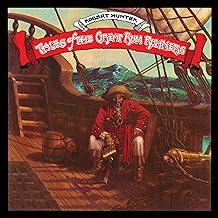
Recorded at Micky Hart’s Rolling Thunder Ranch and featuring members of the Dead as well as other key San Francisco players, Rum Runners is the birth of Hunter-as-recording-artist, an extension of his role as lyricist. It would launch an alternative career and a series of albums over the next several decades before a series of literary endeavors took priority. And, like The Silver Snarling Trumpet, it reaches back to Hunter’s formative years as a musician.
Many of the album’s songs would be called Americana today, but they are simply a return to Hunter’s early musical interests when, as he explained, “I considered myself a folksinger…” (2) The most lilting and alluring of Hunter’s balladry on tunes like “Boys in the Barroom,” “Rum Runners” and “Lady Simplicity” could almost be mistaken for traditional folk tunes. The slightly jazz-tinged horns on “Standing at Your Door” might conjure up The Crescents for a moment. The album’s best-known tune, “It Must Have Been the Roses,” covered by the Dead in Garcia’s favored dirge-like arrangement, is performed here in a quicker, folkier-sounding rendition that retains its achingly mournful tone. And in “Keys to the Rain,” “I Heard You Singing” and “That Train,” Hunter doesn’t try to hide Dylan’s overarching influence; instead, he leans into it, always incorporating just enough of his own poetic sensibilities into the verses and delivery to claim it as his own.
The previously unreleased material on disc two of the new set serves as a vantage point of the entire recording session and might tempt the listener to reconfigure the content and sequencing of the original album. While there are several tracks, particularly ballads, that would fit quite nicely on Rum Runners, most would sabotage the cohesiveness of the album were they to find their way onto it. No, the album fifty years later is still fine as it is, a rough gem whose moments of imperfection save it from becoming too self-confident.

If Rum Runners had freed Hunter from a self-imposed invisibility, his subsequent solo albums, such as Tiger Rose, and Liberty, his spoken word releases, including The Flight of the Maria Helena, and his aforementioned poetic publishings allowed him to maintain somewhat of a public persona that culminated in the 1990s with a presence on the World Wide Web.
Establishing The Robert Hunter Archive on dead.net, he proceeded to offer writings that had escaped publishing over the previous decade as well as new works and some that had already appeared in print. A Strange Music, The Giant’s Harp, the Rilke translations, “Raggedy Remus” “A Cupful of Rain,” and the Visions of the Dead movie script led the way, but Hunter didn’t stop there. He would upload his journals, conversations, correspondence and lyrics and encourage feedback from readers. His daily response to emails was carried out with the same voraciousness he exhibited in his letter-writing two decades earlier. He treated the site as an opportunity for direct contact with fans, eschewing interviewer and commentator alike, and even offered free downloads of soundboards of his live performances, consolidating his work as author, musician and lyricist in the then fledgling realm of Cyberspace.
It was therefore fitting that a new project in 2006 came in the form of a series of thirty-nine short stories which, according to their author, “pivot on the concept of transformation. Characters transform or fail to, but the notion is always uppermost.” (12) The tales have never been posted online or published. Except for anyone who has chosen to print them out for personal use, they exist as PDF files and their distribution has been through emails, beginning with Hunter sending them, at no charge, to anyone who wished to subscribe.
“Such activity constitutes a new idea of publication,” he wrote in the final email of the subscription on April 4, 2007. “It’s an experiment in the dark because there’ll be no way to tell how well it succeeds or fails…” And he stressed that “limited publication by email is encouraged but the author requests that none of the stories be published on the internet.”
Once he began circulating the stories, he engaged with his subscribers, informing them in a December 7, 2006 email, “I always awaken way before dawn on story day…It’s a keen excitement to send each of these small tales into the world to meet its readers. Would enjoy hearing from those who vine the stories to others as I have no idea of the extent of the readership other than that it’s growing each week as people become aware of it.”

His emails to subscribers date most of the writing of the Red Sky Fishing tales from March through May of 2006 and credit, in a December 14 email, the genesis of the collection to “Time of the Star,” which he refers to as “the story that made me think it might be an interesting idea to write more stories.” His interaction with online fans became as much a part of his creative process as the writing. As he noted in the April 4 email, “I’m concluding the continuity of weekly publication in a very positive frame of mind, having learned much about the dimensions of reader response which can’t help but influence further writing.”
The April 4 email also revealed that “new material is being written, but I want to let it sit around and gather moss before revising. I plan to send out new stuff once in awhile; haven’t decided yet how that will work. Need to write it first.” Instead, Hunter withdrew from his internet duties, decreasing his online presence until it ceased altogether well before his death in 2019. The older uploads remained but the promise of new works never materialized online or in emails, joining a selection of Hunter’s unpublished writings that include “Sister Joseph of Arimathea,” “Evald and Fanteon” and “Brass Axis.”
Had Hunter been playing with the ephemerality of print publishing by posting his works at the dead.net website? (Sadly, only two weeks after this article was posted, Hunter’s archives page disappeared from the internet, ending his works’ virtual existence.) Was emailing the short stories of Red Sky Fishing to subscribers or providing downloads of his music a means of preserving his creations with true believers who could continue to circulate and appreciate them? Were these attempts at immortality in the face of a presumed extinction of the physical? The reality is that, at the moment, there are more of Hunter’s writings now available in document/PDF files than are in print.
Kris Kristofferson may have best surmised the true nature of a writer when he described the protagonist in his song “Pilgrim: Chapter 23,” as “a walking contradiction, partly truth and partly fiction.” But language, the writer’s tool, is also a contradiction, as Hunter explained in his essay “The Thesis of No Thesis,” noting the “failing in the function of words, which are able to illustrate so much better than they can tell.” The consummate writer knows this. We need only refer to Hunter’s journal entry for October 24, 1996 to understand the potency of illustration: “Sitting at my desk this evening, working on Giant’s Harp, it occurred to me that this is exactly what I pictured for myself decades ago: in my mid-fifties happily occupied writing a book, a body of youthful work behind me.”
Notes
- Caption by Garcia’s daughter Keelin, wife Manasha or Roberta Weir” in the article “See Jerry Garcia’s Most Astounding Paintings and Sketches” Rolling Stone, 24 November 2014. The caption seems to have influenced the recent revisionist retitling of the painting as The Poet Absorbs the War for its use in the J. Garcia line of neckties.
- Mary Eisenhart. “Robert Hunter: Songs of Innocence. Songs of Experience” in The Grateful Dead Reader, edited by David G. Dodd and Diana Spaulding, New York: Oxford University Press, 2000.
- Bob Sarlin, Turn It Up (I Can’t Hear the Words), New York: Simon and Schuster, 1973.
- Dennis McNally, Long Strange Trip: The Inside History of the Grateful Dead, New York: Random House, Inc., 2002.
- Bruce Pollock, In Their Own Words, New York: Macmillan Publishing Co., Inc., 1975.
- Patrick Snyder-Scumpy, “Robert Hunter, Dark Star.” Crawdaddy, January 1975, 50-53. The article consists of a lengthy letter written by Hunter to Snyder-Scumpy.
- Grateful Dead Hour radio showtranscript of Robert Hunter interview 25 February, 1988 in David Gans, Conversations with the Dead, New York: Citadel Underground, 1991.
- Steve Silberman, “Standing in the Soul: Robert Hunter Interview,” Poetry Flash, December 1992. retrieved from www.uccs/ddodd.
- Transcript of Robert Hunter online chat hosted by Geoff Gould and Karen Libertore for AOL GD Forum/MacWorld Live Event, December 19, 1996.
- David Dodd, “The Aoxomoxoa Song Cycle,” Annotated Grateful Dead Lyrics, February 1995. retrieved from http://www.uccs.edu/ddodd.
- Christopher K. Coffman, “Robert Hunter’s Prose Debut: “Starship ‘Grateful Dead,’” Proceedings of the Grateful Dead Studies Association, Vol. 1, 2021. retrieved from www.deadstudies.org.
- Robert Hunter, email to subscribers, 4 April 2007. From summer 2006 through spring 2007 Hunter sent emails to subscribers of the Red Sky Fishing stories, each containing an attachment with a new story and usually a bit of information about it. Dates for subsequent quotes from this set of emails will be identified in the text and not footnoted.





 Epistrophe
Leave a comment