
June 1, 2026
John le Carre’s Tradecraft
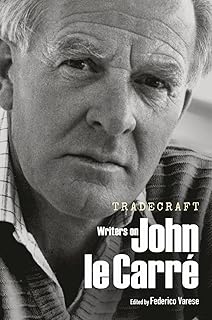
It began with an exhibition, Tradecraft, organized by the Bodleian Library of Oxford University showcasing a collection from the archives of author David Cornwell, aka John le Carre, who died in 2020. Co-curators Federico Varese and Dr Jessica Douthwaite assembled the exhibit, which ran from October 1, 2025 until April 6 of this year, featuring “research, drafts and corrections for his novels, as well as non-fiction, adaptations and personal correspondence” in addition to “annotated manuscripts of Tinker Tailor Soldier Spy (1974), The Constant Gardener (2001) and The Little Drummer Girl (1983),according to the John le Carre website.
What followed was a companion book, edited by Varese and also titled Tradecraft, containing a collection of eight essays mostly penned by individuals who worked with le Carre over his sixty-year career as master of spy fiction. The book’s midsection acts as an extension of the Bodleian presentation, filled as it is with photographs and typescript pages containing cross-outs and margin notes in the familiar le Carre handwritten style. While the images are well-selected, the midsection does manage to miss some of the exhibition’s curiosities like a hand-painted, bright-red stone reading “to fix” in white lettering that would be placed on piles of le Carré’s writings as a reminder of the editing needed to be done.
The essay collection opens and closes with pieces dwelling on the author’s late years. Director Errol Morris’s account of filming Le Carre for the 2023 documentary The Pigeon Tunnel is a rather appropriate summation and tribute to welcome us into Tradecraft. Nicholas Cornwell, le Carre’s son better known by his pen name Nick Harkaway, concludes the assemblage discussing his father’s A Delicate Truth (2013), A Legacy of Spies (2017) , the posthumous release Silverview (2021) and his own Karla’s Choice (2024).
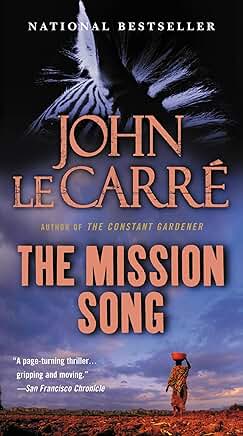
In between there are a variety of topics. The standouts Lawrence Osborne’s piece on le Carre’s overseas travels to research his eighth novel and author/journalist Michela Wrong’s “One Week in Bukavu.” Both demonstrate the homework undertaken to properly portray the inner and outer landscapes of places like Hong Kong and Rwanda for books like The Honourable Schoolboy (1977) and The Mission Song (2006), respectively. These two essays connect to the exhibition, which, as The Guardian reported, “shows the extent to which Cornwell, much like a journalist, relied on sources – they included his former colleagues in MI6 – and how he travelled extensively to research his plots.”
Morris, whose documentary was filmed over a four-day period in 2019, provides insights on what it was like to interview le Carre the writer, the observer, the contradiction who, on screen, calls the life of a double agent “self-imposed schizophrenia, the duality of all the time being the opposite of yourself.” It was, we’re told, an experience that led the director to “numerous philosophical investigations.” By the conclusion of filming, Morris came to see his documentary’s subject as “a tortured man,” “a philosopher” and “an exquisite poet of self-loathing.” With a laugh, le Carre agreed with the last.
Varese, in his introduction to Morris’s contribution, calls The Pigeon Tunnel “a visual essay on the nature of the interview, on what we learn when we talk to others.” During the documentary, however, le Carre equates interviews with interrogations and their accompanying “addiction to betrayal,” setting it apart from writing, which he clarifies as a journey of self-discovery in which the characters “tell me who I am.” The tradecraft of spying, it seems, was always in play, even in the absence of a Cold War or in the presence of an ally.
The piece by Nicholas Cornwell is equally insightful about his father and his creations. Between reminiscences about growing up in the Cornwell household and in the shadow of the le Carre legacy, he discusses his approach to inserting Karla’s Choice into the Smiley timeline and his own involvement with preparing Silverview for publication (le Carre finished the novel by October 2014, as he reveals in a letter to playwright Tom Stoppard, but “wasn’t convinced, wasn’t moved…& decided to dump it,” leaving his estate to determine its publishing fate). Calling his tweaking of Silverview “an act of filial piety,” he explains that the writing of “the book was complete but unpolished. It had small errors and moments of confusion…but it was fundamentally itself in tone and intent.” Silverview and A Delicate Truth, he believes, constitute his father’s Songs of Experience.
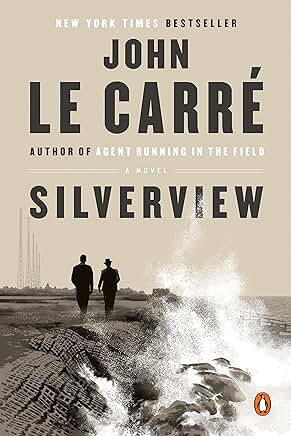
As the contributor closest to Tradecraft’s subject, Nicholas wields the most informative biographical details about le Carre’s later period. We learn, for instance, that A Legacy of Spies was written as the result of a proposed television series on The Spy Who Came in from the Cold (1963), during which le Carre “was thrown back into that world and produced Legacy in a flurry of creation and energy.” When the author questioned Smiley’s age in the novel after seven decades, Nicholas calmed his father’s concerns, saying he thought “people would readily accept it as a literary device.”
In engaging with his father’s world when writing Karla’s Choice, Nicholas considered the distinctions between the early “stark noir style” and “sheer, clean prose of The Spy Who” and the later “more reflective Tinker, Tailor” approach of the next stage. Constructing Karla’s Choice required honoring the latter, he says, to properly place it into the continuity between Spy Who and Tinker Tailor as the new transition into the Karla trilogy.
“He must make more of his facts,” reads an assessment written long ago by a Lincoln College tutor about the pre-pseudonymous David Cornwell, The Guardian reports. Proof that he heeded the advice is evidenced in the Osborne and Wrong pieces. Taken together, they form a travelogue of le Carre’s literal legwork in researching the environments, both social and political, of his intended settings.
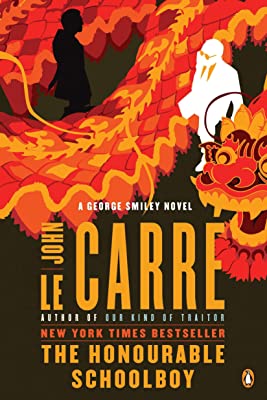
Osborne’s essay, a mixture of research and reflection, examines le Carre’s time in Phnom Penh and Hong Kong in preparing The Honourable Schoolboy is a study in context, ever so effective because it arrives nearly fifty years after the novel first appeared. “If ever Le Carre transcended the machinery of the spy novel without most of his readers even noticing, it was here,” Osborne observes, tying together the influence of Graham Greene, Buddhism (“its subterranean fatalism is there”) and the journalist collectives ensconced in the regions. Some of it has already been addressed by Le Carre in his version of an autobiography, The Pigeon Tunnel, but Osborne’s evaluation, consistently qualified as it is, adjusts the perspective for a panoramic view.
Wrong’s essay offers her first-hand account of le Carre’s Rwanda visit, counterpoint to the same events recounted in The Pigeon Tunnel (2016). Wrong is very forthcoming, delivering a detailed itinerary of the trip with the occasional revelation. After landing in Nairobi, she discovered “this trip marked, in David’s mind, a possible end to a career characterized by constant travel and a relentless production rate…maybe he would focus on shorter projects, he said.”
According to le Carre’s Pigeon Tunnel telling, Wrong was given an early draft of The Mission Song to review. She soon became an editor of a steady flow of revised manuscripts that included her recommendations. And she discovered the process behind the novels, writing, “he explained that he started with character, not plot, and went from there. Once the characters existed as three-dimensional beings in his own mind, the plot could be left to work itself out.” The Rwanda visit provided the cultural and historical accuracy required by the plot, the necessary “nuance” and “brushstroke” that gave the book authenticity in the final drafts before publications. Very frank about The Mission Song, Wrong does not consider it one of le Carre’s best, finding it “too careful, too polite,” and lacking the instinct he demonstrated in books about Communist Europe.
Other essays include a KGB view of the author’s novels by journalist Andrei Soldatov, a behind-the-scenes account of Hossein Amini’s screenplay for the film adaptation of Our Kind of Traitor (2010), Elleke Boehmer and Steven Matthews’s evaluation of the author as a world writer and Andrea Ruggeri’s look at international relations in le Carre’s novels, which concludes with a conjecture as to what the author might have written to address the current state of Israeli affairs. It’s a rather gracious acknowledgement of how le Carre spoke to more than simply the Cold War.
No one can be taken to task for viewing le Carre exclusively as a Cold War writer, but such a perspective imposes an undeserved limit on an author who examined his characters’ humanity or lack thereof as much as their undercover abilities. Yes, it had been the detective genre that provided the passageway for David Cornwell to enter the tradecraft of writing, and it was the Cold War that served as inspiration for a good portion of his career. But, along the way, world politics and the craft of spying became more complex as did le Carre’s characters. The East vs. West of the old days when, as the author told Morris, both sides “were inventing the enemy that they needed,” soon surrendered to other concerns once the Berlin Wall fell, ignoring, as Ruggeri notes, that “the world of espionage persists.” To that end, le Carre continued to cover it in all its guises, to report on it and to turn it into a fictional portrait for us to mull over and to hold up, as if it were a mirror, to nature.
Notes
Cornwell, Nicholas. “Writing with My Father: Karla’s Choice by Way of Silverview,” in Tradecraft: Writers on John le Carre, Federico Varese (ed). Oxford: Bodleian Library Publishing, 2025.
Cornwell, Tim (ed.). A Private Spy: The Letters of John le Carre. New York: Viking, 2022.
Morris, Errol. “David Cornwell and the Hopeless Uncertainties of History,” in Tradecraft: Writers on John le Carre, Federico Varese (ed). Oxford: Bodleian Library Publishing, 2025.
Norton-Taylor, Richard. “The Story Behind the Spy Stories: Show Reveals Secrets of John le Carré’s Craft.” The Guardian, 12 October 2025. retrieved from theguardian.com.
Phillips, Vicki. “John le Carré’s Archive is Feature of Bodleian Library Exhibition.” John le Carre website, 23 November 2025. retrieved from johnlecarre.com.
Ruggeri, Andrea. “The World Has Gone Mad: International Relations in the Work of John le Carre,” in Tradecraft:Writers on John le Carre, Federico Varese (ed). Oxford: Bodleian Library Publishing, 2025.
Wrong, Michela. “One Week in Bukavu,” in Tradecraft:Writers on John le Carre, Federico Varese (ed). Oxford: Bodleian Library Publishing, 2025.
Related Articles




Leave a Reply