
December 1, 2026
Christmas with the Devil of Hell’s Kitchen
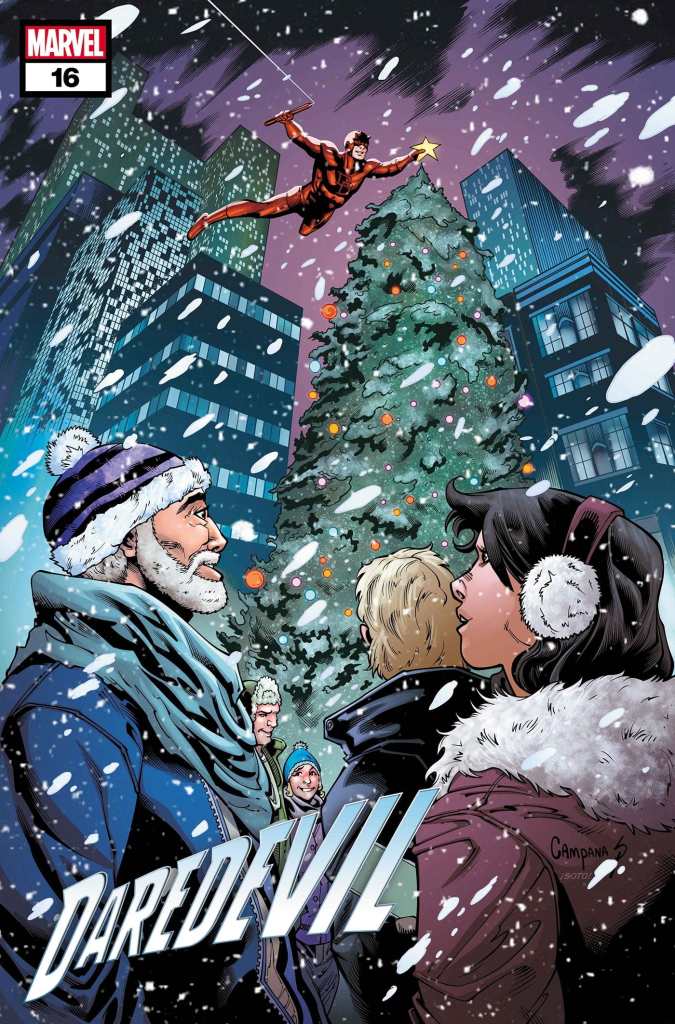
Some refer to him as DD. Others as the Man Without Fear. Punisher calls him Red. It’s true that Daredevil’s nicknames are as well-known as his official title, but on a few occasions Ol’ Hornhead also engaged in the holiday cheer as a sort of Christmas Crusader. While there are other tales about him set during the winter chill, most of the six examined below not only belong to the Yuletide season, they embody it. What’s more is that the setting isn’t the only thing tying them together as a unique collection of stories about the Devil of Hell’s Kitchen.
Although Roger McKenzie’s DD Christmas narrative “Snow” appeared in Marvel Fanfare #1 in late 1981, Frank Miller was the first to seriously integrate the character into the fabric of the holiday with issue #229, released in late 1985. The story, “Pariah,” was the third part of the Born Again arc, which finds the hero’s alter ego, Matt Murdock, at the lowest point in his life. With crime lord Wilson Fisk, aka Kingpin, aware of his vigilante identity, he is shorn of home, finances and reputation and badly beaten in a confrontation with Fisk. The tale, set during Christmas Eve and the following morning, much like Charles Dickens’s Christmas Carol, opens with Murdock’s recollections of the past when he was blinded, moves to the present where he searches for his childhood home in Hell’s Kitchen only to find it gone, and glimpses the future as a meditative Kingpin realizes he has provided his opponent the key to victory: “I have shown him that a man without hope is a man without fear.”
By the end, we witness Matt’s moment of epiphany while visiting the sole remnant of his youth, Fogwell’s Gym, where his father trained for boxing matches and Murdock secretly worked out after losing his sight. The only part of himself he still possesses, he acknowledges, is the fighter, and it’s no coincidence the next issue is titled “Born Again.” Just like Scrooge’s ghostly encounters, Murdock’s Christmas Eve experience has provided a second chance. Miller even punctuates his Dickensian narrative with a Fagin-like Turk Barrett, along with his accomplice Grotto, stealing Santa Clause suits so they can “shlep to the Upper East Side,” where “the rich ones give us money – and they feel better about being rich – and we feel better all around.”
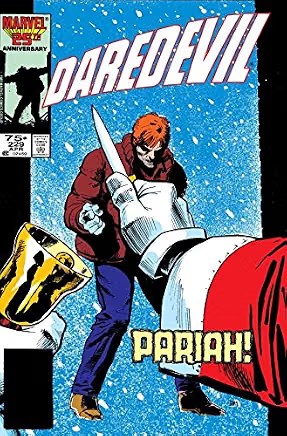
One year later, the next installment saw Ann Nocenti begin a run of DD holiday tales that produced a total of four in six years. Issue #241 led the way with “Black Christmas,” followed by “Merry Christmas, Kingpin” in the 1987 issue #253. Unfolding during Christmas Eve and Christmas Day, the tales are a study of its characters’ perspectives, which at times are not unlike Scrooge’s view of his life before those fateful visitations.
If the ability to read people is a fine art, “Black Christmas,” illustrates the danger of misinterpretation. Early on, a nun is given money collected by the youthful street gang called the Fatboys. She turns out to be a scam artist who fools even Daredevil. What follows is a series of shifting perspectives between characters such as an antagonist known as the Trickster, the crowd watching him on a tightrope, Daredevil and the Fatboys, whose members include the naïve Freddie.
“I like it out here on the edge,” says the Trickster high above the street with a crowd below looking to be entertained. “I like the perspective.” After saving Daredevil from falling, the Trickster proclaims, “Now I’m a hero too.” The statement leads to self-doubts for the Man Without Fear when, despite his efforts, he fails to return the favor. “He sought me out because I stood for something he thought was better than him…am I not careful enough of the image I present?” Meanwhile, Freddie dresses in a makeshift DD outfit to skateboard from one roof to the next, a feat taught him by Daredevil. “You got any more tricks you can teach me,” he enthusiastically asks the self-interrogating DD in the comic’s last panels as their figures become silhouetted against the falling snow.
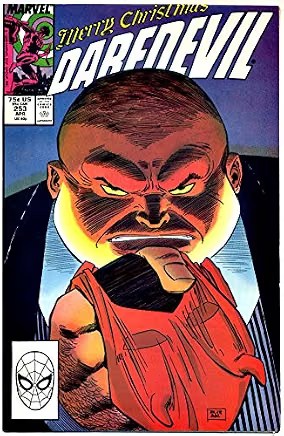
Almost an addendum to “Pariah,” “Merry Christmas, Kingpin” contains a speech in which Matt briefly summarizes for his Hell’s Kitchen pro bono clients his persecution at the hands of Fisk during the Born Again arc, emphasizing, “the Kingpin missed something – heart and spirit…What he’ll never really understand is that he took nothing.” Fisk not only fails to comprehend but also invokes Scrooge in the process, denying his employees time off for the holidays and pestering others about properties he wishes to purchase after they have joined their families to celebrate the season. In turn, it costs him those business deals. He is alone, a Scrooge forsaken the visit of even one ghost, while dismissing Murdock, who is happily sharing the holiday with the clients he’s helping, as relegated to friendships with only the low-life of Hell’s Kitchen.
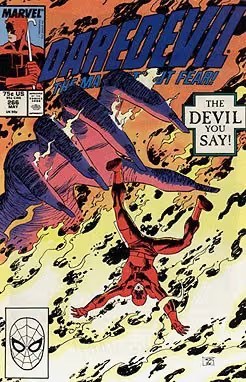
The 1989 story that appeared in Daredevil #266, “A Beer with the Devil,” is based on one Christmas in NYC when Nocenti was alone and decided to stop at a dive bar where the patrons, equally singular for the day, provided company and good cheer. That’s what is happening at the start of this tale until a woman enters, sits next to a bandaged Daredevil five beers in at the bar and commences conversing and seducing. Without giving away the details, suffice it to say that the patrons become more antagonistic upon her arrival and DD less concerned with his role as guardian of Hell’s Kitchen. Call it a nightmare Christmas Carol with the past, present and future rolled into one visit.
With Nocenti’s fourth contribution, the 1992 8-page story “The Rapt Lamb” published in Marvel Holiday Special, we have the jewel of her Christmas contributions. Narrated by a decades-old figurine of a lamb that was just purchased by Daredevil as a gift, the tale centers on where this statuette is being taken and who its owner is. Daredevil, whose minimal dialogue provides the space for his lamb’s narrative, first stops at a church before revisiting the bar from “A Beer with the Devil,” watching from outside its denizens, whose conversations appear to be on a continuous loop from three years earlier, except for one topic – the hope that Daredevil will join them again this Christmas. The final stop of the journey, which we won’t reveal, is touching and appropriate in its portrayal of the contrast between true Christmas spirit and its unsettling absence as depicted in earlier panels of Scrooge-like pedestrians consumed only with themselves.
Mark Waid’s 2011 untitled story in Daredevil Vol. 3 #7 is a Christmas story in name only. It did return the title character to the season after nearly twenty years but fell well short of providing much Christmas other than a flashback to a Nelson and Murdock holiday party, discussion of presents and an attempt at a carol. Instead, it focuses on Murdock chaperoning eight blind elementary school students on a winter trip to the Catskills (and, yes, there are more than a few practical issues overlooked here). When they run afoul of nature with no cell phone reception and are forced to trek on foot through snow and gusting winds, Matt’s efforts fall short until the children save him and themselves. Lacking the depth and precision of Miller’s and Nocenti’s contributions, the narrative recalls “Snow” in never quite managing to encompass the lore, tradition or spirit of the season.
But Chip Campana’s 2024 variant cover for Daredevil Vol. 8 #16 does. It’s the first graphic at the top of this page, and it’s resplendent in how it captures the ritual and cheer that should accompany the season. Scroll back up and examine it, then carry that feeling with you for the remainder of the holidays.
Related Articles




Leave a Reply